Event submissions
Published
This submission belongs to the session S5. Biomaterials for Drug Delivery and Therapy of the event The 2nd International Online Conference on Functional Biomaterials
Published date
03 Jul, 2026
Academic Editor
'%3e%3cpath%20d='M12.6657%2010.9104C12.4185%2010.325%2012.0599%209.79327%2011.6097%209.34482C11.1609%208.89508%2010.6293%208.5365%2010.0442%208.28888C10.0389%208.28626%2010.0337%208.28495%2010.0285%208.28233C10.8446%207.69279%2011.3752%206.73249%2011.3752%205.64904C11.3752%203.8542%209.92103%202.39999%208.1262%202.39999C6.33136%202.39999%204.87715%203.8542%204.87715%205.64904C4.87715%206.73249%205.40774%207.69279%206.22393%208.28364C6.21869%208.28626%206.21345%208.28757%206.20821%208.29019C5.62129%208.5378%205.09463%208.89284%204.64265%209.34613C4.1929%209.79493%203.83432%2010.3266%203.58671%2010.9117C3.34345%2011.4845%203.21226%2012.0987%203.20023%2012.7209C3.19988%2012.7349%203.20233%2012.7488%203.20744%2012.7619C3.21255%2012.7749%203.22022%2012.7867%203.22998%2012.7968C3.23975%2012.8068%203.25142%2012.8147%203.26431%2012.8202C3.2772%2012.8256%203.29105%2012.8284%203.30504%2012.8284H4.09109C4.14874%2012.8284%204.19459%2012.7825%204.1959%2012.7262C4.2221%2011.7148%204.62823%2010.7676%205.34617%2010.0497C6.08899%209.30683%207.0755%208.89808%208.1262%208.89808C9.17689%208.89808%2010.1634%209.30683%2010.9062%2010.0497C11.6242%2010.7676%2012.0303%2011.7148%2012.0565%2012.7262C12.0578%2012.7838%2012.1037%2012.8284%2012.1613%2012.8284H12.9474C12.9613%2012.8284%2012.9752%2012.8256%2012.9881%2012.8202C13.001%2012.8147%2013.0126%2012.8068%2013.0224%2012.7968C13.0322%2012.7867%2013.0398%2012.7749%2013.0449%2012.7619C13.0501%2012.7488%2013.0525%2012.7349%2013.0522%2012.7209C13.0391%2012.0947%2012.9094%2011.4855%2012.6657%2010.9104ZM8.1262%207.9024C7.52486%207.9024%206.9589%207.6679%206.53312%207.24211C6.10733%206.81633%205.87283%206.25037%205.87283%205.64904C5.87283%205.0477%206.10733%204.48174%206.53312%204.05596C6.9589%203.63018%207.52486%203.39567%208.1262%203.39567C8.72753%203.39567%209.29349%203.63018%209.71927%204.05596C10.1451%204.48174%2010.3796%205.0477%2010.3796%205.64904C10.3796%206.25037%2010.1451%206.81633%209.71927%207.24211C9.29349%207.6679%208.72753%207.9024%208.1262%207.9024Z'%20fill='%235D1EE1'/%3e%3c/g%3e%3c/svg%3e) Filippo Rossi
Filippo RossiCitation
Marta Barata Martins, Inês Pereira, João Guilherme Costa, Ana Júlio, Can Biobased Ionic Liquids act as Cryoprotectants?, in Proceedings of The 2nd International Online Conference on Functional Biomaterials, 8 July–10 July 2026, MDPI: Basel, Switzerland
Share
Email
Facebook
Twitter
LinkedIn
Can Biobased Ionic Liquids act as Cryoprotectants?
'%3e%3cpath%20d='M12.6647%2010.9104C12.4176%2010.325%2012.0589%209.7933%2011.6088%209.34485C11.16%208.89511%2010.6283%208.53653%2010.0432%208.28891C10.038%208.28629%2010.0327%208.28498%2010.0275%208.28236C10.8437%207.69282%2011.3743%206.73252%2011.3743%205.64907C11.3743%203.85423%209.92005%202.40002%208.12522%202.40002C6.33038%202.40002%204.87618%203.85423%204.87618%205.64907C4.87618%206.73252%205.40677%207.69282%206.22296%208.28367C6.21772%208.28629%206.21248%208.2876%206.20724%208.29022C5.62031%208.53783%205.09365%208.89287%204.64167%209.34616C4.19192%209.79496%203.83334%2010.3266%203.58573%2010.9117C3.34247%2011.4846%203.21128%2012.0987%203.19925%2012.721C3.1989%2012.735%203.20135%2012.7489%203.20646%2012.7619C3.21157%2012.7749%203.21924%2012.7868%203.22901%2012.7968C3.23877%2012.8068%203.25045%2012.8148%203.26334%2012.8202C3.27623%2012.8256%203.29007%2012.8284%203.30406%2012.8284H4.09012C4.14776%2012.8284%204.19362%2012.7825%204.19493%2012.7262C4.22113%2011.7148%204.62726%2010.7676%205.34519%2010.0497C6.08802%209.30686%207.07452%208.89811%208.12522%208.89811C9.17592%208.89811%2010.1624%209.30686%2010.9052%2010.0497C11.6232%2010.7676%2012.0293%2011.7148%2012.0555%2012.7262C12.0568%2012.7839%2012.1027%2012.8284%2012.1603%2012.8284H12.9464C12.9604%2012.8284%2012.9742%2012.8256%2012.9871%2012.8202C13%2012.8148%2013.0117%2012.8068%2013.0214%2012.7968C13.0312%2012.7868%2013.0389%2012.7749%2013.044%2012.7619C13.0491%2012.7489%2013.0515%2012.735%2013.0512%2012.721C13.0381%2012.0947%2012.9084%2011.4856%2012.6647%2010.9104ZM8.12522%207.90243C7.52388%207.90243%206.95792%207.66793%206.53214%207.24215C6.10636%206.81636%205.87185%206.2504%205.87185%205.64907C5.87185%205.04773%206.10636%204.48177%206.53214%204.05599C6.95792%203.63021%207.52388%203.3957%208.12522%203.3957C8.72655%203.3957%209.29252%203.63021%209.7183%204.05599C10.1441%204.48177%2010.3786%205.04773%2010.3786%205.64907C10.3786%206.2504%2010.1441%206.81636%209.7183%207.24215C9.29252%207.66793%208.72655%207.90243%208.12522%207.90243Z'%20fill='%235D1EE1'/%3e%3c/g%3e%3c/svg%3e)
Marta Barata Martins 1
Inês Pereira 2
João Guilherme Costa 1

Ana Júlio 1
1. Research Center for Biosciences and Health Technologies (CBIOS), Lusófona University, Av do Campo Grande, 376. 1749-024, Lisboa, Portugal, Portugal
2. Escola de Ciências e Tecnologias da Saúde (ECTS), Lusófona University, Av do Campo Grande, 376. 1749-024, Lisboa, Portugal, Portugal
Abstract
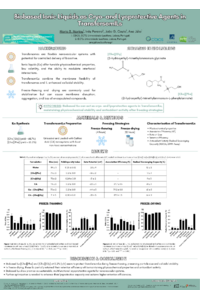
Biomaterials research increasingly relies on multifunctional platforms that integrate structural performance with biological activity. In this context, transfersomes have attracted considerable attention due to their adaptability, biocompatibility, and potential for controlled delivery of bioactive compounds. Additionally, ionic liquids (ILs) have been explored as functional compounds in biomaterial design due to their tunable physicochemical properties, low volatility, and capacity to modulate interfacial interactions. When incorporated into nanovesicular systems, they give rise to TransfersomILs, an advanced hybrid nanosystem that combines membrane flexibility with enhanced colloidal stability.
A critical challenge in the development of vesicular biomaterials is ensuring structural integrity and functional preservation during storage. Freeze–thawing and freeze-drying are widely employed stabilization strategies; however, they may induce membrane disruption, aggregation, and loss of encapsulated compounds. Therefore, identifying effective cryo- and lyoprotective agents is essential to maintain nanosystem performance and extend shelf life.
Within this framework, the present study explores biobased ILs as multifunctional excipients in unloaded and loaded TransfersomILs, evaluating their role in preserving physicochemical stability and antioxidant functionality after lyophilization.
Two ILs, (2-hydroxyethyl)-trimethylammonium-L-phenylalaninate [Cho][Phe] and (2-hydroxyethyl)-trimethylammonium glycinate [Cho][Gly], were synthesized and incorporated at 0.2% (v/v). Physicochemical properties of all produced nanoparticles, as well as association and retention efficiencies of caffeic acid-loaded systems, were assessed before and after the freezing strategies. Antioxidant activity was also determined using the DPPH radical scavenging assay.
Results demonstrated that both produced TransfersomILs maintained suitable particle size distribution and colloidal stability after freeze–thawing, demonstrating that biobased ILs exhibited cryoprotective performance comparable to conventional cryoprotectants. In freeze-drying studies, although retention efficiency was lower than that achieved with classical lyoprotectants, structural integrity and antioxidant activity were preserved.
Overall, biobased ILs show potential as alternative cryoprotective compounds for nanovesicular systems, warranting further optimization to enhance their lyoprotective capacity.
Keywords
TransfersomILs
Biobased Ionic Liquids
Freeze-drying
Freeze-thawing
Poster
Marta Barata Martins_IOCFB26.pdf
Linking Neuroproteomics to Predictive Brain Drug Delivery: A Physicochemically-Informed Modeling Framework for Silver Nanocarriers in Alzheimer’s and Parkinson’s Disease
Biodegradable PHB–Alginate Composite Matrix for Controlled Endolysin Release