Event submissions
Published
This submission belongs to the session S5. Biomaterials for Drug Delivery and Therapy of the event The 2nd International Online Conference on Functional Biomaterials
Published date
03 Jul, 2026
Academic Editor
'%3e%3cpath%20d='M12.6657%2010.9104C12.4185%2010.325%2012.0599%209.79327%2011.6097%209.34482C11.1609%208.89508%2010.6293%208.5365%2010.0442%208.28888C10.0389%208.28626%2010.0337%208.28495%2010.0285%208.28233C10.8446%207.69279%2011.3752%206.73249%2011.3752%205.64904C11.3752%203.8542%209.92103%202.39999%208.1262%202.39999C6.33136%202.39999%204.87715%203.8542%204.87715%205.64904C4.87715%206.73249%205.40774%207.69279%206.22393%208.28364C6.21869%208.28626%206.21345%208.28757%206.20821%208.29019C5.62129%208.5378%205.09463%208.89284%204.64265%209.34613C4.1929%209.79493%203.83432%2010.3266%203.58671%2010.9117C3.34345%2011.4845%203.21226%2012.0987%203.20023%2012.7209C3.19988%2012.7349%203.20233%2012.7488%203.20744%2012.7619C3.21255%2012.7749%203.22022%2012.7867%203.22998%2012.7968C3.23975%2012.8068%203.25142%2012.8147%203.26431%2012.8202C3.2772%2012.8256%203.29105%2012.8284%203.30504%2012.8284H4.09109C4.14874%2012.8284%204.19459%2012.7825%204.1959%2012.7262C4.2221%2011.7148%204.62823%2010.7676%205.34617%2010.0497C6.08899%209.30683%207.0755%208.89808%208.1262%208.89808C9.17689%208.89808%2010.1634%209.30683%2010.9062%2010.0497C11.6242%2010.7676%2012.0303%2011.7148%2012.0565%2012.7262C12.0578%2012.7838%2012.1037%2012.8284%2012.1613%2012.8284H12.9474C12.9613%2012.8284%2012.9752%2012.8256%2012.9881%2012.8202C13.001%2012.8147%2013.0126%2012.8068%2013.0224%2012.7968C13.0322%2012.7867%2013.0398%2012.7749%2013.0449%2012.7619C13.0501%2012.7488%2013.0525%2012.7349%2013.0522%2012.7209C13.0391%2012.0947%2012.9094%2011.4855%2012.6657%2010.9104ZM8.1262%207.9024C7.52486%207.9024%206.9589%207.6679%206.53312%207.24211C6.10733%206.81633%205.87283%206.25037%205.87283%205.64904C5.87283%205.0477%206.10733%204.48174%206.53312%204.05596C6.9589%203.63018%207.52486%203.39567%208.1262%203.39567C8.72753%203.39567%209.29349%203.63018%209.71927%204.05596C10.1451%204.48174%2010.3796%205.0477%2010.3796%205.64904C10.3796%206.25037%2010.1451%206.81633%209.71927%207.24211C9.29349%207.6679%208.72753%207.9024%208.1262%207.9024Z'%20fill='%235D1EE1'/%3e%3c/g%3e%3c/svg%3e) Filippo Rossi
Filippo RossiCitation
Alibala Aliyev, Aygun Israyilova, Alakbar Huseynzada, Aykhan Ismayilov, Altunay Aliyeva, Macroheterocycle-Functionalized Bentonite Nanohybrids for Antimicrobial Biomaterial Coatings, in Proceedings of The 2nd International Online Conference on Functional Biomaterials, 8 July–10 July 2026, MDPI: Basel, Switzerland
Share
Email
Facebook
Twitter
LinkedIn
Macroheterocycle-Functionalized Bentonite Nanohybrids for Antimicrobial Biomaterial Coatings
'%3e%3cpath%20d='M12.6647%2010.9104C12.4176%2010.325%2012.0589%209.7933%2011.6088%209.34485C11.16%208.89511%2010.6283%208.53653%2010.0432%208.28891C10.038%208.28629%2010.0327%208.28498%2010.0275%208.28236C10.8437%207.69282%2011.3743%206.73252%2011.3743%205.64907C11.3743%203.85423%209.92005%202.40002%208.12522%202.40002C6.33038%202.40002%204.87618%203.85423%204.87618%205.64907C4.87618%206.73252%205.40677%207.69282%206.22296%208.28367C6.21772%208.28629%206.21248%208.2876%206.20724%208.29022C5.62031%208.53783%205.09365%208.89287%204.64167%209.34616C4.19192%209.79496%203.83334%2010.3266%203.58573%2010.9117C3.34247%2011.4846%203.21128%2012.0987%203.19925%2012.721C3.1989%2012.735%203.20135%2012.7489%203.20646%2012.7619C3.21157%2012.7749%203.21924%2012.7868%203.22901%2012.7968C3.23877%2012.8068%203.25045%2012.8148%203.26334%2012.8202C3.27623%2012.8256%203.29007%2012.8284%203.30406%2012.8284H4.09012C4.14776%2012.8284%204.19362%2012.7825%204.19493%2012.7262C4.22113%2011.7148%204.62726%2010.7676%205.34519%2010.0497C6.08802%209.30686%207.07452%208.89811%208.12522%208.89811C9.17592%208.89811%2010.1624%209.30686%2010.9052%2010.0497C11.6232%2010.7676%2012.0293%2011.7148%2012.0555%2012.7262C12.0568%2012.7839%2012.1027%2012.8284%2012.1603%2012.8284H12.9464C12.9604%2012.8284%2012.9742%2012.8256%2012.9871%2012.8202C13%2012.8148%2013.0117%2012.8068%2013.0214%2012.7968C13.0312%2012.7868%2013.0389%2012.7749%2013.044%2012.7619C13.0491%2012.7489%2013.0515%2012.735%2013.0512%2012.721C13.0381%2012.0947%2012.9084%2011.4856%2012.6647%2010.9104ZM8.12522%207.90243C7.52388%207.90243%206.95792%207.66793%206.53214%207.24215C6.10636%206.81636%205.87185%206.2504%205.87185%205.64907C5.87185%205.04773%206.10636%204.48177%206.53214%204.05599C6.95792%203.63021%207.52388%203.3957%208.12522%203.3957C8.72655%203.3957%209.29252%203.63021%209.7183%204.05599C10.1441%204.48177%2010.3786%205.04773%2010.3786%205.64907C10.3786%206.2504%2010.1441%206.81636%209.7183%207.24215C9.29252%207.66793%208.72655%207.90243%208.12522%207.90243Z'%20fill='%235D1EE1'/%3e%3c/g%3e%3c/svg%3e)
Alibala Aliyev 1
Aygun Israyilova 2
Alakbar Huseynzada 3
Aykhan Ismayilov 4
Altunay Aliyeva 4
1. Industrial chemistry research laboratory (ICRL), Baku State University, Z. Khalilov 33, Baku, AZ 1148, Azerbaijan, Azerbaijan
2. Laboratory of Microbiology and Virology, Baku State University, Z. Khalilov 33, Baku, AZ 1148, Azerbaijan, Azerbaijan
3. ICRL, Baku State University, Z. Khalilov 33, AZ 1148 Baku, Azerbaijan, Azerbaijan
4. Faculty of Chemistry, Baku State University, Z. Khalilov 33, AZ 1148 Baku, Azerbaijan, Azerbaijan
Abstract
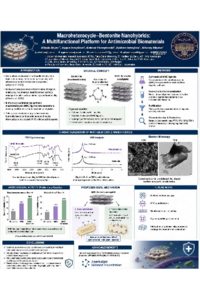
Bentonite is an abundant montmorillonite clay widely explored in biomedical applications due to its high surface area, cation-exchange capacity, and inherent antibacterial adsorption properties (Aliyev et al. 2025). Its layered structure enables intercalation of organic molecules, and chemical modification is routinely employed to tailor surface chemistry and functionality (Aliyev et al., 2026). In this study, we investigate the immobilization of synthetic macroheterocycle (MHC) ligands onto bentonite to develop multifunctional antimicrobial nanohybrids. This approach extends our previous work on bentonite-based antibacterial nanocoatings by introducing purely organic MHC units as active agents.
Bentonite was non-covalently functionalized with newly synthesized MHC compounds, and the hybrids were characterized by FTIR, XRD, and electron microscopy. Spectroscopic analysis revealed new functional bands consistent with MHC incorporation, while XRD indicated slight interlayer expansion. SEM/TEM observations demonstrated coated and partially exfoliated clay sheets, confirming successful modification.
Preliminary antimicrobial assays against Staphylococcus aureus and Escherichia coli suggest enhanced activity of MHC–bentonite compared to unmodified clay. Ongoing studies include biofilm inhibition analysis, ROS quantification, membrane integrity testing, and cytocompatibility assessment. Polymer–clay composite coatings are also being fabricated to evaluate their applicability in biomaterial systems.
These findings indicate that MHC–bentonite hybrids may act through dual mechanisms—sustained release from the clay matrix and direct antimicrobial interaction of macroheterocycles—supporting their potential use in infection-resistant biomaterials.
This work was supported by the Azerbaijan Science Foundation (Grant No. AEF-MGC-2025-1(54)-20/17/3-M-17).
Keywords
macroheterocycles
bentonite
antibacterial coatings
wound healing
biomaterials
Poster
Abstract.pdf
Layered Double Hydroxide-Engineered Oxidized Hyaluronic Acid/Gelatin/Carboxymethyl Chitosan Injectable Hydrogel Incorporating Salvianolic Acid B and Dexamethasone for Cartilage Regeneration
Doxorubicin-loaded Cholesterol-Glycopolymer Nanomicelles with Autophagy Activator Rapamycin for Synergistic Glioblastoma Cell Inhibition