Event submissions
Published
This submission belongs to the session S7. Bioprinting and Bio-Fabrication of the event The 2nd International Online Conference on Functional Biomaterials
Published date
03 Jul, 2026
Academic Editor
'%3e%3cpath%20d='M12.6657%2010.9104C12.4185%2010.325%2012.0599%209.79327%2011.6097%209.34482C11.1609%208.89508%2010.6293%208.5365%2010.0442%208.28888C10.0389%208.28626%2010.0337%208.28495%2010.0285%208.28233C10.8446%207.69279%2011.3752%206.73249%2011.3752%205.64904C11.3752%203.8542%209.92103%202.39999%208.1262%202.39999C6.33136%202.39999%204.87715%203.8542%204.87715%205.64904C4.87715%206.73249%205.40774%207.69279%206.22393%208.28364C6.21869%208.28626%206.21345%208.28757%206.20821%208.29019C5.62129%208.5378%205.09463%208.89284%204.64265%209.34613C4.1929%209.79493%203.83432%2010.3266%203.58671%2010.9117C3.34345%2011.4845%203.21226%2012.0987%203.20023%2012.7209C3.19988%2012.7349%203.20233%2012.7488%203.20744%2012.7619C3.21255%2012.7749%203.22022%2012.7867%203.22998%2012.7968C3.23975%2012.8068%203.25142%2012.8147%203.26431%2012.8202C3.2772%2012.8256%203.29105%2012.8284%203.30504%2012.8284H4.09109C4.14874%2012.8284%204.19459%2012.7825%204.1959%2012.7262C4.2221%2011.7148%204.62823%2010.7676%205.34617%2010.0497C6.08899%209.30683%207.0755%208.89808%208.1262%208.89808C9.17689%208.89808%2010.1634%209.30683%2010.9062%2010.0497C11.6242%2010.7676%2012.0303%2011.7148%2012.0565%2012.7262C12.0578%2012.7838%2012.1037%2012.8284%2012.1613%2012.8284H12.9474C12.9613%2012.8284%2012.9752%2012.8256%2012.9881%2012.8202C13.001%2012.8147%2013.0126%2012.8068%2013.0224%2012.7968C13.0322%2012.7867%2013.0398%2012.7749%2013.0449%2012.7619C13.0501%2012.7488%2013.0525%2012.7349%2013.0522%2012.7209C13.0391%2012.0947%2012.9094%2011.4855%2012.6657%2010.9104ZM8.1262%207.9024C7.52486%207.9024%206.9589%207.6679%206.53312%207.24211C6.10733%206.81633%205.87283%206.25037%205.87283%205.64904C5.87283%205.0477%206.10733%204.48174%206.53312%204.05596C6.9589%203.63018%207.52486%203.39567%208.1262%203.39567C8.72753%203.39567%209.29349%203.63018%209.71927%204.05596C10.1451%204.48174%2010.3796%205.0477%2010.3796%205.64904C10.3796%206.25037%2010.1451%206.81633%209.71927%207.24211C9.29349%207.6679%208.72753%207.9024%208.1262%207.9024Z'%20fill='%235D1EE1'/%3e%3c/g%3e%3c/svg%3e) Lidy Fratila-Apachitei
Lidy Fratila-ApachiteiCitation
Gintaras Matulis, Nataliia Herbina, Yuliia Maslii, Lauryna Pudžiuvelytė, Jurga Bernatonienė, DOBOT MG400 Robotic Arm-Assisted Electrospinning: A Novel Hybrid Biofabrication Platform for Precise Manufacturing of PVA-Based Drug Delivery Films Containing Natural Active Compounds, in Proceedings of The 2nd International Online Conference on Functional Biomaterials, 8 July–10 July 2026, MDPI: Basel, Switzerland
Share
Email
Facebook
Twitter
LinkedIn
DOBOT MG400 Robotic Arm-Assisted Electrospinning: A Novel Hybrid Biofabrication Platform for Precise Manufacturing of PVA-Based Drug Delivery Films Containing Natural Active Compounds

Gintaras Matulis 1
'%3e%3cpath%20d='M12.6647%2010.9104C12.4176%2010.325%2012.0589%209.7933%2011.6088%209.34485C11.16%208.89511%2010.6283%208.53653%2010.0432%208.28891C10.038%208.28629%2010.0327%208.28498%2010.0275%208.28236C10.8437%207.69282%2011.3743%206.73252%2011.3743%205.64907C11.3743%203.85423%209.92005%202.40002%208.12522%202.40002C6.33038%202.40002%204.87618%203.85423%204.87618%205.64907C4.87618%206.73252%205.40677%207.69282%206.22296%208.28367C6.21772%208.28629%206.21248%208.2876%206.20724%208.29022C5.62031%208.53783%205.09365%208.89287%204.64167%209.34616C4.19192%209.79496%203.83334%2010.3266%203.58573%2010.9117C3.34247%2011.4846%203.21128%2012.0987%203.19925%2012.721C3.1989%2012.735%203.20135%2012.7489%203.20646%2012.7619C3.21157%2012.7749%203.21924%2012.7868%203.22901%2012.7968C3.23877%2012.8068%203.25045%2012.8148%203.26334%2012.8202C3.27623%2012.8256%203.29007%2012.8284%203.30406%2012.8284H4.09012C4.14776%2012.8284%204.19362%2012.7825%204.19493%2012.7262C4.22113%2011.7148%204.62726%2010.7676%205.34519%2010.0497C6.08802%209.30686%207.07452%208.89811%208.12522%208.89811C9.17592%208.89811%2010.1624%209.30686%2010.9052%2010.0497C11.6232%2010.7676%2012.0293%2011.7148%2012.0555%2012.7262C12.0568%2012.7839%2012.1027%2012.8284%2012.1603%2012.8284H12.9464C12.9604%2012.8284%2012.9742%2012.8256%2012.9871%2012.8202C13%2012.8148%2013.0117%2012.8068%2013.0214%2012.7968C13.0312%2012.7868%2013.0389%2012.7749%2013.044%2012.7619C13.0491%2012.7489%2013.0515%2012.735%2013.0512%2012.721C13.0381%2012.0947%2012.9084%2011.4856%2012.6647%2010.9104ZM8.12522%207.90243C7.52388%207.90243%206.95792%207.66793%206.53214%207.24215C6.10636%206.81636%205.87185%206.2504%205.87185%205.64907C5.87185%205.04773%206.10636%204.48177%206.53214%204.05599C6.95792%203.63021%207.52388%203.3957%208.12522%203.3957C8.72655%203.3957%209.29252%203.63021%209.7183%204.05599C10.1441%204.48177%2010.3786%205.04773%2010.3786%205.64907C10.3786%206.2504%2010.1441%206.81636%209.7183%207.24215C9.29252%207.66793%208.72655%207.90243%208.12522%207.90243Z'%20fill='%235D1EE1'/%3e%3c/g%3e%3c/svg%3e)
Nataliia Herbina 2

Yuliia Maslii 2

Lauryna Pudžiuvelytė 1,3

Jurga Bernatonienė 1,3
1. Department of Drug Technology and Social Pharmacy, Lithuanian University of Health Sciences, Kaunas, LT-50161, Lithuania, Lithuania
2. Institute of Pharmaceutical Technologies, Faculty of Pharmacy, Medical Academy, Lithuanian University of Health Sciences, Kaunas, LT-50161, Lithuania, Lithuania
3. Institute of Pharmaceutical Technologies, Faculty of Pharmacy, Medical Academy, Lithuanian University of Health Sciences, Kaunas, LT-50161, Lithuania
Abstract
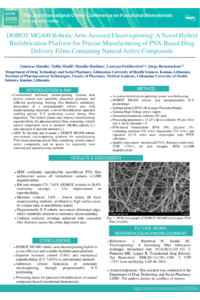
Introduction: Conventional stationary electrospinning systems lack precise control over nanofibre deposition geometry and collector positioning, limiting film thickness uniformity. Integration of a programmable robotic arm with electrospinning represents a novel biofabrication approach enabling precise X-Y positioning control during fibre deposition. This hybrid system may improve manufacturing reproducibility for pharmaceutical films containing volatile natural compounds such as menthol (Mentha piperita L.) and capsaicin (Capsicum annuum L.).
Methods: A custom-built hybrid electrospinning system was constructed using a DOBOT MG400 robotic arm (Shenzhen Yuejiang Technology Co., China) with programmable X-Y positioning, a syringe pump (LSP02-1B, Longer Precision Pump, China), Gamma High Voltage power supply (USA), and grounded aluminium collector (85 mm). Processing parameters included 15 kV, tip-to-collector distance 10 cm, flow rate 1 mL/h and duration 1 hour. PVA-based formulations (PVA 10%, glycerol 3%) containing menthol (5% w/w), benzocaine (5% w/w), and capsaicin (0–1% w/w) were electrospun onto PTFE substrates. Manufacturing quality was assessed by mechanical CV%, thickness uniformity (USP <731>), rib seal strength, and scanning electron microscopy.
Results: The DOBOT MG400 robotic arm-assisted system produced reproducible nanofibrous PVA films confirmed by SEM (×1,000 magnification) across all formulation variants. Optimized films (menthol-benzocaine-capsaicin) achieved rib seal strength CV of 7.65%, superior to stationary casting (CV: 26.8%). Moisture content was optimally controlled at 5.6% — lowest across all three manufacturing methods — attributable to the high surface-area-to-volume ratio of the nanofibrous matrix. Programmable X-Y robotic movement reduced edge-effect variability inherent to stationary electrospinning, enabling uniform collector coverage and consistent film thickness.
Conclusions: The custom-built DOBOT MG400 robotic arm-electrospinning hybrid platform represents a cost-effective and scalable biofabrication approach combining robotic precision positioning with electrospinning nanostructuring capability. The system successfully produces pharmaceutical-grade nanofibrous films containing volatile natural compounds, achieving superior moisture control and mechanical reproducibility. This novel platform addresses a critical limitation of conventional electrospinning and offers a promising basis for precision biofabrication of natural compound-based transdermal biomaterials.
Keywords
electrospinning
robotic arm
DOBOT MG400
PVA nanofibers
biofabrication
drug delivery
menthol
pharmaceutical manufacturing
Poster
DOBOT_poster_IOCFB2026.pdf
Multifunctional Bioactive Coatings for Metallic Veterinary Implants
3D-bioprinted scaffold for dermal tissue imitation in burn treatment: physicochemical characterization