Event submissions
Published
This submission belongs to the session S7. Bioprinting and Bio-Fabrication of the event The 2nd International Online Conference on Functional Biomaterials
Published date
03 Jul, 2026
Academic Editor
'%3e%3cpath%20d='M12.6657%2010.9104C12.4185%2010.325%2012.0599%209.79327%2011.6097%209.34482C11.1609%208.89508%2010.6293%208.5365%2010.0442%208.28888C10.0389%208.28626%2010.0337%208.28495%2010.0285%208.28233C10.8446%207.69279%2011.3752%206.73249%2011.3752%205.64904C11.3752%203.8542%209.92103%202.39999%208.1262%202.39999C6.33136%202.39999%204.87715%203.8542%204.87715%205.64904C4.87715%206.73249%205.40774%207.69279%206.22393%208.28364C6.21869%208.28626%206.21345%208.28757%206.20821%208.29019C5.62129%208.5378%205.09463%208.89284%204.64265%209.34613C4.1929%209.79493%203.83432%2010.3266%203.58671%2010.9117C3.34345%2011.4845%203.21226%2012.0987%203.20023%2012.7209C3.19988%2012.7349%203.20233%2012.7488%203.20744%2012.7619C3.21255%2012.7749%203.22022%2012.7867%203.22998%2012.7968C3.23975%2012.8068%203.25142%2012.8147%203.26431%2012.8202C3.2772%2012.8256%203.29105%2012.8284%203.30504%2012.8284H4.09109C4.14874%2012.8284%204.19459%2012.7825%204.1959%2012.7262C4.2221%2011.7148%204.62823%2010.7676%205.34617%2010.0497C6.08899%209.30683%207.0755%208.89808%208.1262%208.89808C9.17689%208.89808%2010.1634%209.30683%2010.9062%2010.0497C11.6242%2010.7676%2012.0303%2011.7148%2012.0565%2012.7262C12.0578%2012.7838%2012.1037%2012.8284%2012.1613%2012.8284H12.9474C12.9613%2012.8284%2012.9752%2012.8256%2012.9881%2012.8202C13.001%2012.8147%2013.0126%2012.8068%2013.0224%2012.7968C13.0322%2012.7867%2013.0398%2012.7749%2013.0449%2012.7619C13.0501%2012.7488%2013.0525%2012.7349%2013.0522%2012.7209C13.0391%2012.0947%2012.9094%2011.4855%2012.6657%2010.9104ZM8.1262%207.9024C7.52486%207.9024%206.9589%207.6679%206.53312%207.24211C6.10733%206.81633%205.87283%206.25037%205.87283%205.64904C5.87283%205.0477%206.10733%204.48174%206.53312%204.05596C6.9589%203.63018%207.52486%203.39567%208.1262%203.39567C8.72753%203.39567%209.29349%203.63018%209.71927%204.05596C10.1451%204.48174%2010.3796%205.0477%2010.3796%205.64904C10.3796%206.25037%2010.1451%206.81633%209.71927%207.24211C9.29349%207.6679%208.72753%207.9024%208.1262%207.9024Z'%20fill='%235D1EE1'/%3e%3c/g%3e%3c/svg%3e) Lidy Fratila-Apachitei
Lidy Fratila-ApachiteiCitation
Victor Yahir Moreno Canseco, Aura Sandoval Lora, María Guadalupe Flores Sanchez, Pedro Ulises Muñoz González, 3D-bioprinted scaffold for dermal tissue imitation in burn treatment: physicochemical characterization, in Proceedings of The 2nd International Online Conference on Functional Biomaterials, 8 July–10 July 2026, MDPI: Basel, Switzerland
Share
Email
Facebook
Twitter
LinkedIn
3D-bioprinted scaffold for dermal tissue imitation in burn treatment: physicochemical characterization
'%3e%3cpath%20d='M12.6647%2010.9104C12.4176%2010.325%2012.0589%209.7933%2011.6088%209.34485C11.16%208.89511%2010.6283%208.53653%2010.0432%208.28891C10.038%208.28629%2010.0327%208.28498%2010.0275%208.28236C10.8437%207.69282%2011.3743%206.73252%2011.3743%205.64907C11.3743%203.85423%209.92005%202.40002%208.12522%202.40002C6.33038%202.40002%204.87618%203.85423%204.87618%205.64907C4.87618%206.73252%205.40677%207.69282%206.22296%208.28367C6.21772%208.28629%206.21248%208.2876%206.20724%208.29022C5.62031%208.53783%205.09365%208.89287%204.64167%209.34616C4.19192%209.79496%203.83334%2010.3266%203.58573%2010.9117C3.34247%2011.4846%203.21128%2012.0987%203.19925%2012.721C3.1989%2012.735%203.20135%2012.7489%203.20646%2012.7619C3.21157%2012.7749%203.21924%2012.7868%203.22901%2012.7968C3.23877%2012.8068%203.25045%2012.8148%203.26334%2012.8202C3.27623%2012.8256%203.29007%2012.8284%203.30406%2012.8284H4.09012C4.14776%2012.8284%204.19362%2012.7825%204.19493%2012.7262C4.22113%2011.7148%204.62726%2010.7676%205.34519%2010.0497C6.08802%209.30686%207.07452%208.89811%208.12522%208.89811C9.17592%208.89811%2010.1624%209.30686%2010.9052%2010.0497C11.6232%2010.7676%2012.0293%2011.7148%2012.0555%2012.7262C12.0568%2012.7839%2012.1027%2012.8284%2012.1603%2012.8284H12.9464C12.9604%2012.8284%2012.9742%2012.8256%2012.9871%2012.8202C13%2012.8148%2013.0117%2012.8068%2013.0214%2012.7968C13.0312%2012.7868%2013.0389%2012.7749%2013.044%2012.7619C13.0491%2012.7489%2013.0515%2012.735%2013.0512%2012.721C13.0381%2012.0947%2012.9084%2011.4856%2012.6647%2010.9104ZM8.12522%207.90243C7.52388%207.90243%206.95792%207.66793%206.53214%207.24215C6.10636%206.81636%205.87185%206.2504%205.87185%205.64907C5.87185%205.04773%206.10636%204.48177%206.53214%204.05599C6.95792%203.63021%207.52388%203.3957%208.12522%203.3957C8.72655%203.3957%209.29252%203.63021%209.7183%204.05599C10.1441%204.48177%2010.3786%205.04773%2010.3786%205.64907C10.3786%206.2504%2010.1441%206.81636%209.7183%207.24215C9.29252%207.66793%208.72655%207.90243%208.12522%207.90243Z'%20fill='%235D1EE1'/%3e%3c/g%3e%3c/svg%3e)
Victor Yahir Moreno Canseco 1
Aura Sandoval Lora 1
María Guadalupe Flores Sanchez 2
Pedro Ulises Muñoz González 3
1. Bionic Engineering, National Polytechnic Institute, Mexico City, 07340, Mx., Mexico
2. 3D BioTissue, University La salle México, Mexico City, 06140,Mx, Mexico
3. Laboratory for Biomaterials and Bioengineering (LBB), Laval University, Québec, Quebec G1V 0A6, Canada, Canada
Abstract
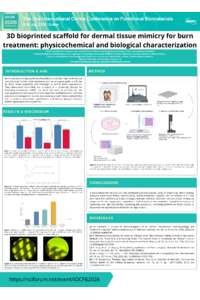
The need for personalized scaffolds for skin replacement has led us to explore technologies such as three-dimensional bioprinting, which has become a promising alternative in regenerative medicine, enabling the fabrication of customized scaffolds that mimic the architecture and function of native skin tissue.
This project focuses on the development of preliminary 3D-bioprinted scaffolds for dermal tissue regeneration in first- and second-degree burns using extrusion-based bioprinting. The methodology included the segmentation of clinical burn images to define the geometry of the area of interest , the formulation of bioinks combining natural polymers (type I collagen extracted from bovine Achilles tendon) and synthetic polymers (polylactic acid), and scaffold fabrication.
This hybrid approach leverages the biocompatibility of collagen and its properties similar to those of the extracellular matrix, while incorporating PLA to improve mechanical strength and structural stability. Physicochemical characterization through mechanical testing was used to assess the performance of the developed formulations , where the scaffold showed hydrogel retention at different porosities, leading to the selection of a specific porosity type.
The obtained results include optimized bioink formulations that provide adequate mechanical properties and create a favorable microenvironment for their potential application as a scaffold. In addition, the printed constructs exhibited sufficient structural stability for handling.
This research contributes to the development of dermal substitutes, addressing current therapeutic limitations in burn care by establishing a personalized bioprinting strategy and identifying promising scaffold design parameters for dermal regeneration.
Keywords
Bioprinting
scaffolds
skin tissue
collagen.
Poster
Cartel.pdf
DOBOT MG400 Robotic Arm-Assisted Electrospinning: A Novel Hybrid Biofabrication Platform for Precise Manufacturing of PVA-Based Drug Delivery Films Containing Natural Active Compounds
Data-Driven Inverse Design of Electrospun Biomaterials with Controlled Fibre-Diameter Distributions for Tissue Regeneration