Event submissions
Published
This submission belongs to the session S7. Bioprinting and Bio-Fabrication of the event The 2nd International Online Conference on Functional Biomaterials
Published date
03 Jul, 2026
Academic Editor
'%3e%3cpath%20d='M12.6657%2010.9104C12.4185%2010.325%2012.0599%209.79327%2011.6097%209.34482C11.1609%208.89508%2010.6293%208.5365%2010.0442%208.28888C10.0389%208.28626%2010.0337%208.28495%2010.0285%208.28233C10.8446%207.69279%2011.3752%206.73249%2011.3752%205.64904C11.3752%203.8542%209.92103%202.39999%208.1262%202.39999C6.33136%202.39999%204.87715%203.8542%204.87715%205.64904C4.87715%206.73249%205.40774%207.69279%206.22393%208.28364C6.21869%208.28626%206.21345%208.28757%206.20821%208.29019C5.62129%208.5378%205.09463%208.89284%204.64265%209.34613C4.1929%209.79493%203.83432%2010.3266%203.58671%2010.9117C3.34345%2011.4845%203.21226%2012.0987%203.20023%2012.7209C3.19988%2012.7349%203.20233%2012.7488%203.20744%2012.7619C3.21255%2012.7749%203.22022%2012.7867%203.22998%2012.7968C3.23975%2012.8068%203.25142%2012.8147%203.26431%2012.8202C3.2772%2012.8256%203.29105%2012.8284%203.30504%2012.8284H4.09109C4.14874%2012.8284%204.19459%2012.7825%204.1959%2012.7262C4.2221%2011.7148%204.62823%2010.7676%205.34617%2010.0497C6.08899%209.30683%207.0755%208.89808%208.1262%208.89808C9.17689%208.89808%2010.1634%209.30683%2010.9062%2010.0497C11.6242%2010.7676%2012.0303%2011.7148%2012.0565%2012.7262C12.0578%2012.7838%2012.1037%2012.8284%2012.1613%2012.8284H12.9474C12.9613%2012.8284%2012.9752%2012.8256%2012.9881%2012.8202C13.001%2012.8147%2013.0126%2012.8068%2013.0224%2012.7968C13.0322%2012.7867%2013.0398%2012.7749%2013.0449%2012.7619C13.0501%2012.7488%2013.0525%2012.7349%2013.0522%2012.7209C13.0391%2012.0947%2012.9094%2011.4855%2012.6657%2010.9104ZM8.1262%207.9024C7.52486%207.9024%206.9589%207.6679%206.53312%207.24211C6.10733%206.81633%205.87283%206.25037%205.87283%205.64904C5.87283%205.0477%206.10733%204.48174%206.53312%204.05596C6.9589%203.63018%207.52486%203.39567%208.1262%203.39567C8.72753%203.39567%209.29349%203.63018%209.71927%204.05596C10.1451%204.48174%2010.3796%205.0477%2010.3796%205.64904C10.3796%206.25037%2010.1451%206.81633%209.71927%207.24211C9.29349%207.6679%208.72753%207.9024%208.1262%207.9024Z'%20fill='%235D1EE1'/%3e%3c/g%3e%3c/svg%3e) Lidy Fratila-Apachitei
Lidy Fratila-ApachiteiCitation
Elisa Roldan Ciudad, Data-Driven Inverse Design of Electrospun Biomaterials with Controlled Fibre-Diameter Distributions for Tissue Regeneration, in Proceedings of The 2nd International Online Conference on Functional Biomaterials, 8 July–10 July 2026, MDPI: Basel, Switzerland
Share
Email
Facebook
Twitter
LinkedIn
Data-Driven Inverse Design of Electrospun Biomaterials with Controlled Fibre-Diameter Distributions for Tissue Regeneration
'%3e%3cpath%20d='M12.6647%2010.9104C12.4176%2010.325%2012.0589%209.7933%2011.6088%209.34485C11.16%208.89511%2010.6283%208.53653%2010.0432%208.28891C10.038%208.28629%2010.0327%208.28498%2010.0275%208.28236C10.8437%207.69282%2011.3743%206.73252%2011.3743%205.64907C11.3743%203.85423%209.92005%202.40002%208.12522%202.40002C6.33038%202.40002%204.87618%203.85423%204.87618%205.64907C4.87618%206.73252%205.40677%207.69282%206.22296%208.28367C6.21772%208.28629%206.21248%208.2876%206.20724%208.29022C5.62031%208.53783%205.09365%208.89287%204.64167%209.34616C4.19192%209.79496%203.83334%2010.3266%203.58573%2010.9117C3.34247%2011.4846%203.21128%2012.0987%203.19925%2012.721C3.1989%2012.735%203.20135%2012.7489%203.20646%2012.7619C3.21157%2012.7749%203.21924%2012.7868%203.22901%2012.7968C3.23877%2012.8068%203.25045%2012.8148%203.26334%2012.8202C3.27623%2012.8256%203.29007%2012.8284%203.30406%2012.8284H4.09012C4.14776%2012.8284%204.19362%2012.7825%204.19493%2012.7262C4.22113%2011.7148%204.62726%2010.7676%205.34519%2010.0497C6.08802%209.30686%207.07452%208.89811%208.12522%208.89811C9.17592%208.89811%2010.1624%209.30686%2010.9052%2010.0497C11.6232%2010.7676%2012.0293%2011.7148%2012.0555%2012.7262C12.0568%2012.7839%2012.1027%2012.8284%2012.1603%2012.8284H12.9464C12.9604%2012.8284%2012.9742%2012.8256%2012.9871%2012.8202C13%2012.8148%2013.0117%2012.8068%2013.0214%2012.7968C13.0312%2012.7868%2013.0389%2012.7749%2013.044%2012.7619C13.0491%2012.7489%2013.0515%2012.735%2013.0512%2012.721C13.0381%2012.0947%2012.9084%2011.4856%2012.6647%2010.9104ZM8.12522%207.90243C7.52388%207.90243%206.95792%207.66793%206.53214%207.24215C6.10636%206.81636%205.87185%206.2504%205.87185%205.64907C5.87185%205.04773%206.10636%204.48177%206.53214%204.05599C6.95792%203.63021%207.52388%203.3957%208.12522%203.3957C8.72655%203.3957%209.29252%203.63021%209.7183%204.05599C10.1441%204.48177%2010.3786%205.04773%2010.3786%205.64907C10.3786%206.2504%2010.1441%206.81636%209.7183%207.24215C9.29252%207.66793%208.72655%207.90243%208.12522%207.90243Z'%20fill='%235D1EE1'/%3e%3c/g%3e%3c/svg%3e)
Elisa Roldan Ciudad 1
1. Department of Engineering, Faculty of Science & Engineering, Manchester Metropolitan University,
Manchester, United Kingdom, UK
Abstract
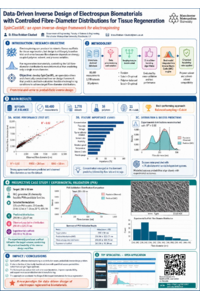
Electrospun nanofibrous scaffolds are widely used in tissue engineering because their fibrous architectures closely resemble the extracellular matrix (ECM), providing structural and biochemical cues that regulate cell adhesion, proliferation, and tissue regeneration. However, designing electrospun biomaterials with targeted structural features remains largely empirical. In particular, biological performance is strongly influenced by the full fibre-diameter distribution, which governs pore size, mechanical behaviour, and cell infiltration, yet most optimisation strategies rely only on mean fibre diameter.
This work presents a data-driven framework for the inverse design of electrospun biomaterials with tailored fibre-diameter distributions relevant to regenerative applications. Using a curated meta-dataset containing more than 68,000 fibre-diameter measurements extracted from 1,778 datasets across 16 polymers commonly used in biomaterials, we develop predictive models capable of reconstructing complete fibre-diameter distributions from experimentally controllable electrospinning parameters, including polymer composition, solvent system, and electrohydrodynamic conditions. Model performance is rigorously evaluated computationally and empirically to ensure robust generalisation across different experimental sources.
To enable scaffold design, the predictive models are embedded within a chemically constrained and Inverse Monte Carlo framework that generates feasible polymer–solvent–process combinations capable of achieving user-defined fibre-diameter distributions while respecting experimentally validated compatibility constraints. This inverse design approach allows researchers to computationally explore process conditions that produce biomimetic architectures, including bimodal fibre distributions known to enhance cell infiltration and tissue integration.
By integrating interpretable machine learning, chemically informed constraints, and distribution-aware modelling, this framework provides a new pathway for the rational design of electrospun biomaterials for tissue regeneration. The approach reduces trial-and-error experimentation, accelerates scaffold optimisation, and supports the development of next-generation electrospun constructs with tunable structural properties tailored to specific regenerative medicine applications.
Keywords
artificial intelligence
electrospinning
machine learning models
meta-analysis
nanofibres
open-access application
sustainability
Poster
IOCFB 2026_Poster_ERC.pdf
3D-bioprinted scaffold for dermal tissue imitation in burn treatment: physicochemical characterization
Three-Dimensional Bioprinting of New Hydrogel-based Bioinks into Cell-scaffold Constructs for Articular Cartilage Repair