Event submissions
Published
This submission belongs to the session S7. Bioprinting and Bio-Fabrication of the event The 2nd International Online Conference on Functional Biomaterials
Published date
03 Jul, 2026
Academic Editor
'%3e%3cpath%20d='M12.6657%2010.9104C12.4185%2010.325%2012.0599%209.79327%2011.6097%209.34482C11.1609%208.89508%2010.6293%208.5365%2010.0442%208.28888C10.0389%208.28626%2010.0337%208.28495%2010.0285%208.28233C10.8446%207.69279%2011.3752%206.73249%2011.3752%205.64904C11.3752%203.8542%209.92103%202.39999%208.1262%202.39999C6.33136%202.39999%204.87715%203.8542%204.87715%205.64904C4.87715%206.73249%205.40774%207.69279%206.22393%208.28364C6.21869%208.28626%206.21345%208.28757%206.20821%208.29019C5.62129%208.5378%205.09463%208.89284%204.64265%209.34613C4.1929%209.79493%203.83432%2010.3266%203.58671%2010.9117C3.34345%2011.4845%203.21226%2012.0987%203.20023%2012.7209C3.19988%2012.7349%203.20233%2012.7488%203.20744%2012.7619C3.21255%2012.7749%203.22022%2012.7867%203.22998%2012.7968C3.23975%2012.8068%203.25142%2012.8147%203.26431%2012.8202C3.2772%2012.8256%203.29105%2012.8284%203.30504%2012.8284H4.09109C4.14874%2012.8284%204.19459%2012.7825%204.1959%2012.7262C4.2221%2011.7148%204.62823%2010.7676%205.34617%2010.0497C6.08899%209.30683%207.0755%208.89808%208.1262%208.89808C9.17689%208.89808%2010.1634%209.30683%2010.9062%2010.0497C11.6242%2010.7676%2012.0303%2011.7148%2012.0565%2012.7262C12.0578%2012.7838%2012.1037%2012.8284%2012.1613%2012.8284H12.9474C12.9613%2012.8284%2012.9752%2012.8256%2012.9881%2012.8202C13.001%2012.8147%2013.0126%2012.8068%2013.0224%2012.7968C13.0322%2012.7867%2013.0398%2012.7749%2013.0449%2012.7619C13.0501%2012.7488%2013.0525%2012.7349%2013.0522%2012.7209C13.0391%2012.0947%2012.9094%2011.4855%2012.6657%2010.9104ZM8.1262%207.9024C7.52486%207.9024%206.9589%207.6679%206.53312%207.24211C6.10733%206.81633%205.87283%206.25037%205.87283%205.64904C5.87283%205.0477%206.10733%204.48174%206.53312%204.05596C6.9589%203.63018%207.52486%203.39567%208.1262%203.39567C8.72753%203.39567%209.29349%203.63018%209.71927%204.05596C10.1451%204.48174%2010.3796%205.0477%2010.3796%205.64904C10.3796%206.25037%2010.1451%206.81633%209.71927%207.24211C9.29349%207.6679%208.72753%207.9024%208.1262%207.9024Z'%20fill='%235D1EE1'/%3e%3c/g%3e%3c/svg%3e) Lidy Fratila-Apachitei
Lidy Fratila-ApachiteiCitation
Kristin Schüler, João Carlos Silva, Paola Sanjuan-Alberte, Frederico Castelo Ferreira, Top-Down and Bottom-Up Biofabrication of Biomimetic Cartilage Scaffolds for Regenerative Applications, in Proceedings of The 2nd International Online Conference on Functional Biomaterials, 8 July–10 July 2026, MDPI: Basel, Switzerland
Share
Email
Facebook
Twitter
LinkedIn
Top-Down and Bottom-Up Biofabrication of Biomimetic Cartilage Scaffolds for Regenerative Applications
'%3e%3cpath%20d='M12.6647%2010.9104C12.4176%2010.325%2012.0589%209.7933%2011.6088%209.34485C11.16%208.89511%2010.6283%208.53653%2010.0432%208.28891C10.038%208.28629%2010.0327%208.28498%2010.0275%208.28236C10.8437%207.69282%2011.3743%206.73252%2011.3743%205.64907C11.3743%203.85423%209.92005%202.40002%208.12522%202.40002C6.33038%202.40002%204.87618%203.85423%204.87618%205.64907C4.87618%206.73252%205.40677%207.69282%206.22296%208.28367C6.21772%208.28629%206.21248%208.2876%206.20724%208.29022C5.62031%208.53783%205.09365%208.89287%204.64167%209.34616C4.19192%209.79496%203.83334%2010.3266%203.58573%2010.9117C3.34247%2011.4846%203.21128%2012.0987%203.19925%2012.721C3.1989%2012.735%203.20135%2012.7489%203.20646%2012.7619C3.21157%2012.7749%203.21924%2012.7868%203.22901%2012.7968C3.23877%2012.8068%203.25045%2012.8148%203.26334%2012.8202C3.27623%2012.8256%203.29007%2012.8284%203.30406%2012.8284H4.09012C4.14776%2012.8284%204.19362%2012.7825%204.19493%2012.7262C4.22113%2011.7148%204.62726%2010.7676%205.34519%2010.0497C6.08802%209.30686%207.07452%208.89811%208.12522%208.89811C9.17592%208.89811%2010.1624%209.30686%2010.9052%2010.0497C11.6232%2010.7676%2012.0293%2011.7148%2012.0555%2012.7262C12.0568%2012.7839%2012.1027%2012.8284%2012.1603%2012.8284H12.9464C12.9604%2012.8284%2012.9742%2012.8256%2012.9871%2012.8202C13%2012.8148%2013.0117%2012.8068%2013.0214%2012.7968C13.0312%2012.7868%2013.0389%2012.7749%2013.044%2012.7619C13.0491%2012.7489%2013.0515%2012.735%2013.0512%2012.721C13.0381%2012.0947%2012.9084%2011.4856%2012.6647%2010.9104ZM8.12522%207.90243C7.52388%207.90243%206.95792%207.66793%206.53214%207.24215C6.10636%206.81636%205.87185%206.2504%205.87185%205.64907C5.87185%205.04773%206.10636%204.48177%206.53214%204.05599C6.95792%203.63021%207.52388%203.3957%208.12522%203.3957C8.72655%203.3957%209.29252%203.63021%209.7183%204.05599C10.1441%204.48177%2010.3786%205.04773%2010.3786%205.64907C10.3786%206.2504%2010.1441%206.81636%209.7183%207.24215C9.29252%207.66793%208.72655%207.90243%208.12522%207.90243Z'%20fill='%235D1EE1'/%3e%3c/g%3e%3c/svg%3e)
Kristin Schüler 1

João Carlos Silva 1,2

Paola Sanjuan-Alberte 1,2
Frederico Castelo Ferreira 1,2
1. Department of Bioengineering and Institute for Bioengineering and Biosciences, Instituto Superior Técnico, Universidade de Lisboa, Av. Rovisco Pais, 1049-001 Lisbon, Portugal, Portugal
2. Associate Laboratory i4HB—Institute for Health and Bioeconomy, Instituto Superior Técnico, Universidade de Lisboa, Av. Rovisco Pais, 1049-001 Lisbon, Portugal
Abstract
Articular cartilage (AC) is a highly specialized, load-bearing tissue whose extracellular matrix (ECM) composition and zonal organization are essential for its exceptional biomechanical performance. However, due to its avascular and aneural nature, AC possesses very limited intrinsic repair capacity, making functional regeneration a longstanding clinical challenge. Although current biomaterials and scaffold-based strategies can reproduce aspects of gross architecture and mechanical properties, they often fail to replicate the anisotropic collagen type II organization and biochemical complexity required for durable joint function [1].
To address these limitations, we present a biofabrication strategy that combines advanced 3D printing technologies, genetically engineered cells with enhanced cartilage-like ECM production capacity and devitalization methods. Two complementary fabrication approaches were employed: digital light processing (DLP) printing for rapid, high-resolution construct generation, and coaxial extrusion printing to deposit multi-material core–shell filaments integrating structural and bioactive components.
To enhance biochemical fidelity, bioinks were supplemented with devitalized ECM (dECM) derived from CRISPRa-edited adipose-derived stem/stromal cells engineered to upregulate proliferation as well as aggrecan and collagen type II expression, key structural components of cartilage [2]. This strategy provides a scalable and reproducible source of cartilage-specific ECM without exogenous growth factors while maintaining bioactivity through mild devitalization [3].
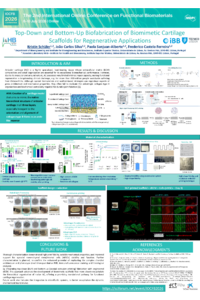
Poly(ethylenglycol)-diacrylate-Gelatine-Methacryloyl (PEGDA-GelMA)-based bioinks enriched with lyophilized dECM were processed using both printing techniques to generate anisotropic scaffolds replicating the different zones of cartilage, especially in regard to collagen type II organization. Thorough characterization demonstrated high print fidelity, suitable mechanical properties, and improved support for synovial mesenchymal stem/stromal cell (sMSC) viability and function (Figure 1).
By integrating top-down (DLP) and bottom-up (coaxial extrusion printing) fabrication with engineered dECM, this approach advances the development of biomimetic scaffolds that more closely recapitulate the hierarchical organization of native AC, offering a promising translational pathway for functional cartilage regeneration.
[1] doi :10.1039/9781782623663
[2] doi: 10.1016/j.actbio.2024.11.007
[3] doi: 10.1016/j.mtbio.2025.101735
Keywords
devitalized ECM
cartilage TE
biomimetic scaffolding
DLP printing
Extrusion-based printing
Poster
poster_Kristin Schüler.pdf
New Natural Polymer-based Bioinks and their 3D Bioprinting for Liver Tissue Engineering
Glucose-Responsive G-quartet/Protein hydrogels for Smart Insulin Delivery