Event submissions
Published
This submission belongs to the session S8. Reactive/Smart Biomaterials of the event The 2nd International Online Conference on Functional Biomaterials
Published date
03 Jul, 2026
Academic Editor
'%3e%3cpath%20d='M12.6657%2010.9104C12.4185%2010.325%2012.0599%209.79327%2011.6097%209.34482C11.1609%208.89508%2010.6293%208.5365%2010.0442%208.28888C10.0389%208.28626%2010.0337%208.28495%2010.0285%208.28233C10.8446%207.69279%2011.3752%206.73249%2011.3752%205.64904C11.3752%203.8542%209.92103%202.39999%208.1262%202.39999C6.33136%202.39999%204.87715%203.8542%204.87715%205.64904C4.87715%206.73249%205.40774%207.69279%206.22393%208.28364C6.21869%208.28626%206.21345%208.28757%206.20821%208.29019C5.62129%208.5378%205.09463%208.89284%204.64265%209.34613C4.1929%209.79493%203.83432%2010.3266%203.58671%2010.9117C3.34345%2011.4845%203.21226%2012.0987%203.20023%2012.7209C3.19988%2012.7349%203.20233%2012.7488%203.20744%2012.7619C3.21255%2012.7749%203.22022%2012.7867%203.22998%2012.7968C3.23975%2012.8068%203.25142%2012.8147%203.26431%2012.8202C3.2772%2012.8256%203.29105%2012.8284%203.30504%2012.8284H4.09109C4.14874%2012.8284%204.19459%2012.7825%204.1959%2012.7262C4.2221%2011.7148%204.62823%2010.7676%205.34617%2010.0497C6.08899%209.30683%207.0755%208.89808%208.1262%208.89808C9.17689%208.89808%2010.1634%209.30683%2010.9062%2010.0497C11.6242%2010.7676%2012.0303%2011.7148%2012.0565%2012.7262C12.0578%2012.7838%2012.1037%2012.8284%2012.1613%2012.8284H12.9474C12.9613%2012.8284%2012.9752%2012.8256%2012.9881%2012.8202C13.001%2012.8147%2013.0126%2012.8068%2013.0224%2012.7968C13.0322%2012.7867%2013.0398%2012.7749%2013.0449%2012.7619C13.0501%2012.7488%2013.0525%2012.7349%2013.0522%2012.7209C13.0391%2012.0947%2012.9094%2011.4855%2012.6657%2010.9104ZM8.1262%207.9024C7.52486%207.9024%206.9589%207.6679%206.53312%207.24211C6.10733%206.81633%205.87283%206.25037%205.87283%205.64904C5.87283%205.0477%206.10733%204.48174%206.53312%204.05596C6.9589%203.63018%207.52486%203.39567%208.1262%203.39567C8.72753%203.39567%209.29349%203.63018%209.71927%204.05596C10.1451%204.48174%2010.3796%205.0477%2010.3796%205.64904C10.3796%206.25037%2010.1451%206.81633%209.71927%207.24211C9.29349%207.6679%208.72753%207.9024%208.1262%207.9024Z'%20fill='%235D1EE1'/%3e%3c/g%3e%3c/svg%3e) Serena Danti
Serena DantiCitation
Aishwarya Devendra Murkar, Rachit Singh, Ayush Singh, Lakshmi Narashimhan Ramana, Investigation of carbon dots for toxic metal chelation therapy employing red blood cell membranes as a biomimetic model, in Proceedings of The 2nd International Online Conference on Functional Biomaterials, 8 July–10 July 2026, MDPI: Basel, Switzerland
Share
Email
Facebook
Twitter
LinkedIn
Investigation of carbon dots for toxic metal chelation therapy employing red blood cell membranes as a biomimetic model
'%3e%3cpath%20d='M12.6647%2010.9104C12.4176%2010.325%2012.0589%209.7933%2011.6088%209.34485C11.16%208.89511%2010.6283%208.53653%2010.0432%208.28891C10.038%208.28629%2010.0327%208.28498%2010.0275%208.28236C10.8437%207.69282%2011.3743%206.73252%2011.3743%205.64907C11.3743%203.85423%209.92005%202.40002%208.12522%202.40002C6.33038%202.40002%204.87618%203.85423%204.87618%205.64907C4.87618%206.73252%205.40677%207.69282%206.22296%208.28367C6.21772%208.28629%206.21248%208.2876%206.20724%208.29022C5.62031%208.53783%205.09365%208.89287%204.64167%209.34616C4.19192%209.79496%203.83334%2010.3266%203.58573%2010.9117C3.34247%2011.4846%203.21128%2012.0987%203.19925%2012.721C3.1989%2012.735%203.20135%2012.7489%203.20646%2012.7619C3.21157%2012.7749%203.21924%2012.7868%203.22901%2012.7968C3.23877%2012.8068%203.25045%2012.8148%203.26334%2012.8202C3.27623%2012.8256%203.29007%2012.8284%203.30406%2012.8284H4.09012C4.14776%2012.8284%204.19362%2012.7825%204.19493%2012.7262C4.22113%2011.7148%204.62726%2010.7676%205.34519%2010.0497C6.08802%209.30686%207.07452%208.89811%208.12522%208.89811C9.17592%208.89811%2010.1624%209.30686%2010.9052%2010.0497C11.6232%2010.7676%2012.0293%2011.7148%2012.0555%2012.7262C12.0568%2012.7839%2012.1027%2012.8284%2012.1603%2012.8284H12.9464C12.9604%2012.8284%2012.9742%2012.8256%2012.9871%2012.8202C13%2012.8148%2013.0117%2012.8068%2013.0214%2012.7968C13.0312%2012.7868%2013.0389%2012.7749%2013.044%2012.7619C13.0491%2012.7489%2013.0515%2012.735%2013.0512%2012.721C13.0381%2012.0947%2012.9084%2011.4856%2012.6647%2010.9104ZM8.12522%207.90243C7.52388%207.90243%206.95792%207.66793%206.53214%207.24215C6.10636%206.81636%205.87185%206.2504%205.87185%205.64907C5.87185%205.04773%206.10636%204.48177%206.53214%204.05599C6.95792%203.63021%207.52388%203.3957%208.12522%203.3957C8.72655%203.3957%209.29252%203.63021%209.7183%204.05599C10.1441%204.48177%2010.3786%205.04773%2010.3786%205.64907C10.3786%206.2504%2010.1441%206.81636%209.7183%207.24215C9.29252%207.66793%208.72655%207.90243%208.12522%207.90243Z'%20fill='%235D1EE1'/%3e%3c/g%3e%3c/svg%3e)
Rachit Singh 1
Ayush Singh 1
Aishwarya Devendra Murkar 1
Lakshmi Narashimhan Ramana 1
1. Department of Chemistry and Biochemistry, School of Science, Jain (Deemed to be) University, Bengaluru, India., India
Abstract
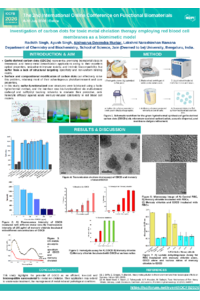
Heavy metal poisoning is a global health concern due to rapid industrialisation, urbanisation and environmental contamination. In recent years, nanotechnology-based chelation therapy has emerged as a transformative approach in biomedical sciences. Mercury is toxic to red blood cells (RBCs) by interacting with the sulfhydryl group of the membrane proteins and alteration in the membrane phosphatidyl serine, resulting in the formation of echinocytes, leading to hemolysis. This study involves the synthesis of sulphur-functionalised garlic-derived carbon dots (GDCDs) using the hydrothermal method followed by evaluating the haemolysis properties of mercury in their presence and establishing the membrane protection action of GDCDs against mercury ions using RBCs as the biomimetic membrane model.
Characterization techniques utilized include UV–visible and fluorescence spectroscopy, transmission electron microscopy and zeta potential measurements of the GDCDs. Additionally, hemocompatibility and protection against damage from mercury exposure for GDCD were evaluated using hemolysis assays, hemolysis inhibition assays and analysis of RBC morphology using microscopy. Measurements of lactate dehydrogenase (LDH) activity were also part of the evaluations.
Fluorescence spectra of GDCDs indicated an emission peak of approximately 475 nm and reduced fluorescence intensity when exposed to Hg(II) ions, indicating strong interactions between Hg(II) and the sulfur on the thiol group of GDCD. In hemolysis assays, GDCDs had good hemocompatibility (less than 5% hemolysis up to 150 µg/mL); GDCDs were an effective inhibitor of Hg(II)-induced hemolysis, with as much as 98% protection observed when GDCDs were present at a 1:1 molar ratio with Hg(II). Imaging data showed that normal RBC morphology was restored in the presence of GDCD, and cytotoxicity was reduced as evidenced by LDH assays demonstrating lower levels of membrane damage when GDCD was included in assays with Hg(II). These findings highlight GDCD as a promising, biocompatible nanoplatform for heavy metal detoxification and nanomedicine-based chelation therapy.
Keywords
Quantum dots
chelation therapy
nanotechnology
biointeraction
toxicology
Poster
MDPI Functional Biomaterials Conference_Quantum Dots (1) (1).pdf
Multiscale Design of Piezoelectric PLA/BaTiO₃ Composites for Electrically Active Bone Grafts
Innovations in Injectable Conductive Hydrogels for Neural Regeneration and Biointerface Compatibility