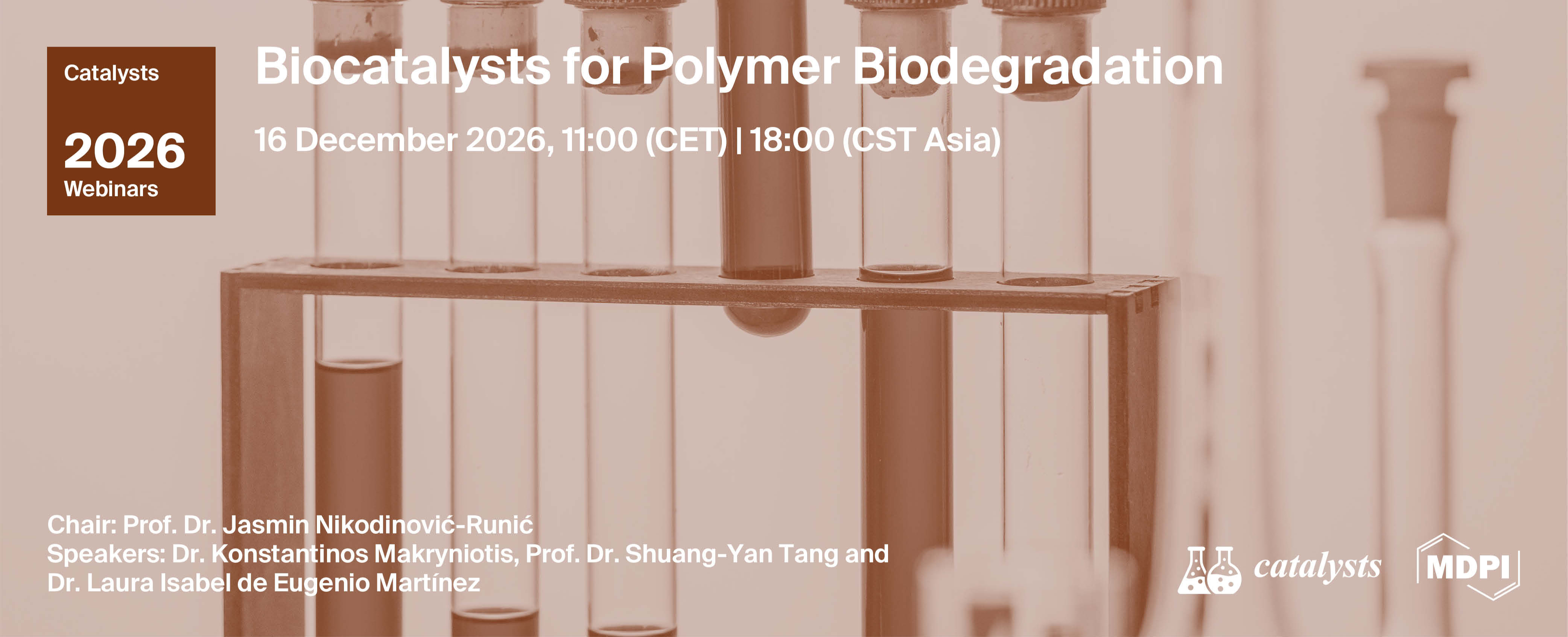
Catalysts Webinar | Biocatalysts for Polymer Biodegradation
the chair
16th Catalysts Webinar
Biocatalysts for Polymer Biodegradation
The growing accumulation of plastic waste and the urgent need for sustainable material management have placed biocatalysis at the forefront of innovative strategies for polymer degradation, recycling, and circularity. Enzymes and microorganisms offer exciting opportunities to rethink how we design, use, and manage polymeric materials, enabling more selective, resource-efficient, and environmentally compatible end-of-life solutions.
Moving beyond polymer breakdown, emerging biocatalytic technologies are opening new pathways towards polymer circularity, where enzymatic depolymerization can facilitate the recovery of valuable monomers and building blocks, their subsequent biological conversion, and potentially the regeneration of materials within circular value chains.
This webinar, “Biocatalysts for Polymer Biodegradation,” brings together leading researchers working at the interface of enzyme discovery, protein engineering, microbial biotechnology, and polymer science. Through three complementary presentations, we will explore recent advances in identifying and optimizing polymer-degrading enzymes, improving their catalytic performance towards challenging substrates, and developing innovative strategies for the biodegradation and recycling of synthetic and bio-based polyesters.
Particular attention will be given to bridging fundamental enzymology with practical applications, addressing challenges such as polymer crystallinity, substrate accessibility, enzyme stability, and the translation of laboratory discoveries into scalable technologies. By connecting advances in enzyme discovery, biocatalyst engineering, and polymer valorization, we aim to stimulate scientific exchange, encourage interdisciplinary collaborations, and highlight how biocatalysis can contribute to transforming plastic waste from an environmental burden into a valuable resource.
We warmly welcome researchers, students, and professionals from academia and industry to join us in exploring the role of biocatalysis in shaping a more circular and sustainable future for polymeric materials.
Dr. Jasmina Nikodinovic-Runic
Webinar Chair
Date: 16 December 2026, Wednesday
Time: 11:00am (CET) | 18:00 (CST Asia)
Webinar ID: 865 3917 9725
Webinar Secretariat: journal.webinar@mdpi.com
Meet Our Chair
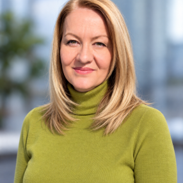
Institute of Molecular Genetics and Genetic Engineering (IMGGE), University of Belgrade, Serbia;Dr Jasmina Nikodinovic-Runic is a Full Research Professor at the Institute of Molecular Genetics and Genetic Engineering (IMGGE), University of Belgrade, Serbia, where she leads the Eco-Biotechnology and Drug Development Research Group. Her research focuses on microbial biotechnology, biocatalysis, polymer biodegradation, and the development of sustainable bio-based materials. Her group investigates microbial and enzymatic approaches to plastic waste valorization, the production and functionalization of biodegradable polymers, and innovative strategies for polymer end-of-life management within the circular bioeconomy. She has extensive experience coordinating and participating in national and international research projects, including European initiatives addressing sustainable polymers, enzyme technologies, and waste-to-value bioprocesses. She has authored more than 230 scientific publications and holds several patents. Her current research particularly emphasizes integrating microbial biocatalysis, polymer biotechnology, and environmental sustainability to develop practical solutions for plastic pollution and resource circularity.
Meet Our Speakers

School of Chemical Engineering, National Technical University of Athens, Greece;Dr. Konstantinos Makryniotis holds an MEng in Chemical Engineering and a PhD in Biotechnology from the National Technical University of Athens, Greece, where his doctoral research was supported by a fellowship from the Hellenic Foundation for Research and Innovation. His research focuses on developing biological platforms for the degradation and upcycling of synthetic polymers. His work combines enzyme discovery, biochemical characterization and protein engineering with the development of biocatalytic processes for polyester degradation, spanning laboratory studies and reactor-scale applications. More recently, he has focused on integrating plastic degradation with biological upcycling to transform plastic waste into value-added products. His approach reflects a simple idea: “Sometimes, building something new starts with breaking something down.”
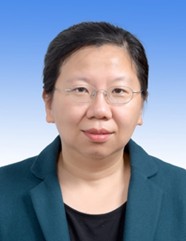
Prof. Dr. Shuang-Yan Tang
Institute of Microbiology, Chinese Academy of Sciences, China;Dr. Shuang-Yan Tang is a Researcher and the Deputy Director of the Department of Microbial Physiological and Metabolic Engineering, Institute of Microbiology, Chinese Academy of Sciences. She was selected for the Hundred Talents Program of the Chinese Academy of Sciences. Her research primarily focuses on metabolic engineering and the design of high-throughput screening methods. She has established and developed technologies for designing and constructing small-molecule-responsive regulatory elements by mining and engineering transcriptional regulators. These elements have been successfully applied to the engineering and optimization of enzymes and whole-cell catalysts. Her work has been published in leading international journals such as Nature Communications, Metabolic Engineering, and Biosensors and Bioelectronics. Additionally, she holds a series of granted patents on highly efficient enzymes and whole-cell catalysts obtained through her engineering efforts.

Department of Microbial & Plant Biotechnology, Centro de Investigaciones Biológicas Margarita Salas, Spanish National Research Council (CSIC), Spain;Dr Laura de Eugenio is a researcher at CIB-CSIC with long-standing expertise in polyhydroxyalkanoate metabolism and degradation. Her work has evolved from understanding how microorganisms synthesize, mobilize and regulate these biopolymers to developing synthetic biology and enzyme-based strategies for their recycling and end-of-life valorization. She also has extensive expertise in the enzymatic valorization of lignocellulosic biomass, providing a complementary background for developing broader biotechnological strategies for the sustainable use, deconstruction and end-of-life management of bio-based materials. Her current research combines microbial biotechnology and biocatalysis to develop new approaches for bioplastic degradation, monomer recovery and circular material use. She currently leads activities in European projects focused on sustainable materials and PHA circularity.
This is a FREE webinar. After registering, you will receive a confirmation email containing information on how to join the webinar. Registrations with academic institutional email addresses will be prioritized.
Certificates of attendance will be delivered to those who attend the live webinar.
Can’t attend? Register anyway and we’ll let you know when the recording is available to watch.
Register for free here!
| Speaker/Presentation | Time (CET) | Time (CST Asia) |
| Prof. Dr. Jasmin T. Nikodinović-Runić Webinar Opening |
11:00–11:10 | 18:00–18:10 |
| Dr. Konstantinos Makryniotis Advancing Biocatalytic Processes for the Degradation and Upcycling of Synthetic Polyesters |
11:10–11:40 | 18:10–18:40 |
|
Prof. Dr. Shaung-Yan Tang |
11:40–12:10 | 18:40–19:10 |
| Dr. Laura Isabel de Eugenio Martínez Beyond Biodegradation: Engineering Enzymes for PHA Circularity |
12:10–12:40 | 19:10–19:40 |
| Q&A Session | 12:40-12:55 | 19:40-19:55 |
| Prof. Dr. Jasmin T. Nikodinović-Runić Closing of Webinar |
12:55 –13:00 | 19:55–20:00 |
Biocatalysis and Biosynthesis: Opportunities and Challenges
Edited by Jennifer Noro
Deadline for manuscript submissions: 28 February 2027
Submit to Catalysts