
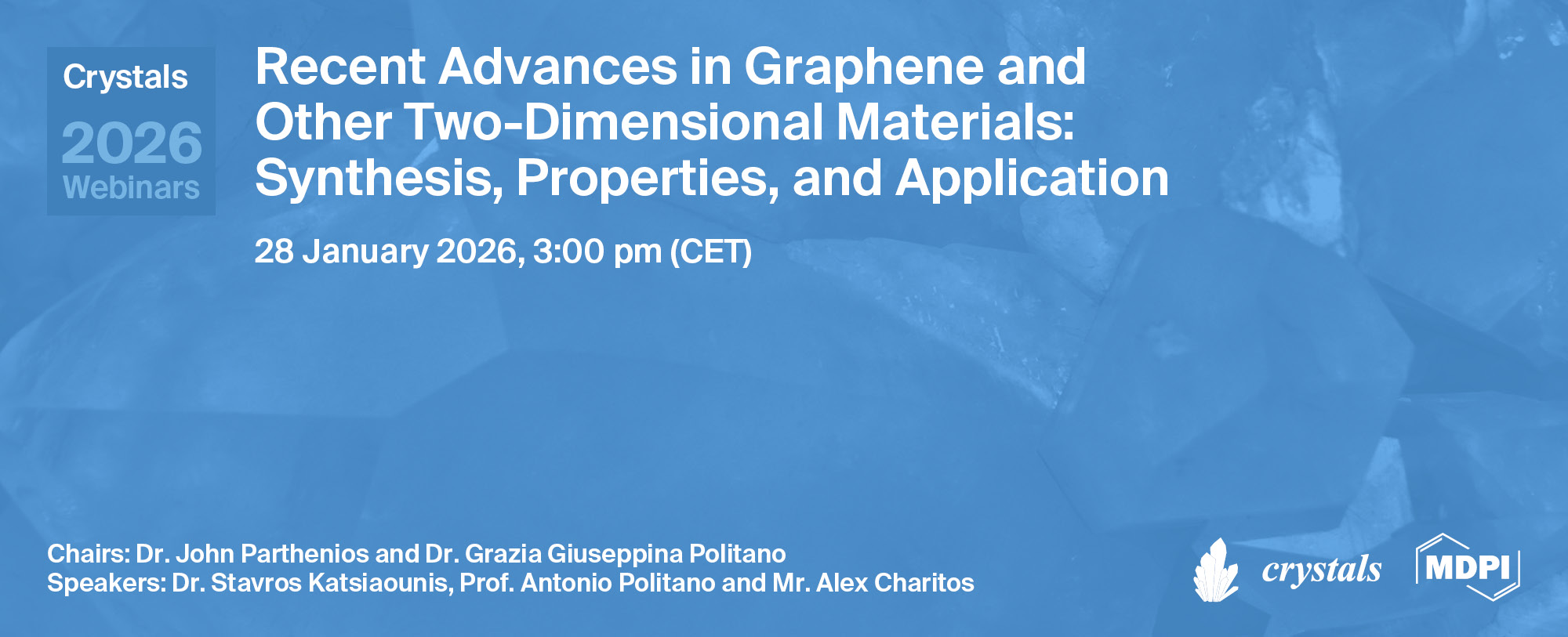
Crystals Webinar | Recent Advances in Graphene and Other Two-Dimensional Materials: Synthesis, Properties, and Applications
the chairs
Crystals Webinar
Recent Advances in Graphene and Other Two-Dimensional Materials: Synthesis, Properties, and Applications
We are pleased to invite you to participate in this webinar dedicated to the latest developments in the science and technology of graphene and 2D materials.
The aim of this webinar is to bring together leading academic scientists, early-career researchers and members of the materials-science community to share their perspectives, experiences, and recent research achievements in the rapidly evolving field of graphene and two-dimensional materials.
This webinar also serves to celebrate the success of the current Special Issue and to officially open the second edition of “Recent Advances in Graphene and Other Two-Dimensional Materials,” offering a renewed opportunity for researchers to disseminate their latest findings in full open access.
The event will provide a high-quality interdisciplinary platform to present and discuss the most recent advances in synthesis, structural and optical characterization, modelling, device integration, and emerging applications.
Graphene and related 2D materials continue to attract tremendous interest worldwide due to their unique electronic, optical, mechanical, and thermal properties. Their potential impact spans flexible nanoelectronics, sensing and biosensing, energy storage and generation, photonics, and semiconductor technologies. In this webinar, chairs and keynote speakers represent different stages of their scientific careers, reflecting the inclusive and collaborative spirit of the 2D-materials community. MDPI strongly promotes the visibility and growth of early-career scientists, and this event provides a valuable opportunity for them to showcase their work alongside established experts, fostering dialogue, inspiration, and new scientific connections.
We warmly invite the scientific community to join us to contribute to an engaging dialogue on the future of graphene and two-dimensional materials.
Dr. John Parthenios
Dr. Grazia Giuseppina Politano
Chairs
Date: 28 January 2026
Time: 3:00 pm CET | 4:00 pm EET | 10:00 pm CST Asia
Webinar ID: 862 8736 7806
Webinar Secretariat: journal.webinar@mdpi.com
Meet Our Chairs

FORTH / Institute of Chemical Engineering Sciences, Patras, Greece;-Dr. Parthenios is a Principal Researcher at the Institute of Chemical Engineering Sciences (ICE-HT), Foundation for Research and Technology – Hellas (FORTH), Greece. He holds a PhD in Physics from the University of Patras, Greece with postdoctoral training in laser spectroscopy and nanomaterials. His research centers on the synthesis, characterization, and strain engineering of graphene and other 2D materials (e.g., MoS₂, WS₂), with emphasis on Raman and photoluminescence spectroscopy, optical straintronics, and the development of nanocomposites for tribological and aerospace applications. He has co-authored over 90 peer-reviewed journal articles, including high-impact publications with A. Geim and K. Novoselov, recipients of the 2010 Nobel Prize in Physics, on topics related to strain and structure–property relationships in graphene. His work has received over 7,900 citations (h-index 34), and includes five book chapters and two international patents. He served as Adjunct Faculty Member at the Hellenic Open University, Lecturer at the University of Patras, and Assistant Professor (contract) at the Technological Educational Institute of Patras. His career combines academic excellence with interdisciplinary research coordination, international peer recognition, and commitment to education.

Department of Environmental Engineering, University of Calabria, Italy;Dr. Grazia Giuseppina Politano is a postdoctoral fellow at the University of Calabria at the Department of Environmental Engineering, focusing on light–matter interaction at the nanoscale for solar membrane distillation. She earned her master’s degree in physics (cum laude) in 2016 and a PhD in “Physical, Chemical and Materials Sciences and Technologies” in 2021, with research spanning graphene-based thin films, nanostructured materials, and advanced optical characterization techniques such as spectroscopic ellipsometry and Raman spectroscopy. Her multidisciplinary expertise bridges physics, chemistry, and materials science, covering topics from two-dimensional materials and nanophotonics to functional membranes for sustainable technologies. She has been recognized with the MDPI Crystals Outstanding Reviewer Award in 2025. Dr. Politano has served as guest editor and reviewer for leading international journals and has authored numerous scientific publications on nanomaterials and functional graphene -based films.
Meet Our Speakers

Institute of Accelerating Systems and Applications (IASA), University of Athens, Athens, Greece;Mechanical engineer Dr. Stavros Katsiaounis has significant research experience in investigating the properties of 2D materials (such as graphene) and composites containing carbon nanotubes (CNTs) or carbon fibers using primarily experimental techniques such as conventional Raman spectroscopy as well as Time-Resolved Incoherent Anti-Stokes Raman Scattering (TRIARS). Concurrently, he also has more than a decade of experience in product design and development in a range of industrial sectors such as mobility, heavy machinery and stationary/portable fuel cell systems.
'%3e%3cpath%20d='M12.6647%2010.9104C12.4176%2010.325%2012.0589%209.7933%2011.6088%209.34485C11.16%208.89511%2010.6283%208.53653%2010.0432%208.28891C10.038%208.28629%2010.0327%208.28498%2010.0275%208.28236C10.8437%207.69282%2011.3743%206.73252%2011.3743%205.64907C11.3743%203.85423%209.92005%202.40002%208.12522%202.40002C6.33038%202.40002%204.87618%203.85423%204.87618%205.64907C4.87618%206.73252%205.40677%207.69282%206.22296%208.28367C6.21772%208.28629%206.21248%208.2876%206.20724%208.29022C5.62031%208.53783%205.09365%208.89287%204.64167%209.34616C4.19192%209.79496%203.83334%2010.3266%203.58573%2010.9117C3.34247%2011.4846%203.21128%2012.0987%203.19925%2012.721C3.1989%2012.735%203.20135%2012.7489%203.20646%2012.7619C3.21157%2012.7749%203.21924%2012.7868%203.22901%2012.7968C3.23877%2012.8068%203.25045%2012.8148%203.26334%2012.8202C3.27623%2012.8256%203.29007%2012.8284%203.30406%2012.8284H4.09012C4.14776%2012.8284%204.19362%2012.7825%204.19493%2012.7262C4.22113%2011.7148%204.62726%2010.7676%205.34519%2010.0497C6.08802%209.30686%207.07452%208.89811%208.12522%208.89811C9.17592%208.89811%2010.1624%209.30686%2010.9052%2010.0497C11.6232%2010.7676%2012.0293%2011.7148%2012.0555%2012.7262C12.0568%2012.7839%2012.1027%2012.8284%2012.1603%2012.8284H12.9464C12.9604%2012.8284%2012.9742%2012.8256%2012.9871%2012.8202C13%2012.8148%2013.0117%2012.8068%2013.0214%2012.7968C13.0312%2012.7868%2013.0389%2012.7749%2013.044%2012.7619C13.0491%2012.7489%2013.0515%2012.735%2013.0512%2012.721C13.0381%2012.0947%2012.9084%2011.4856%2012.6647%2010.9104ZM8.12522%207.90243C7.52388%207.90243%206.95792%207.66793%206.53214%207.24215C6.10636%206.81636%205.87185%206.2504%205.87185%205.64907C5.87185%205.04773%206.10636%204.48177%206.53214%204.05599C6.95792%203.63021%207.52388%203.3957%208.12522%203.3957C8.72655%203.3957%209.29252%203.63021%209.7183%204.05599C10.1441%204.48177%2010.3786%205.04773%2010.3786%205.64907C10.3786%206.2504%2010.1441%206.81636%209.7183%207.24215C9.29252%207.66793%208.72655%207.90243%208.12522%207.90243Z'%20fill='%235D1EE1'/%3e%3c/g%3e%3c/svg%3e)
Department of Physical and Chemical Sciences, University of L'Aquila, Italy;Prof. Antonio Politano has a PhD in Physics and is an Associate Professor at the Department of Physical and Chemical Sciences of the University of L’Aquila (Italy). Previously, he was a post-doc at the Italian Institute of Technology, Genoa (Italy), the Autonomous University of Madrid (Spain), and Imdea Nanociencia, Madrid (Spain). He has coauthored >250 papers ( h index 51) in peer-reviewed journals and he is the principal investigator of several national and international projects. He was awarded with three prizes for his scientific activity, four international fellowships, and the APS Outstanding Referee award.

Mr. Alexander Charitos
University of Patras, Faculty of Natural Sciences, Department of Chemistry, Patras, Greece;Foundation for Research and Technology – Hellas (FORTH), Institute of Chemical Engineering Sciences (ICE-HT), Optical Spectroscopy and Molecular Materials Laboratory, Patras, Greece;Alexander Charitos majored in Environmental Engineering, specializing in zero-emission energy applications, particularly referring to the maritime industry and carbon-neutral powertrains running on pressurized hydrogen, whether it be fuel-cell-focused or internal-combustion-based. Currently, he is a final-year Ph.D. candidate in the field of Molecular Spintronics at the University of Patras Chemistry Department. His research focuses on Fe(II) spin-crossover coordination polymers and their integration with direct-bandgap 2D semiconductors to synthesize novel SCO@2DM heterostructures for spintronics devices. He has co-authored three peer-reviewed publications pertaining to pristine, Cu3-doped and GO-hybrid variants of the Fe1-xCux(NH2trz)3]n(Br2)n SCO system where diverse characterization approaches were presented, including room-temperature micro-Raman spectroscopy, Differential Scanning Calorimetry SQUID Magnetometry and Thermogravimetric Analysis. As a research associate of the Optical Spectroscopy and Molecular Materials lab/FORTH-ICE, he conducted temperature-dependent as well as laser-power-assisted micro-Raman studies of the Fe(Htrz)2(trz)]n(BF4)n 1D coordination polymer chain, followed by extensive micro-Raman and photoluminescence mapping on pristine and SCO-functionalized 1L 2H WS2 grains to probe the excitonic and vibrational response of the 2D material, aiming to capture and evaluate the hybrid interface impact on said optical properties of the TMD monolayer as well as the thermodynamical readout of the pristine, bulk SCO system.


The webinar was hosted via Zoom and required registration to attend. The full recording can be found below. In order to learn about future webinars, you can sign up to our newsletter by clicking “Subscribe” at the top of the page.
Recent Advances in Graphene and Other Two-Dimensional Materials (2nd Edition)
Edited by Dr. Grazia Giuseppina Politano and Dr. John Parthenios
Deadline for manuscript submissions: 20 August 2026