
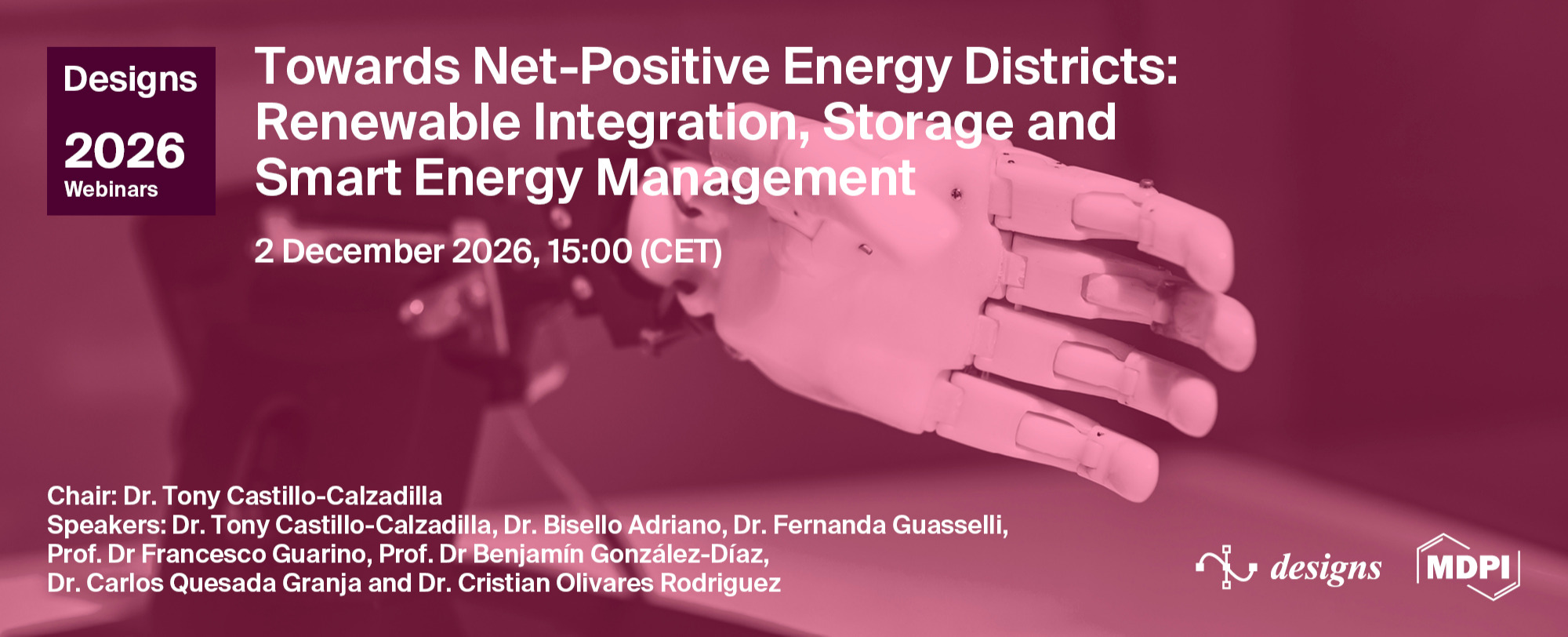
Designs Webinar | Towards Net-Positive Energy Districts: Renewable Integration, Storage and Smart Energy Management
the chair
Designs Webinar
Image Algebra: From Maya Numbers to Intelligence Embedded in Visio-Numerical Landscapes — In Homage to Professor Sir Michael Berry
Dear colleagues,
It is a pleasure to welcome you to this webinar, which brings together researchers working on the design, integration and management of renewable energy systems for future urban districts. Over the next two hours, we will discuss how photovoltaic generation, energy storage, DC microgrids and intelligent energy management can contribute to net-positive energy districts and to the wider energy transition.
Thank you for joining us.
Date: 02 December 2026
Time: 3:00 pm CET | 9:00 am EST | 11:00 am CLST (Chile)
Webinar ID: 869 2692 0384
Webinar Secretariat: journal.webinar@mdpi.com
Meet Our Chair
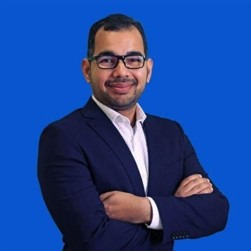
Department of Systems Engineering, Automatic Control, Architecture and Computer Technology, Universidad de La Laguna, Tenerife, Spain;Tony Castillo-Calzadilla is a Lecturer at the Universidad de La Laguna (Tenerife, Spain). His research focuses on Positive Energy Districts, photovoltaic systems, low-voltage direct current (LVDC) microgrids, energy storage systems and energy management, including fuzzy-logic-based management strategies, e-mobility integration and resilient off-grid PV–storage design. He has authored numerous publications on the transition towards net-positive energy urban districts.
Meet Our Speakers
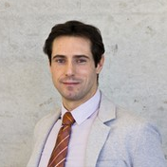
Institute for Renewable Energy, Eurac Research, Viale Druso 1, 39100 Bolzano, Italy;Adriano Bisello is an urban and environmental planner and holds a PhD in Real Estate Economics. He is Vice President of ASSURB, the Italian Association of Urban Planners, and Senior Researcher at Eurac Research in Bolzano, Italy, where he coordinates research activities on city planning and the multiple benefits of urban transitions. His work focuses on sustainable urban planning and governance, particularly on integrating emerging energy technologies into planning processes, Positive Energy Districts, energy communities and climate-neutral urban strategies. He has contributed to numerous EU-funded research and innovation projects, linking urban planning, energy transition, socio-economic assessment and emerging approaches inspired by the New European Bauhaus. He is actively involved in international research networks and knowledge-exchange initiatives and has coordinated the Smart and Sustainable Planning for Cities and Regions international conference since 2015. His research has been published in international scientific journals, books and conference proceedings.

Dr. Fernanda Guasselli
Institute for Renewable Energy, Eurac Research, Bolzano, Italy;Dr. Guasselli holds a PhD in Socially Smart Energy Futures from the Faculty of Engineering and Science at Aalborg University, Denmark. Her interdisciplinary expertise bridges design, engineering, and social sciences to explore the sociotechnical and environmental dimensions of smart technologies and their implications for urban energy transitions. She currently leads the CODE-AI4PEDs (Co-developing Artificial Intelligence for Resilient Positive Energy Districts) project, supported by a MSCA Seal of Excellence postdoctoral fellowship hosted by the Institute for Renewable Energy at Eurac Research, Italy. In collaboration with Dr. Bisello, she investigates how artificial intelligence can be reconceptualised and redesigned through a human-centred approach that prioritises energy sufficiency and fosters community-driven resilience in PEDs.
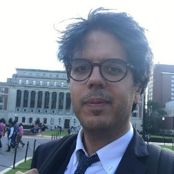
Engineering Department, University of Palermo, Palermo, Italy;Francesco Guarino is an Associate Professor at the Department of Engineering of the University of Palermo (UNIPA), where he chairs the Building Modeling & Design Lab (BMD LAB). His research covers building and urban energy simulation, life cycle assessment and eco-design, and resilient cooling in Mediterranean climates, within an integrated environmental, economic and social framework. He leads international projects funded through the EU landscape including EU joint partnership, as well as national projects, on topics ranging from urban-scale energy modeling and sustainability assessment to climate resilience of the built environment. He was Operating Agent of IEA EBC Annex 83 and co-chair of the EU SET-Plan IWG5.
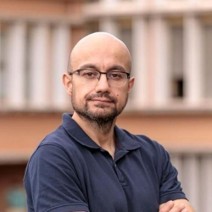
Departamento de Ingeniería Industrial, Escuela Superior de Ingeniería y Tecnología, Universidad de La Laguna (ULL), La Laguna, Spain;Benjamín J. González Díaz holds a PhD in Physics (2008) and is Full Professor of Electrical Engineering at the University of La Laguna (ULL), where he has taught since 2011. His research addresses the integration of renewable energy into weak and isolated grids, photovoltaic (PV) systems and self-consumption, solar resource assessment and the planning and policy of the energy transition in island systems. Across these lines, a common question runs through his work: how technical solutions for decarbonisation reach households and territories, and at what cost. FAIR-ISLANDS puts that question at the centre. He has authored 85 scientific documents, 49 of them in JCR journals (677 citations and h-index 15 in Scopus; 996 citations and h-index 18 in Google Scholar). Work directly relevant to FAIR-ISLANDS includes the characterisation of solar radiation zones in the Canary Islands by cluster analysis (Results in Engineering, 2025), which supplies the radiation and PV-yield data for the simulation of collective self-consumption; GIS-based assessment of rooftop PV potential, the subject of a doctoral thesis he supervises; scenario-based analyses of the energy transition of Tenerife and a review of the Canary energy-policy objectives for 2040, written with the economists of the team (Energy Conversion and Management: X, 2025; Energies, 2023); studies on the electrification of light-duty and zero-tailpipe vehicles in isolated power systems (Journal of Cleaner Production, 2021; Energy, 2023), which inform the transport-poverty dimension of the project; and optimised control of PV inverters in distribution grids (IET Renewable Power Generation, 2021), the basis for the low-voltage network analysis of collective self-consumption in vulnerable neighbourhoods. His recent work on energy communities in island territories and on near-real-time performance of PV plants was presented at ICRE 2026. He has taken part in 20 competitive research projects: 6 international (one of them Horizo
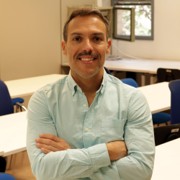
Robotics, Vision and Intelligent Technologies Laboratory (RoVIT), Computational Sciences and Artificial Intelligence Department, Polytechnic School, University of Alicante, San Vicente del Raspeig, Spain;Dr. Quesada is an Assistant Professor in the Department of Computer Science and Artificial Intelligence at the University of Alicante, Spain. He holds a degree in Telecommunications Engineering and a PhD in Mechanical Engineering. His research focuses on data science and artificial intelligence, particularly machine learning, dimensionality reduction and interpretable time-series analysis. He has conducted research at several institutions in Spain and France and participated in the European H2020 WHY project on household energy consumption. His current work focuses on identifying interpretable patterns in large-scale electricity consumption datasets.
This is a FREE webinar. After registering, you will receive a confirmation email containing information on how to join the webinar. Registrations with academic institutional email addresses will be prioritized.
Certificates of attendance will be delivered to those who attend the live webinar.
Can’t attend? Register anyway and we’ll let you know when the recording is available to watch.
Register for free here!
Innovative Energy Systems: Thermodynamics, Energy Storage, Performance Assessment and Optimization
edited by Dr. Panagiotis Lykas
Deadline for manuscript submissions: 30 April 2027