
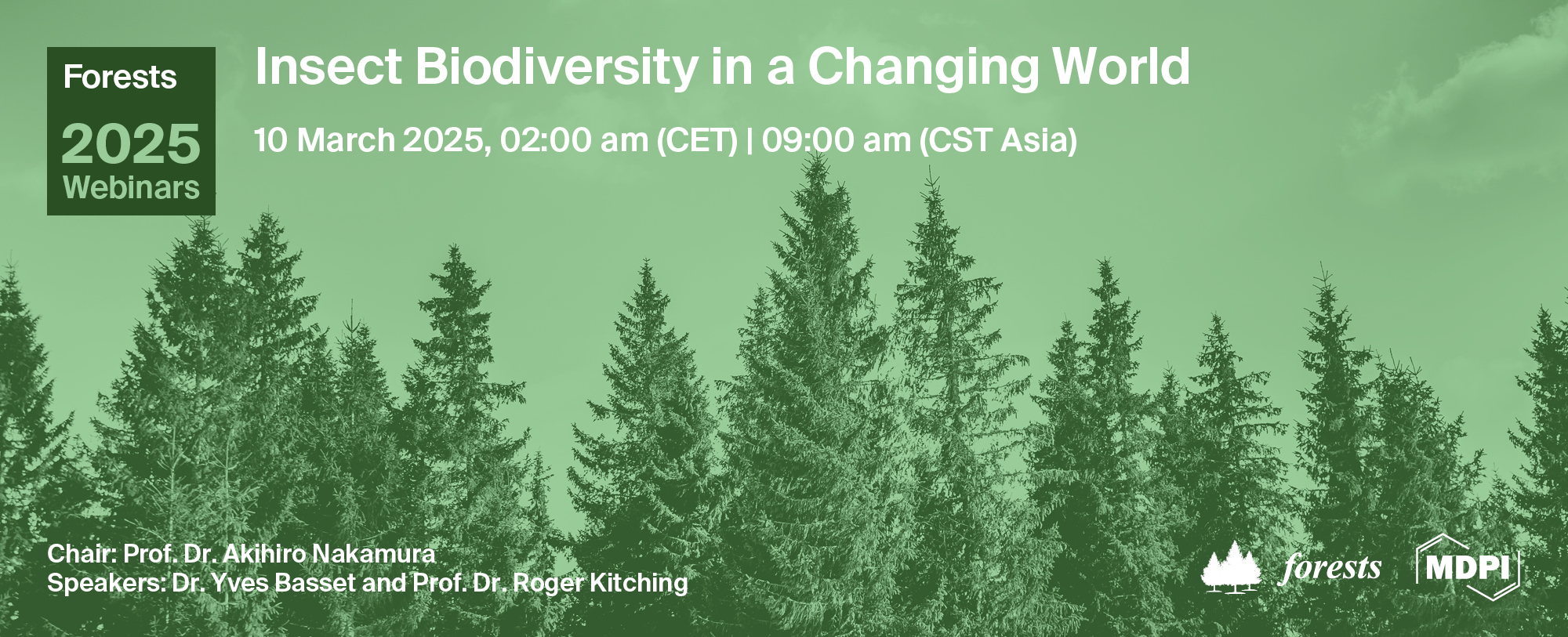
Forests Webinar | Insect Biodiversity in a Changing World
the chair
Insects play a fundamental role in ecosystems, contributing to pollination, decomposition, and food webs. Their diversity and abundance make them excellent indicators of environmental change, yet they remain underappreciated in conservation and ecological monitoring.
This Special Issue seeks to deepen our understanding of insect altitudinal distribution—a critical aspect of terrestrial biodiversity—in tropical and subtropical habitats. Understanding these distribution patterns is essential for assessing biodiversity dynamics, ecosystem processes, and the potential impacts of climate change, ultimately informing more effective conservation strategies.
For this webinar, we are honored to have two leading experts from the field of insect ecology—Professor Roger Kitching from Griffith University and Dr. Yves Basset from the Smithsonian Tropical Research Institute. These talks will explore the challenges and opportunities in insect monitoring, highlighting the significance of insects in tracking ecological change. We invite you to engage in the discussion and gain valuable insights from our esteemed speakers.
Professor Kitching, a distinguished rainforest ecologist, has pioneered the use of moths as bioindicators, contributing to our understanding of ecosystem dynamics across Australia, China, France, and Réunion. His extensive research has earned him numerous accolades, including the Gregor Mendel Medal and membership in the Order of Australia. Dr. Basset is a leading entomologist, who specializes in long-term insect monitoring, with extensive research in tropical rainforests. As the head of the ForestGEO Arthropod Initiative, he has advanced methods in biodiversity assessment, including AI-driven monitoring.
Date: 10 March 2025
Time: 2:00 am (CET) | 9:00am (CST Asia)
Webinar ID: 863 5259 5074
Webinar Secretariat: journal.webinar@mdpi.com
Meet Our Chair

Xishuangbanna Tropical Botanical Garden Chinese Academy of Sciences, Mengla, China;Akihiro Nakamura, PhD Supervisor, Xishuangbanna Tropical Botanical Garden, Chinese Academy of Sciences. Research interests include community ecology, entomology, biodiversity conservation
Meet Our Speakers
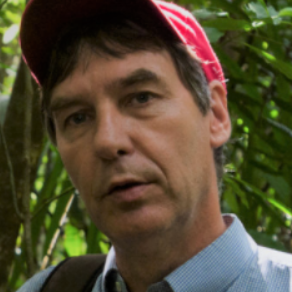
Dr. Yves Basset
Smithsonian Tropical Research Institute, Washington, D.C., United States;Dr. Yves Basset is a Swiss citizen with permanent residency in Panama. He completed an MSc at the University of Neuchatel in Switzerland and then received a scholarship to perform his PhD at the University of Griffith in Australia, under the supervision of Prof. Roger Kitching, where he studied the distribution of canopy insects in rainforests. Following this, he continued to live in the Tropics and study insects, particularly in rainforests. He then worked at the Bishop Museum (Hawaii) and in the field in Papua New Guinea until 1995, when he joined the International Institute of Entomology under Prof. Val Brown to work in Guyana. Since 1998, Dr. Yves Basset has been working at the Smithsonian Tropical Research Institute in Panama. He first explored the vertical gradients of insect diversity in tropical rain forests with canopy cranes. His research with canopy cranes led him, in 2003, to be contracted as a Scientific Coordinator for the Tropical Canopy Biology Program. In 2008, he was contracted to lead the ForestGEO Arthropod Initiative, an insect monitoring program conducted at tropical ForestGEO sites, which now focuses on the site of Barro Colorado Island in Panama. He has published 208 scientific publications so far, including six in Nature and Science. Dr. Yves Basset is also regularly invited to national and international meetings. In 2022, he organized the session “3.4. Insect decline” at the INTECOL 2022 Meeting of the International Association for Ecology in Geneva, Switzerland. His track record of grant income includes $2.7 million as a PI and $3.4 million as a Co-PI. His website details his current research activities, including insect monitoring, DNA metabarcoding, the automated monitoring of insects with AI, plant–insect interactions, etc. He has served as the Senior Editor for Insect Conservation and Diversity since its inception (2008) and, since 2024, as the Editor-in-Chief with his colleagues, Raphael Didham and Manu Saunders.
Environmental Futures Centre and Griffith School of Environment, Griffith Univ., Nathan, QLD 4111, Australia;Roger Kitching is an Emeritus Professor of Ecology at Griffith University, Brisbane. He is a rainforest ecologist with special expertise in using insect diversity to tackle questions regarding ecosystem dynamics and biogeography. A graduate of the Imperial College, London, with a DPhil from Oxford University and a DSc from Griffith, Kitching has authored, edited, or co-authored almost 300 papers and 12 books. He received the Gregor Mendel Medal from the Czech Academy of Sciences in 2017 and was made a member of the Order of Australia in 2010. His next book, Moths of Australia: A Natural History will be published in 2026.


Our webinar was a great success, with nearly 100 participants in attendance. We were honored to host two distinguished entomologists: Professor Roger Kitching and Dr. Yves Basset.
Dr. Basset presented his long-term research on monitoring tropical forest insect diversity at Barro Colorado Island, where he has been tracking insect populations for over 15 years. He shared data that revealed long-term trends, with some insect populations declining over time while others have increased. Additionally, he explored the latest technological advancements in insect monitoring, including meta-DNA barcoding, AI-based visual recognition, and bioacoustic monitoring systems, which help address the immense diversity of tropical forest insects.
Professor Kitching discussed the biogeography of Lepidoptera, focusing on their latitudinal and elevational distributions across various biomes worldwide. He highlighted the challenges in understanding the ecology and biogeography of tropical moths, emphasizing how little we still know about their natural histories.
The webinar concluded with a dynamic and insightful Q&A session, featuring engaging discussions on the future of insect ecology and monitoring.
Kindly find the slides prepared by Prof. Dr. Roger Kitching here.
Altitude Distribution of Insects in Tropical and Subtropical Rainforests
Edited by: Prof. Dr. Akihiro Nakamura, Prof. Dr. Roger Kitching, Dr. Chris J. Burwell and Dr. Louise Ashton
Deadline for manuscript submissions: 21 March 2025