
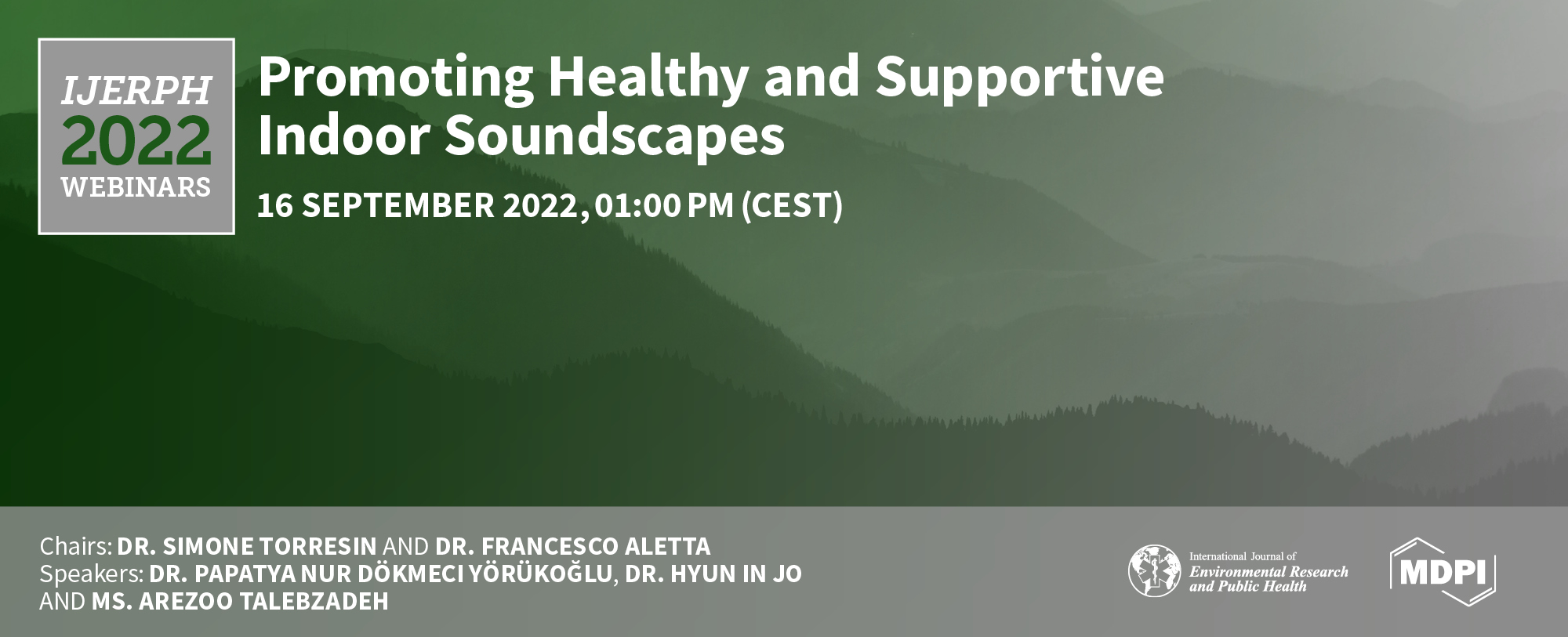
IJERPH Webinar | Promoting Healthy and Supportive Indoor Soundscapes
the chair
7th IJERPH Webinar
Promoting Healthy and Supportive Indoor Soundscapes
One of the lessons learned from the COVID-19 pandemic period is the importance of sound in our lives. Urban sounds (or the lack thereof) tell a story of an unprecedented change in our society, traffic reduction has brought the sounds of nature back into our urban centres, and the sounds of our unusually crowded homes made us to be comforted from our nearest and dearest's presence, while leading to challenges in carrying out new activities from home. Notwithstanding the potential impact in terms of conveying information, creating a sense of place, supporting activities, enhancing affective and mental states, “sound” has been traditionally considered as unwanted, and as such as “noise” to be avoided and reduced. However, this approach is not always successful in improving quality of life and acoustic comfort. This is not just a function of decibel noise level; it is a function of human response to the acoustic environment in context, created by a range of acoustic and non-acoustic factors. While the scientific evidence gathered so far on the impact of sound stimuli on humans has focused on the risks arising from noise exposure, more research is needed towards new approaches for the characterization, management, and design of indoor soundscapes that support restoration, health, and well-being, as well as basic research on (negative and positive) potential health-related, emotional, cognitive, and behavioural outcomes for people.
Date: 16 September 2022
Time: 1:00 pm CEST | 7:00 am EDT | 7:00 pm CST Asia
Webinar ID: 889 2532 7735
Webinar Secretariat: ijerph.webinar@mdpi.com
Meet Our Speakers

Institute for Renewable Energy, Eurac Research, Italy;Institute for Environmental Design and Engineering, University College London, United Kingdom;Simone Torresin is a Building Engineer, post-doctoral researcher at Eurac Research (Bolzano, Italy), currently Honorary Research Fellow at UCL IEDE. He was granted the title of PhD in Civil, Environmental and Mechanical Engineering at the University of Trento, in cooperation with Eurac Research, Institute for Renewable Energy, and with the Institute for Environmental Design and Engineering, The Bartlett, University College London (UK). His research focuses on the characterization of the relationship between sound and building occupants, by developing and applying indoor soundscape methodologies.

Institute for Environmental Design and Engineering, University College London, United Kingdom;Francesco Aletta is an architect and urban sound planner by training, research associate at University College London (UK). He has been active in soundscape studies for more than 10 years with an interest in methods for measuring soundscape perception by people and standardization processes, as well as how to translate soundscape descriptors in languages other than English.


The webinar "Promoting Healthy and Supportive Indoor Soundscapes" aligns with the growing interest in the relationship between the built environment and the health and well-being of building occupants, which has become topical for research and practice, especially since the COVID-19 pandemic. The event brought together different perspectives around the topic of indoor soundscape research, i.e. the acoustic environment inside buildings as perceived by occupants, in context.
Dr. Simone Torresin introduced the indoor soundscape framework in relation to the existing assessment tools for the outdoor acoustic environments and illustrated an example of assessment in the residential context in his talk "Assessing Indoor Soundscapes in Residential Buildings: Preliminary Results From a Pilot Study in London". Further case studies were presented by Dr. Papatya Nur Dökmeci Yörükoğlu, in her talk entitled "Evaluating Interior Architecture Through an Indoor Soundscape Framework", in which the relationship between indoor soundscape science and architectural practice was emphasised, from a multisensory perspective. Finally, Ms. Arezoo Talebzadeh presented her current research on the potential of the indoor soundscape in patients with dementia in her talk "Augmented Soundscape to Promote Health and Well-Being in Care Facilities", touching on hot research topics on sound augmentation in indoor built environments and the impacts of sound on vulnerable individuals. The webinar led to a lively discussion on open issues and future lines of research in the indoor soundscape agenda.
The webinar was offered via Zoom and required registration to attend. The full recording can be found here on Sciforum website. In order to stay updated on the next webinars on IJERPH be sure to sign up for our newsletter by clicking on “Subscribe” at the top of the page.
Guest Editors: Dr. Francesco Aletta & Dr. Simone Torresin
Deadline for manuscript submissions: 31 January 2023