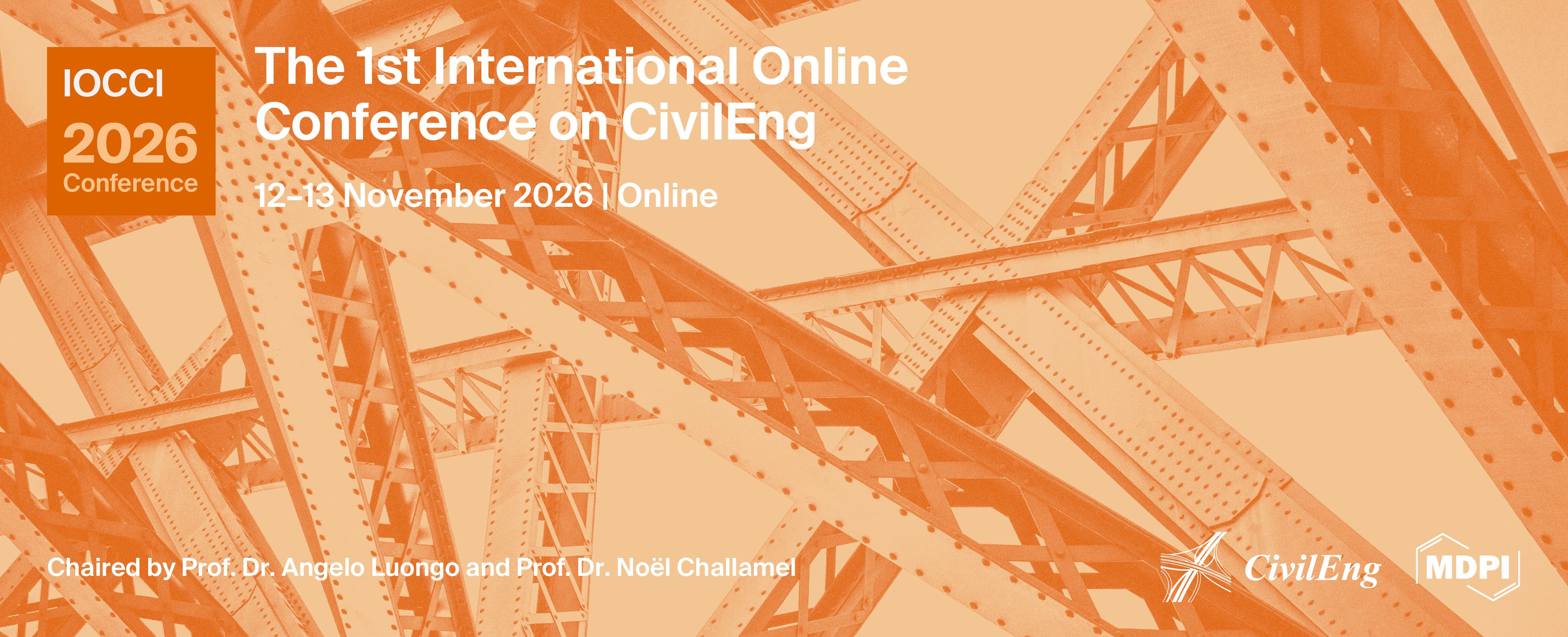
The 1st International Online Conference on CivilEng
Part of the International Online Conference on CivilEng series
12–13 November 2026
13 July 2026
14 August 2026
6 November 2026
Civil Engineering, Infrastructures, Construction Materials, Structural Engineering, Computational Mechanics, Coastal Engineering, Geotechnical Engineering, Earthquake Engineering, Building Information Modeling (BIM)
- Go to the Sessions
- Event Details
The IOCCI 2026 is Now OPEN for Abstract Submission and Registration.
Instructions for authors are available online.
Submit your abstracts HERE.
For any inquiries, please contact us at iocci2026@mdpi.com.
Welcome from the Chairs
Dear colleagues,
It is our pleasure to invite you to join the 1st International Online Conference on CivilEng (IOCCI 2026). The conference is organized by the MDPI open access journal CivilEng (ISSN 2673-4109, Impact Factor: 2.0) and will be held online from 12-13 November 2026.
The agenda of the conference includes, but is not limited to, the following topics:S1: Mathematical Models for Civil Engineering;
S2: Urban, Economy, Management and Transportation Engineering;
S3: Structural and Earthquake Engineering;
S4: Water Resources and Coastal Engineering;
S5: Construction and Material Engineering.
IOCCI 2026 will enable you to share and discuss your most recent research findings, with the active engagement of the audience in question-and-answer sessions that will take place online without any registration fee.
The conference committee will review the submitted abstracts. Following the conference, outstanding contributions will be invited to be submitted as a full-length paper for publication in CivilEng with a 20% discount on the publication fee.
We hope you will join us, present your work at IOCCI 2026, and be part of this exciting online event.
Best regards,
Conference Chairs
Prof. Dr. Angelo Luongo, Past Professor, DICEAA, University of L’Aquila, Italy;
Prof. Dr. Noël Challamel, University of South Brittany (UBS), France.

Event Chairs
Department of Civil, Architecture and Environmental Engineering, University of L’Aquila, L’Aquila, Italy
Full professor of Solid and Structural Mechanics, at University of L'Aquila (Italy), since 1990. He works in the following research fields: Bifurcation and Stability of Static and Dynamical Systems, Linear and Nonlinear Dynamics, Buckling and Post-Buckling of elastic structures, Cable Mechanics, Bridge Mechanics, Aeroelasticity, Sensitivity Analysis, Localization Phenomena in Dynamics and Buckling, Homogeneization Methods for Periodic Structures, Reduced-Order Modeling of Structures, Perturbation Methods. He is author of several educational books on Solid Mechanics and Structural Mechanics, as well as scientific books on Post-buckling, Dynamic Bifurcations, Nonlinear Modelling of Beams and Cables. He authored more than two hundred papers in peer-reviewed journals. He is Editor-in-Chief of CivilEng (MPDI), Associate Ed. of Nonlinear Dynamics (Springer) and Editorial Board Member of several other journals. He was head of department for five three-yearly terms, vicar pro-rector for two years, and held several managerial roles in academia, as founder of new degree courses, PhD schools and Research Centers as well as Laboratory Director.
Department of Civil Engineering, University of South Brittany (UBS), Lorient, France
Noël Challamel is Professor at University of South Brittany (Université de Bretagne Sud – Lorient, France). He is the head of a research team in Civil Engineering and Multiscale Mechanics. His research at University of South Brittany mainly concerns civil engineering, theoretical and applied mechanics problems, with a particular emphasis on scale effects, structural mechanics, stability, vibrations and material modeling (Continuum Damage Mechanics and Plasticity). He is the co-author of several books in the field of mechanics and civil engineering. He has published over two hundred papers in high standard journals. He is often consulted as a referee in more than 50 international journals in Civil Engineering, Physics or Mechanics. He is member of the editorial board of a dozen of international journals, and is associate editor of the Journal of Engineering Mechanics (one of the leading journals published by the American Society of Civil Engineering), and Mechanics Research Communications. He is also editor and head of the collection « Solid Mechanics and Mechanical Engineering » published by ISTE Wiley. He is also chairman of the EMI Stability Committee (ASCE).
Session Chairs
Dr. Aires Camões
Centre of Territory, Environment and Construction, University of Minho, Guimaraes, Portugal
Aires Camões is Associate Professor in the Department of Civil Engineering, School of Engineering, University of Minho, belonging to the Disciplinary Area of Constructions. He is currently the Head of the Laboratory of Materials of Construction. He develops scientific and pedagogical activity in the area of Construction Materials, he is a member of the R&D Centre for Territory, Environment and Construction (CTAC) and he has more than 30 years of teaching and research experience. His main research interests are related with eco-efficient construction materials, mineral additions in cementitious mixtures, high volume fly ash concrete, low cement content concrete and durability of concrete structures. He has published 18 books and book chapters, 155 papers in international journals (including 75 WoS/Scopus papers) and international proceedings and 107 papers in national journals and proceedings. He has 2 patents of invention and participated in 20 national research projects, 8 as responsible researcher. He has supervised 4 post-doctoral students, 15 PhD theses and 66 MSc theses.
eco-efficient construction materials; mineral additions in cementitious mixtures; high volume fly ash concrete; low cement content concrete; durability of concrete structures
Prof. Dr. Noël Challamel
Department of Civil Engineering, University of South Brittany (UBS), Lorient, France
Noël Challamel is Professor at University of South Brittany (Université de Bretagne Sud – Lorient, France). He is the head of a research team in Civil Engineering and Multiscale Mechanics. His research at University of South Brittany mainly concerns civil engineering, theoretical and applied mechanics problems, with a particular emphasis on scale effects, structural mechanics, stability, vibrations and material modeling (Continuum Damage Mechanics and Plasticity). He is the co-author of several books in the field of mechanics and civil engineering. He has published over two hundred papers in high standard journals. He is often consulted as a referee in more than 50 international journals in Civil Engineering, Physics or Mechanics. He is member of the editorial board of a dozen of international journals, and is associate editor of the Journal of Engineering Mechanics (one of the leading journals published by the American Society of Civil Engineering), and Mechanics Research Communications. He is also editor and head of the collection « Solid Mechanics and Mechanical Engineering » published by ISTE Wiley. He is also chairman of the EMI Stability Committee (ASCE).
nonlocal mechanics; buckling; vibrations; gradient elasticity; lattice mechanics; damage mechanics
Dr. Sakdirat Kaewunruen
Birmingham Centre for Railway Research and Education, University of Birmingham Edgbaston, Birmingham, UK
Dr. Sakdirat Kaewunruen is a Chief Editor of Frontiers in Transportation and Transit Systems. He has joined the University of Birmingham in early October 2014, within the Birmingham Centre for Railway Research and Education. Prior to that, he has had over 14 years industry experience, and recently spent over 6 years as a Technical Specialist (Senior Project Manager Level), Track Engineering, with RailCorp, Sydney Trains, and Transport for NSW (TfNSW) in Sydney, Australia. He holds a Ph.D. degree in Civil Engineering with the particular expertise in Structural Engineering (Railway Infrastructure) from the University of Wollongong (UoW), Australia, and completed a Leadership program at John F Kennedy School of Government, Harvard University, MA, USA. He is a Chartered Engineer in both Civil and Structural Colleges. He has also served on the editorial boards of many international journals and has received a large number of awards and recognitions for this endeavour in research and volunteer works.
railway infrastructure; circular economy; resilience; sustainability; digitalization
Dr. Jaan H. Pu
Faculty of Engineering and Informatics, University of Bradford, Bradford, UK
Dr. Jaan H. Pu is an Associate Professor in Civil Engineering at the University of Bradford, UK. His research spans civil and environmental engineering, focusing on hydrodynamics, hydrology, and environmental management. He has published 116 works, including 89 peer-reviewed journal articles, with several top-cited papers and award-winning publications. Dr. Pu serves as Associate Editor for Frontiers in Environmental Science and Frontiers in Built Environment, and sits on editorial boards of multiple journals. He has led seven special issues (i.e. by Frontiers in Environmental Science; Applied Sciences; and Fluids). Within his academic career, he has secured a total of £1.6m in research funding from Kazakhstan, China, and the UK.
CFD shallow-water modelling; analytical modelling for irregular channel flow; flow with vegetation; water quality; sediment transport; flood management
Prof. Dr. Daniele Zulli
Department of Civil, Construction-Architectural and Environmental Engineering, University of L’Aquila, L’Aquila, Italy
Daniele Zulli is Professor of Structural Mechanics at University of L'Aquila (Italy), member of the Department of Civil, Construction-Building and Environmental Engineering (DICEAA). The research activity covers topics relevant to nonlinear dynamics and elastic stability of structural systems, with particular interest in geometrically-nonlinear structures. He teaches “Statics” in the B.S. Program in Civil Engineering, and “Finite Element Method for Structural Analysis” in the M.S. Program in Structural Engineering at University of L’Aquila.
vibration analysis and control; seismic protection of buildings; structural health monitoring; Innovative materials; analytical and computational methods
Event Committee
Department of Civil Engineering and Architecture, University of Catania, Catania, Italy
Francesco Cannizzaro was born in Caltagirone (Catania), Italy. He received his Master’s degree in Civil Engineering in 2007 and his Ph.D. in Structural Engineering in 2011 from the University of Catania. His research focuses on computational modelling of historical masonry structures, with particular emphasis on masonry vaults, and on numerical simulation of the nonlinear behaviour of reinforced masonry structures. His interests also include statics, stability, and dynamics of discontinuous beams and frames. Since March 2023, he has been an Associate Professor of Mechanics of Structures at the University of Catania.
masonry structures; historical structures; FRP composites; discrete element method; macro-models; closed form solution; generalised function; cracked structures; damage identification; inverse problems; dynamic stiffness matrix
Department of Structures for Engineering and Architecture, University of Naples Federico II, Naples, Italy
Prof. Dr. Mario D’Aniello’s research interests cover the seismic response of steel structures, steel joints, seismic retrofitting of existing buildings, historic metallic structures, robustness, and composite materials. He has developed four patents. He is highly active in higher education in the field of steel structures and seismic design and has been involved in numerous national and international research projects. He has authored more than 250 publications. He serves as an associate editor for Structures (Elsevier) and is a member of the editorial board of Engineering Structures (Elsevier). In addition, he is the editor-in-chief of two journals, namely, the International Journal for Housing Science and Its Applications and Insight - Civil Engineering.
seismic response of steel structures; steel joints; seismic retrofitting of existing buildings; vulnerability of historic metallic structures; robustness, and composite materials
1. College of Engineering, University of Kerbala, Karbala, Iraq; 2. School of Civil Engineering and Built Environment, Liverpool John Moores University, Liverpool, UK
Dr. Anmar Dulaimi is an Assistant Professor of Highway Engineering at the University of Kerbala, Iraq. He was previously the Director of the Department of Scientific Affairs and Assistant Professor in Civil Engineering at the University of Warith Al Anbiyaa in Karbala, Iraq. Dr. Dulaimi has a wide scope of field-related interests, with productive research in broad subjects and areas covering pavement engineering. He has over 120 publications, including 80 peer-reviewed international journal articles and 40 peer-reviewed international conference papers.
cold mix asphalt; hot mix asphalt; geopolymer technology; sustainability in construction
Department of Civil and Environmental Engineering and Architecture (DICAAR), University of Cagliari, Via Marengo, Cagliari, Italy
Victor A. Eremeyev (Eremeev) is a full professor at the University of Cagliari in Italy. His working experience includes positions at Rostov State University in Russia, Martin Luther Halle-Wittenberg University and Otto von Guericke University Magdeburg in Germany, and Rzeszów University of Technology and Gdansk University of Technology in Poland. He has published more than 350 papers indexed by Scopus and 25 books as author or editor. His areas of interest include the theory of generalised continuum media: Cosserat media; strain gradient elasticity; non-local continua; peridynamics; surface elasticity; nonlinear elasticity; nano- and micromechanics; and plates and shells. He is a member of the editorial boards of Acta Mechanica, Archive of Applied Mechanics, CivilEng, CMES, Mathematics and Mechanics of Complex Systems, Mathematics and Mechanics of Solids, Mechanics Research Communications, and ZAMM.
surface elasticity; generalized continua; nonlinear elasticity; micromechanics; plates and shells
Laboratory of Structural Technology and Applied Mechanics, Hellenic Open University, Patras, Greece
George D. Hatzigeorgiou is Professor and Director of the Laboratory of Structural Technology and Applied Mechanics at Hellenic Open University, Greece. His research focuses on structural analysis and design, nonlinear behavior of structures, computational mechanics, and earthquake engineering. He has authored 6 books, over 100 journal papers, and 150 Conference papers, with more than 5,700 citations (h-index: 34). He has extensive professional experience in structural engineering projects. He has been ranked in the top 2% of scientists worldwide for seven consecutive years (2019-2025, Stanford List).
earthquake engineering; structural dynamics; nonlinear analysis; computational mechanics; seismic design
Department of Civil Engineering, Indian Institute of Technology Kharagpur, India
Dr Manish Pandey is currently Assistant Professor in the Department of Civil Engineering at Indian Institute of Technology Kharagpur. His research interests include Experimental Hydraulics; Sediment Transport; River Training Works; Hydraulics Structure; and Flow through Open Channels. He has more than eight years teaching and research experience in experimental hydraulics and water resources engineering. He has authored more than 60 peer reviewed journal papers, book chapters and conferences. He has guided 02 PhD and 10 M.Tech students. Presently, he is supervising 10 PhD and 03 M.Tech students to investigate river hydrodynamics and sediment transport challenging applications. He has been a member of the editorial board of several high ranked Journals. He has collaborated with a number of leading universities and research organizations, including University of Glasgow, University of Bradford, Southeast University China, NCHU Taiwan etc. He has also awarded MOST postdoctoral research grant in year 2019 and MATS early career grant in year 2018.
Department of Information, Infrastructure and Sustainable Energy Engineering (DIIES), University Mediterranea of Reggio Calabria, Reggio Calabria, Italy
Filippo Giammaria Praticò received a B.S. and an M.S. degree in civil engineering from the University of Pisa, and a Ph.D. in transportation infrastructures from the University of Palermo. Since 2002, he has been an associate professor at the University “Mediterranea” of Reggio Calabria, Italy. He completed his habilitation and was later appointed full professor in 2012. He is involved in national and international research, industrial projects, and consulting activities. His research interests include transportation infrastructure materials, design, construction, testing, monitoring, assessment, and management, smart city, smart transportation, and LCA. He was also listed in the 'World Ranking Top 2% Scientists' list (Stanford University, many years).
civil engineering; transportation and geotechnical engineering; life cycle cost analysis and infrastructure asset management
Faculty of Civil Engineering and Built Environment, Universiti Tun Hussain Onn, Batu Pahat, Malaysia
Dr. Ebrahim Al-Qadami is an Assistant Professor at Universiti Tun Hussein Onn Malaysia, specializing in water resources and hydraulic engineering. He earned his PhD in Civil Engineering from Universiti Teknologi PETRONAS, Malaysia, in 2022. His research focuses on flood risk management, coastal and offshore hydraulics, environment and water quality, and computational fluid dynamics (CFD). Dr. Al-Qadami has extensive experience in academic teaching, research, and industry consultancy, and has contributed to numerous international publications and funded projects. He is a Professional Technologist (P.Tech) registered with the Malaysia Board of Technologists.
water resource research; hydraulics; computational fluid dynamics (CFD); numerical modelling; flood risk assessment
CERIS, Department of Civil Engineering, University of Aveiro, Campus Universitário de Santiago, Aveiro, Portugal
Hugo Rodrigues is an Associate Professor in the Department of Civil Engineering at the University of Aveiro, Portugal, and a senior researcher at the CERIS Research Centre. His work is primarily focused on Structural and Earthquake Engineering, with particular emphasis on the seismic behaviour, assessment, and strengthening of existing structures. A significant part of his research addresses RC and heritage buildings, combining experimental testing, numerical modelling, and advanced monitoring techniques. His interests also include seismic risk mitigation, structural rehabilitation, and the integration of digital tools to support resilient and sustainable engineering solutions.
structural engineering; earthquake engineering; seismic assessment and strengthening; existing and heritage structures; experimental and numerical modelling; structural health monitoring
Lyles School of Civil and Construction Engineering, Purdue University, West Lafayette, USA
Dr. Akanshu Sharma is working as Jack and Kay Hockema Associate Professor in Civil Engineering at the Lyles School of Civil and Construction Engineering at Purdue University. He received his Doctor of Engineering (PhD) from the University of Stuttgart, Germany in 2013. He is a member of several ACI and fib committees, chair of ACI 216 committee (Fire) and 349 sub-committee C (Anchorages). He worked as Scientific Officer at Bhabha Atomic Research Centre, Mumbai, India from 2004 to 2013 and at the University of Stuttgart from 2013 – 2021 including as Assistant Professor for innovative strengthening methods using fastenings (2017-2021) and as the Head, Department of Fire Safety, Materials Testing Institute (2020-2021).
seismic assessment and strengthening of rc frame structures; fire performance of rc structures; anchorage in concrete construction; impact behavior of rc structures; behavior and strengthening of rc structures subjected to corrosion; development of new co
INCDO-INOE 2000, Research Institute for Analytical Instrumentation Cluj-Napoca, Cluj-Napoca, Romania
Marin Senila is manager and senior researcher at INCDO INOE2000, Research Institute for Analytical Instrumentation, Cluj-Napoca, Romania. He graduated with a degree in chemistry from the Faculty of Chemistry and Chemical Engineering, Babeș-Bolyai University of Cluj-Napoca, and obtained his PhD in the field of analytical chemistry at the same university. He conducted fundamental and applicative research in atomic spectrometry and analytical applications for environmental quality assessment, bioenergy, advanced materials, and developed technologies for the treatment of polluted environments. He participated in over 40 national and international research projects and published over 170 papers in WoS indexed journals.
spectrometry; analytical chemistry; metal pollution; decontamination techniques; zeolites
Economics and Informatics Department, Organization and Management Faculty, Silesian University of Technology, Gliwice, Poland
Prof. Dr. Radosław Wolniak has been a Professor at the Faculty of Organization and Management, Silesian University of Technology, since 2020. His interests include Industry 4.0, Smart City, quality management, and methods and tools for management in manufacturing and services. He is the author of approximately 550 publications and 25 books in the field of Industry 4.0, Smart City, and management, the manager of two research projects, and the promoter of four defended doctoral theses and two open doctoral theses.
Industry 4.0; smart city; quality management; AI in management
Department of Architectural Engineering, Chungnam National University, Daejeon, Republic of Korea
Prof. Hyun-Do Yun is a Professor in the Department of Architectural Engineering at Chungnam National University, Korea, where he has worked since 2002. He received his B.S. from Chungnam National University and his M.S. and Ph.D. in Architectural Engineering from Hanyang University, subsequently earning a doctoral degree from Gifu University, Japan. His research expertise lies in advanced cement-based composites and structural engineering, particularly strain-hardening cementitious composites (SHCCs), steel fiber-reinforced concrete, self-sensing cementitious materials, and the seismic behavior of FRP-reinforced concrete members and structural components. Prof. Yun has authored over 120 SCI-indexed journal papers supported by competitive research grants, including individual investigator programs funded by the National Research Foundation of Korea and collaborative Korea–Japan research programs jointly supported by the NRF and the Japan Society for the Promotion of Science (JSPS). He has served as Vice President of the Korea Concrete Institute and Editor-in-Chief of the International Journal of Concrete Structures and Materials (IJCSM), and he currently serves as an Associate Editor of the Journal of Asian Architecture and Building Engineering (JAABE).
self-sensing cement composite; strain-hardening cement composite; steel fiber-reinforced concrete; recycled aggregate concrete; FRP reinforcement; seismic strengthening; reinforced concrete shear wall
Keynote Speakers
Transport Research Centre, School of Civil and Environmental Engineering, University of Technology Sydney, New South Wales, Australia
Dynamic Fluidization of Soft Subgrades under Repetitive Heavy-Haul Traffic
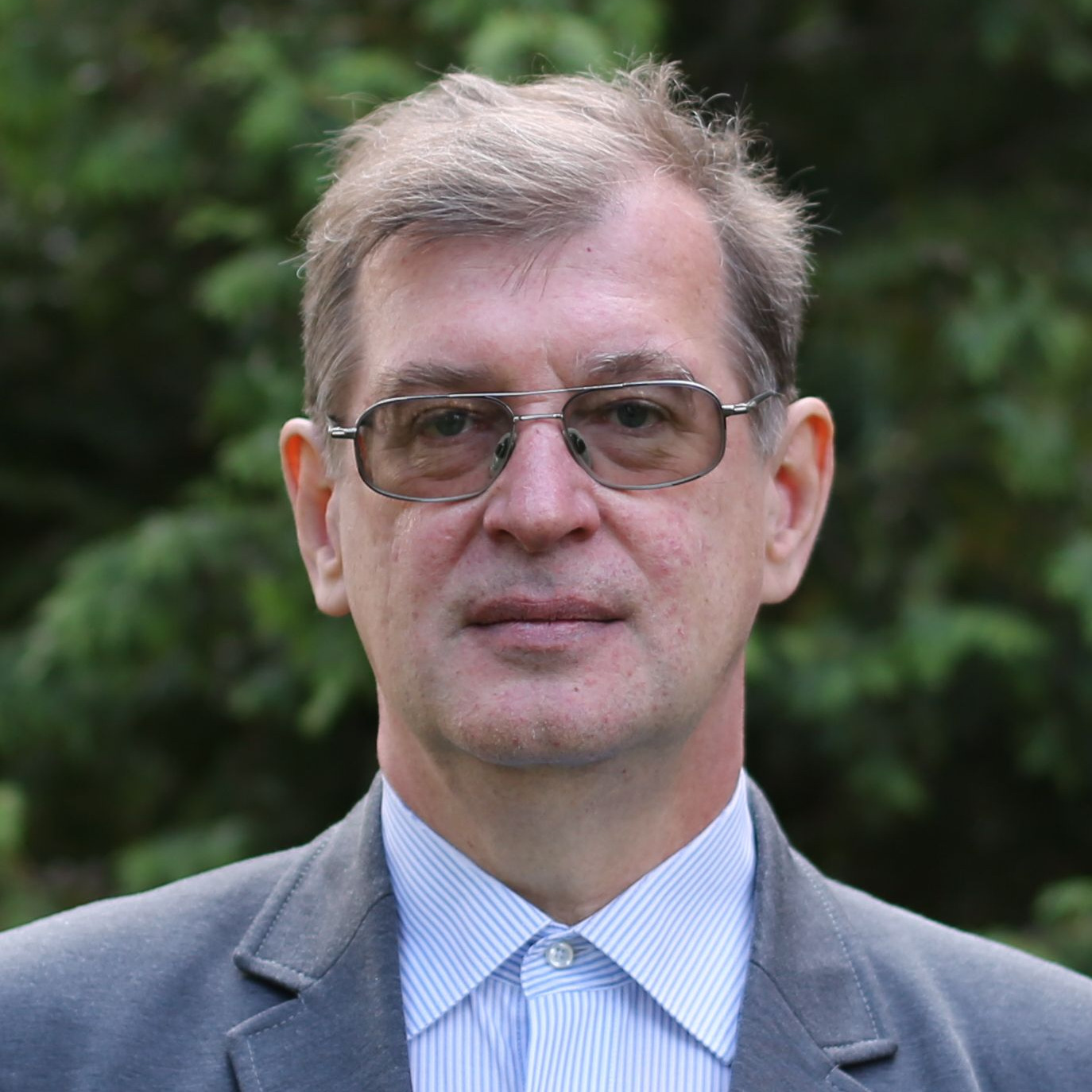
Cholachat Rujikiatkamjorn is a Professor at the Transport Research Centre, School of Civil and Environmental Engineering, University of Technology Sydney. He holds a BEng (First Class Honours) from Khon Kaen University, an MEng from the Asian Institute of Technology, and a PhD in Geotechnical Engineering from the University of Wollongong (UOW), where I received the Australian Geomechanics Society Thesis Award. His early career was recognised with several awards, including the IACMAG Outstanding Paper Award (2009), the Wollongong Trailblazer Award (2006), the DH Trollope Award (2012), and the ISSMGE Young Member Award (2013). He began his academic career as an ARC-DP Research Associate at UOW in 2006, working with Prof. Indraratna on granular mechanics. This collaboration led to joint PhD supervision and a strong publication record. He was appointed Lecturer in 2008, promoted to Senior Lecturer in 2010, and secured a prestigious ARC Centre of Excellence ECR award in 2011. In 2013, He became an Associate Professor and later served as Research Director for the School of Civil, Mining & Environmental Engineering, where he helped lead the successful ARC ITTC-Rail bid and continue to serve as its Technical Program Coordinator. In 2020, He joined UTS as Professor of Geotechnical Engineering and Program Leader for Transport Infrastructure Design at the UTS Transport Research Centre. He mentors early-career researchers and leads projects on innovative road and rail design, sustainable use of industrial by-products, and digital construction optimisation. His work has contributed to national standards, including the development of AS8700 on Vertical Drains in Soft Soils, influenced by his involvement in the Port of Brisbane reclamation project.
railways; instability; ground improvement; subgrade
Registration
The registration for IOCCI 2026 will be free of charge! The registration includes attendance to all conference sessions.
If you are registering several people under the same registration, please do not use the same email address for each person, but their individual university email addresses. Thank you for your understanding.
Instructions for Authors
The 1st International Online Conference on CivilEng will accept abstracts only. The accepted abstracts will be available online on Sciforum.net during and after the conference.
Important Deadline
1. Deadline for abstract submission: 13 July 2026
2. Abstract acceptance notification: 14 August 2026
Please note:
An abstract acceptance email only confirms that your abstract has been accepted. Oral or poster presentation invitations are determined separately by the conference chairs, and you will receive an additional email with the presentation result.
Abstract Submission
If you do not have an account, please register at www.sciforum.net. After logging in, submit your abstract using the “Submit Abstract” button on the conference homepage. No template is required.
Abstract Requirements
1. Types of Submissions
- Accepted: Original research abstracts; systematic reviews or meta-analyses abstracts (must comply with PRISMA 2020).
- Not accepted: Narrative, scoping, comparative, perspective, opinion, or essay-style reviews
2. Content Requirements
- Length: 200–300 words
- Structure: Introduction, Methods, Results, Conclusions
- Language: Clear, publication-ready English
- Originality: Must be original and unpublished; previously published abstracts will not be considered
3. Authorship
- The submitting author must ensure all co-authors approve the content.
- Authors may submit multiple abstracts, but only one abstract per author may be selected for an oral presentation.
Presentation Requirements
1. Each abstract must designate one presenter. To change the presenter, please contact us after you receive the oral/poster presentation invitation.
2. Only live presentations are accepted.
3. Presenters who do not attend the live session will not be eligible for awards or presentation certificates.
Oral Presentation and Slides Preparation
The slot for the oral presentation is 15 mins. We advise that your presentation lasts for a maximum of 12 mins, leaving at least 3 mins for the Q&A session.
Authors are encouraged to prepare presentations using PowerPoint or equivalent software for online display alongside their abstract. If provided, slides will be presented directly on the conference website via the Sciforum.net slide viewer and should be prepared in the same format as a traditional conference presentation of research results. All slides must be converted to PDF format prior to submission to ensure accurate online display.
Each presentation should:
- Communicate the research question or objective, methodology, key results, and scientific novelty;
- Use a clear and logical structure, typically Introduction-Methods-Results&Discussion structure (IMRaD) or a field-appropriate alternative;
- Emphasize the relevance of the work;
- Support key findings with clear figures or tables where appropriate;
- Conclude with a critical interpretation of the results and their impact.
Poster Presentation
Posters should be designed to allow independent understanding of the research and clearly present the essential elements of the study.
Each poster should include:
- Title, authors, affiliations, and contact details (clearly displayed at the top);
- Brief introduction outlining the research objective;
- Concise methodology summary;
- Main results, supported by clear, well-labeled figures or tables where appropriate;
- Short conclusion summarizing key findings and their relevance.
Technical specifications:
Dimensions (cm): 84.1 × 118.9 (A0 - portrait)
Resolution: 300 dpi
Pixel size (portrait, 300 dpi): 9933 × 14043 px
Minimum font size: ≥24
The poster template can be downloaded HERE. We will reach out to you closer to the dates of the conference with more information.
Note: The uploaded poster may be used as provided and serves as a reference. However, as long as the technical specifications are followed, scholars are welcome to use any poster template of their choice.
Potential Conflicts of Interest
It is the author's responsibility to identify and declare any personal circumstances or interests that may be perceived as inappropriately influencing the representation or interpretation of clinical research. If there is no conflict, please state "The authors declare no conflicts of interest." This should be conveyed in a separate "Conflict of Interest" statement preceding the "Acknowledgments" and "References" sections at the end of the manuscript. Any financial support for the study must be fully disclosed in the "Acknowledgments" section.
Copyright
MDPI, the publisher of the Sciforum.net platform, is an open access publisher. We believe authors should retain the copyright to their scholarly works. Hence, by submitting an abstract to this conference, you retain the copyright to the work, but you grant MDPI the non-exclusive right to publish this abstract online on the Sciforum.net platform. This means you can easily submit your full paper (with the abstract) to any scientific journal at a later stage and transfer the copyright to its publisher if required.
Publication Opportunities
1. CivilEng Publication
Participants in this conference are cordially invited to contribute a full manuscript to the conference's Topic (to be updated), published in CivilEng (ISSN 2673-4109, Impact Factor: 2.0), with a 20% discount on the publication fee. Please note, if you have IOAP/association discounts, conference discounts will be combined with IOAP/association discounts. Conference discounts cannot be combined with reviewer vouchers. All submitted papers will undergo MDPI’s standard peer-review procedure. The abstracts should be cited and noted on the first page of the paper.
2. Engineering Proceedings Paper Publication
You are welcome to submit a proceeding paper (4-8 pages) to Engineering Proceedings journal (ISSN 2673-4591) after the conference. Publication of the proceedings will be free of charge.
Authors are asked to disclose that it is a proceeding paper of the IOCCI 2026 conference paper in their cover letter. Carefully read the rules outlined in the 'Instructions for Authors' on the journal’s website and ensure that your submission adheres to these guidelines.
Manuscripts for the proceedings issue must be formatted as follows:
-
Title;
-
Full author names;
-
Affiliations (including full postal address) and authors' e-mail addresses;
-
Abstract;
-
Keywords;
-
Introduction;
-
Methods;
-
Results and Discussion;
-
Conclusions;
-
Acknowledgements;
-
References.
Please click HERE to submit your proceeding paper to the Engineering Proceedings.
IOCCI2026_proceeding_paper-template.dot
Event Awards

To acknowledge the support of the conference's esteemed authors and recognize their outstanding scientific accomplishments, we are pleased to announce that the conference will provide Best Oral Presentation Awards and Best Poster Presentation Awards.
The Awards
Number of Awards Available: 6
Best Oral Presentation Award
- Eligibility: Open to all authors selected as oral speakers who have delivered their presentation. Failure to present, delegation of the presentation to another person, or use of AI-generated voice or similar substitutes will result in disqualification.
- Criteria: Evaluation considers scientific rigor (clear, literature-supported research question or hypothesis, appropriate methodology, robust analysis and critical discussion of the results), IMRaD/field-appropriate structure, clarity of presented data (clear, well-labeled figures and tables), presentation skills and audience engagement, demonstrated scientific novelty and impact.
- Prize: An award of CHF 200 and a certificate in recognition of your outstanding contribution.
Best Poster Award
- Eligibility: Open to all authors who have presented their work through posters. Failure to present, delegation of the presentation to another person, or use of AI-generated voice or similar substitutes will result in disqualification.
- Criteria: Evaluation considers scientific rigor (clear, literature-supported research question or hypothesis, appropriate methodology, robust analysis, and critical discussion of the results), IMRaD/field-appropriate structure enabling independent understanding, clarity of presented data (clear, well-labeled figures and tables), presentation skills (if orally presented), demonstrated scientific novelty and impact.
- Prize: An award of CHF 200 and a certificate in recognition of your outstanding contribution.
Sponsors and Partners
For information regarding sponsorship and exhibition opportunities, please click here.
Organizers
Media Partners
Conference Secretariat
Ms. Florina Maria Muresan
Mr. Ionut Spatar
Mr. Russell Wang
For inquiries regarding submissions and sponsorship opportunities, please feel free to contact us.
Email: iocci2026@mdpi.com
S2. Urban, Economy, Management and Transportation Engineering
Urban, Economy, Management and Transportation Engineering (UEMTE) involves the studies of urban and economy multidisciplinary fields of management and transport engineering. Urban economy seeks to improve theories through an integrated treatment of facets of the urban economy, such as land use, development policies, transportation, housing, local public finance and environmental impact and operations of utilities, infrastructure, construction and waste. Management involves a range of disciplines in the natural and social sciences and includes construction management and engineering, strategic management, industrial management, information management and other areas. Transportation engineering deals with the development of planning, design, operation and maintenance and administration of transportation facilities for the harmless, well-organized, fast, comfortable, economical and environmentally friendly movement of people and goods. Submissions that address interdisciplinary topics in the Section of UEMTE and include applications of artificial intelligence for data mining, machine learning, deep learning and optimization are most welcome.
Session Chair
Dr. Sakdirat Kaewunruen, Birmingham Centre for Railway Research and Education, University of Birmingham, Edgbaston, Birmingham, UK, https://www.birmingham.ac.uk/staff/profiles/civil/kaewunruen-sakdirat
S3. Structural and Earthquake Engineering
The session will focus on a wide range of topics in structural engineering and seismic engineering, with particular reference to (but not restricted to): analysis and control of vibrations in structures; seismic protection strategies for buildings, bridges, and monuments using innovative devices; innovative materials for civil engineering: modelling and experimental tests; soil-structure interaction; tall buildings and long bridges modelling; fluid-structure interaction; structural identification and monitoring techniques; analytical and computational methods for structural analysis.
Session Chair
Prof. Dr. Daniele Zulli, Department of Civil, Construction-Architectural and Environmental Engineering, University of L’Aquila, L’Aquila, Italy, http://ing.univaq.it/zulli/?page=eng&subpage=home
S4. Water Resources and Coastal Engineering
- Climate Resilience: Developing adaptive strategies for water systems and coastal infrastructure under extreme weather and rising sea levels.
- Integrated Water Management: Linking surface water, groundwater, and coastal processes for holistic resource planning.
- Numerical Modelling and AI: Using advanced simulation and machine learning/deep learning for flood forecasting, wave prediction, and optimisation of hydraulic structures.
- Sustainable Solutions: Promoting green infrastructure and ecosystem-based approaches to reduce environmental impact.
Session Chair
Assoc. Prof. Jaan H. Pu, Faculty of Engineering and Informatics, University of Bradford, Bradford, UK, https://www.bradford.ac.uk/staff/jhpu1/
S5. Construction and Material Engineering
This session focuses on advances in construction engineering and the development, characterization, and application of construction materials. It welcomes contributions addressing innovative construction techniques, sustainable and resilient materials, performance assessment, durability, quality control, and lifecycle considerations of civil engineering materials. Topics of interest include, but are not limited to, concrete and cement-based materials, asphalt, composites, geotechnical and structural materials, construction processes, digitalization in construction, and the use of recycled or low-carbon materials. The session aims to bridge research and practice by highlighting solutions that enhance efficiency, safety, sustainability, and performance in the built environment.
Session Chair
Dr. Aires Camões, Centre of Territory, Environment and Construction, University of Minho, Guimaraes, Portugal, https://ctac.uminho.pt/members/aires-camoes/