Sessions & Session Chairs
Sessions
S1. Mathematical Physics
S2. High Energy Physics, Particles and Fields
S3. Applied Physics
S4. Astronomy, Astrophysics and Cosmology
S5. Algebra and Geometry
S6. Mathematical Analysis and Statistics
S7. Applied Mathematics
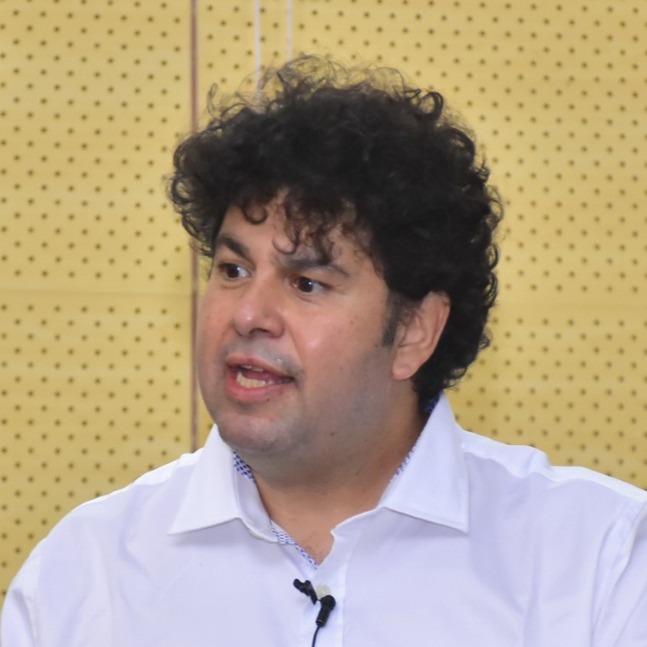
Instituto de Alta Investigación, Universidad de Tarapacá, Arica, Chile
David Laroze is a Full Professor at the Institute for Advanced Studies at the University of Tarapacá (Chile), where he holds the Chair of Mathematical Modeling and previously served as Director. He has held visiting and research positions at the University of Navarra (Spain), the University of Glasgow (UK), the Max Planck Institute for Polymer Research (Germany), and the University of Chile. He was also an Assistant Professor at the Pontifical Catholic University of Valparaiso. He earned his Ph.D. in Physics from the Federico Santa Maria Technical University.
Since joining the CMS collaboration in 2022, Laroze was among the recipients of the 2025 Breakthrough Prize in Fundamental Physics. He has authored over 420 Web of Science-indexed papers in leading journals such as Nature, Physical Review Letters, Macromolecules, and the Journal of High Energy Physics. In 2024, he was named among the World’s Top 2% Scientists by Stanford University and Elsevier.
He has supervised numerous undergraduate and Ph.D. students and mentored postdoctoral researchers, while also serving on scientific and organizing committees and as a reviewer for international journals. His current research interests encompass nonlinear phenomena, magnetism, hydrodynamic instabilities, radiation physics, thermal and electronic transport in quantum systems, and high energy physics.

Faculty of Symbiotic Systems Science, Fukushima University, Fukushima, Japan
Kazuharu Bamba is a full Professor at Fukushima University in Japan. He works on inflationary cosmology, the issue of dark energy, alternative theories of gravity alongside general relativity, and the physics of black holes. He has been an Editor of various international peer-review journals such as Symmetry, Universe and Entropy (MDPI).
Experimental Particle Physics Group, Drew University, Madison, NJ, USA

School of Engineering and Sciences, Tecnologico de Monterrey, Zapopan, Mexico

Department of Physics, Georgetown University, Washington, USA
James Freericks is passionate about research and education in quantum mechanics. He works in areas that include nonequilibrium many-body physics, quantum computing, quantum chemistry, and pedagogy development in quantum mechanics. He is currently the McDevitt Chair at Georgetown University, where he has been since 1994. He was educated at Princeton University (1985), the University of California, Berkeley (1991), and did postdocs at the Santa Barbara and Davis campuses of the University of California. He is a Fellow of the American Physical Society, the American Association for the Advancement of Science, and is currently the Treasurer of the American Association of Physics Teachers. He is also on the editorial board of Symmetry.

Laboratory of Theoretical and Computational Physics, Cruzeiro do Sul University and Cidade de São Paulo University, São Paulo, Brazil
Jo˜ao Pacheco Bicudo Cabral de Melo is a distinguished researcher in Hadronic and Nuclear Physics, specializing in Light-Front Dynamics and Few-Body Physics. Since 2005, he has directed the Laboratory of Theoretical and Computational Physics (LFTC) at Universidade Cruzeiro do Sul (UNICSUL/UNICID). Dr. de Melo earned his undergraduate, Master’s, and Doctorate degrees from the Instituto de F´ısica da Universidade de S˜ao Paulo (IFUSP). His career includes a doctoral visiting period at the Universit¨at Hannover (Germany) and postdoctoral tenures at Universit´e Pierre et Marie Curie (France), IFT-UNESP, and the Chinese Academy of Sciences (2025–2026). His research, centered on Quantum Chromodynamics (QCD) and hadronic structure, has resulted in over 100 high-impact publications. He actively contributes to international projects like the Electron-Ion Collider (EIC) and serves as an editor and referee for prestigious journals. Additionally, he played a vital role in developing the Graduate Program in Computational Physics and Astrophysics at UNICSUL/UNICID and has mentored numerous Master’s, doctoral, and postdoctoral students throughout his career.

Konkoly Observatory, HUN-REN Research Centre for Astronomy and Earth Sciences, Konkoly Thege Miklós út 15-17, 1121 Budapest, Hungary, CSFK, MTA Centre of Excellence, Konkoly Thege Miklós út 15-17, 1121 Budapest, Hungary, Institute of Physics and Astronomy, ELTE Eötvös Loránd University, Pázmány Péter sétány 1/A, 1117 Budapest, Hungary
Dr. Sándor Frey is a senior research fellow and scientific secretary at Konkoly Observatory, HUN-REN Research Centre for Astronomy and Earth Sciences in Budapest, Hungary. He obtained his PhD degree in 2001 and authored more than 300 scientific publications so far. His main field of research is radio astronomy, more specifically, the applications of very long baseline interferometry (VLBI), a technique that provides the highest angular resolution in astronomy by means of coordinated observations by global networks of radio telescope distributed all over the Earth and even beyond. His primary scientific interests include the highest-redshift quasars, dual and binary active galactic nuclei, but he also works on VLBI astrometry to help refining the celestial reference frame and navigating interplanetary spacecraft.
Dipartimento di Fisica Ettore Pancini, Università di Napoli “Federico II” and INFN, Sezione di Napoli, Complesso Univ. Monte S. Angelo, I-80126 Napoli, Italy

Spanish National Research Council (CSIC), Institute of Mathematical Sciences, Madrid, Spain
Manuel de León is a Research Professor at CSIC, his work has been mainly devoted to the study of Differential Geometry and its applications to Mechanics and Mathematical Physics (about 350 papers and 5 monographs). He has been the director of 13 PhD students, and is currently a member of several Editorial Boards and Scientific Committees and Director and Founder of Geometric Mechanics (World Scientific). He has been Founder and Director of the Institute of Mathematical Sciences (ICMAT). He is also a member of the Real Academia de Ciencias de España (of which he is Academic Treasurer and Director of ESTALMAT), of the Real Academia Canaria de Ciencias and of the Real Academia Galega de Ciencias . Coordinator of the Spanish Committee of the World Mathematical Year 2000, President of the Spanish Committee of Mathematics (CEMAT), 2004-2007, President of the International Congress of Mathematicians ICM2006-Madrid, member of the Executive Committee of the International Mathematical Union, IMU (2007-2014) and of the Executive Board of the International Council for Science, ICSU, now International Science Council, ISC (2014-2018). He is Coordinator of the Spanish Committee for the ISC and President of the International Relations Commission of the Royal Academy of Sciences.
School of Science and the Environment, Memorial University of Newfoundland, Grenfell Campus, Corner Brook, NL, Canada

University of Technology of Compiègne, LMAC (Laboratory of Applied Mathematics of Compiègne), Compiègne, France

School of Mathematics, China University of Mining and Technology, Xuzhou, China
Zhang Yufeng, male, PhD, Professor and Doctoral Supervisor at the School of Mathematics, China University of Mining and Technology. He completed postdoctoral research at the Chinese Academy of Sciences and Zhengzhou University. Research Interests 1. Mathematical Physics: symbolic computation in mathematics, integrable systems, Lie group analysis theory 2. Mathematics Education: mathematical methodology He has co-authored more than 100 research papers published in academic journals including Nonlinearity, Letters in Mathematical Physics, Physica D, Journal of Differential Equations, Journal of Mathematical Physics, Physics Letters B, and Acta Mathematica Sinica-English Series. He has co-authored three monographs: 1. Algebraic Methods for Extended Integrable Equation Hierarchies, Science Press, 2014 2. Soliton Theory and Integrable Systems, University of Science and Technology of China Press, 2006 3. Discussions on Mathematics Education and Teaching, China University of Mining and Technology Press, 2017

School of Mathematical Sciences and Statistics, Hunan Normal University, Changsha, China
Quanxin Zhu, Ph.D., is a Second-Level Professor, Xiaoxiang Distinguished Professor, and a doctoral supervisor at Hunan Normal University. He holds the Special Government Allowance of the State Council, major provincial academic honours, and a Humboldt Fellowship. He is vice director of the Ministry of Education (MOE) Key Laboratory of Computing and Stochastic Mathematics and director of a key laboratory at a Hunan provincial university. He is a senior member of the IEEE and the Chinese Automation Society. His research covers Markov processes and stochastic nonlinear system control. He has published over 200 SCI papers in leading control journals, including Automatica and IEEE Transactions on Automatic Control (TAC). He has won multiple first-class provincial natural science awards and has been repeatedly named a Highly Cited Researcher and a top global scientist. He has overseen six NSFC projects and ten provincial research programmes. He is an Executive Director of the Chinese Society for Engineering Probability and Statistics, and holds key positions in multiple national academic societies. He is the Editor-in-Chief of Complex Systems, Stability and Control, and sits on the editorial board of six SCI journals.
Department of Ecological and Biological Sciences, University of Tuscia, Viterbo, Italy
Dimitri Mugnai is Full Professor of Mathematical Analysis at the University of Tuscia (Viterbo, Italy) since 2017. Previously, he was Researcher and Associate Professor at the University of Perugia. He earned his M.Sc. in Mathematics from the University of Florence in 1996 under the supervision of Giorgio Talenti and his Ph.D. in Mathematics from the University of Pisa in 2001 under the supervision of Antonio Marino. His research focuses on nonlinear partial differential equations, variational methods, functional analysis, nonlocal operators, Schrödinger-type systems, and control and stability for evolution equations. Dimitri Mugnai has authored about one hundred peer-reviewed scientific publications in leading international journals. He is actively involved in graduate education, supervision of doctoral students, and organization of international scientific conferences. He appears in the list of ”100,000 top scientists” PLoS Biol (2019) and in the Stanford University’s list of ”World’s Top 2%” scientists in 2020 and 2021, as well as in the World’s Top 5% Scientists in 2025.