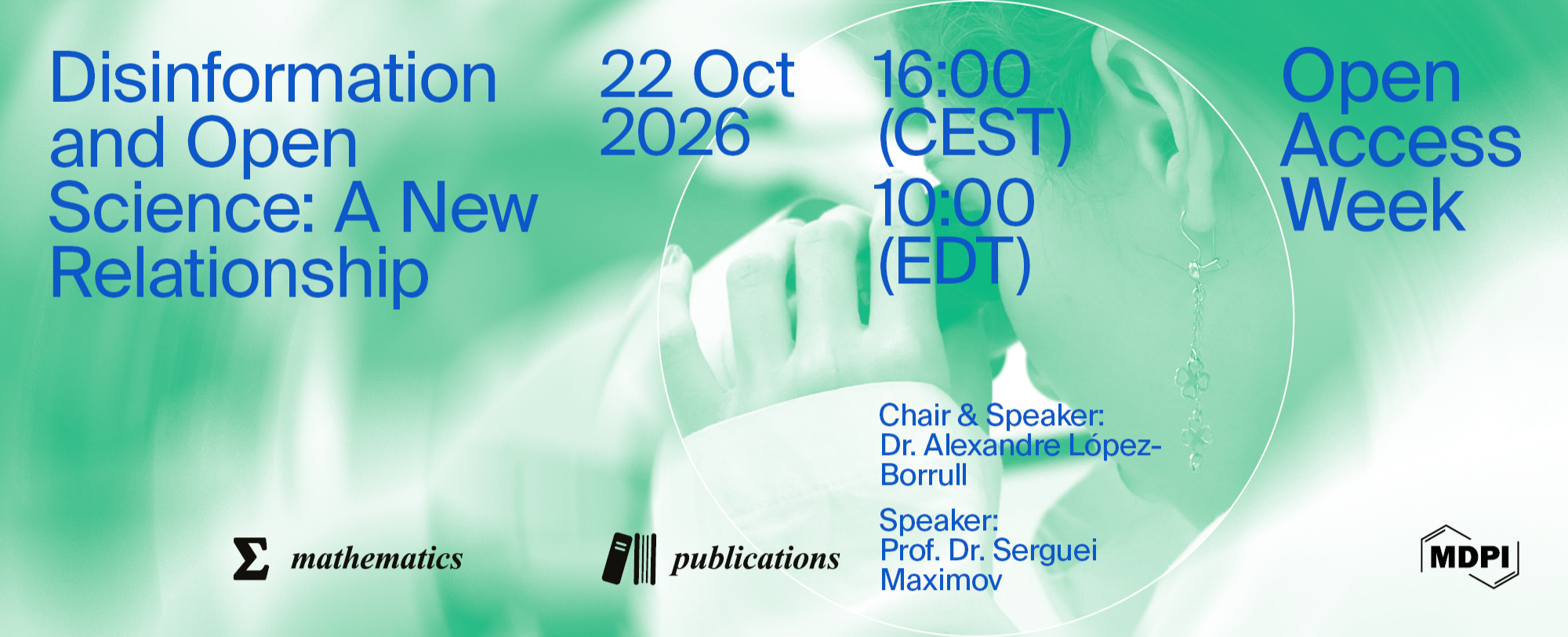
MDPI 2026 Open Access Week Webinar: Disinformation and Open Science: A New Relationship
the chair
In a rapidly changing information ecosystem, the intersection of Open Science and disinformation has become increasingly complex, particularly within environments deeply transformed by generative AI. As generative tools make the creation and spread of synthetic content and scientific disinformation easier and faster than ever, fundamental questions arise: Are we better or worse off than we were a few years ago? While AI poses significant risks to research integrity and public trust, Open Science principles, such as transparency, open data, and open peer review offer critical mechanisms to verify and protect scientific knowledge.
This webinar addresses this key intersection, examining whether Open Science serves as a sufficient shield against AI-mediated disinformation or if new vulnerabilities are emerging. Together with our expert speakers, we will critically analyse current trends, debate the opportunities and threats brought by artificial intelligence, and explore how open practices can evolve to maintain trust and rigour in modern scientific publishing. Join us to explore where we stand today and how we can navigate this new landscape together.
Date: 22 October 2026
Time: 16:00 (CEST) | 10:00 (EDT)
Webinar ID: 825 7251 3843
Webinar Secretariat: journal.webinar@mdpi.com
Meet Our Chair

University of Catalonia, Spain;Alexandre López Borrull is an associate professor in the Faculty of Information and Communication Sciences at the Universitat Oberta de Catalunya (UOC). He has a PhD in Chemistry from the Universitat Autònoma de Barcelona (UAB) and a bachelor's degree in Information Science from the UOC. He is also the director of the UOC's Bachelor's Degree in Information Science. His research interests focus on disinformation, open science and scientific journals. He is a member of the Learning, Media and Entertainment (GAME) research group at the UOC.
Meet Our Speakers

University of Catalonia, Spain;Alexandre López Borrull is an associate professor in the Faculty of Information and Communication Sciences at the Universitat Oberta de Catalunya (UOC). He has a PhD in Chemistry from the Universitat Autònoma de Barcelona (UAB) and a bachelor's degree in Information Science from the UOC. He is also the director of the UOC's Bachelor's Degree in Information Science. His research interests focus on disinformation, open science and scientific journals. He is a member of the Learning, Media and Entertainment (GAME) research group at the UOC.
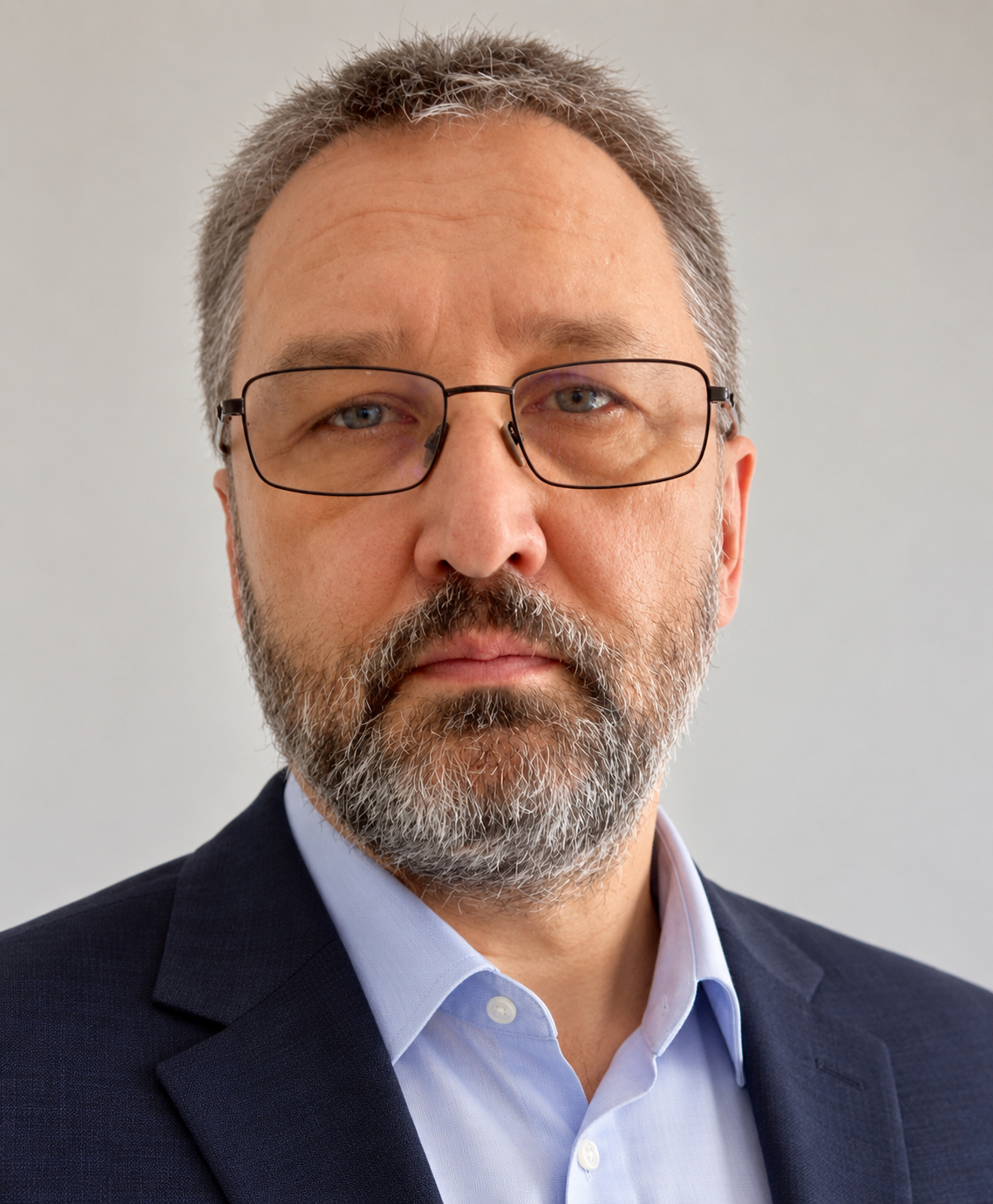
Tecnológico Nacional de México, Mexico;Serguei Maximov is a Professor and Researcher at the Graduate and Research Program in Electrical Engineering of the Instituto Tecnológico de Morelia, Tecnológico Nacional de México. He graduated from the Faculty of Physics of Lomonosov Moscow State University and holds a PhD in Theoretical and Mathematical Physics. His research interests include reliability theory, stochastic modelling, Bayesian inference, renewal processes, maintenance optimization, and mathematical modelling of nonlinear electromagnetic systems. He has authored and co-authored research articles in applied mathematics, reliability, and electrical engineering. He also serves as a Guest Editor for theMathematics Special Issue “Mathematical Foundations of Reliability Theory with Applications in Engineering and Applied Statistics.”