
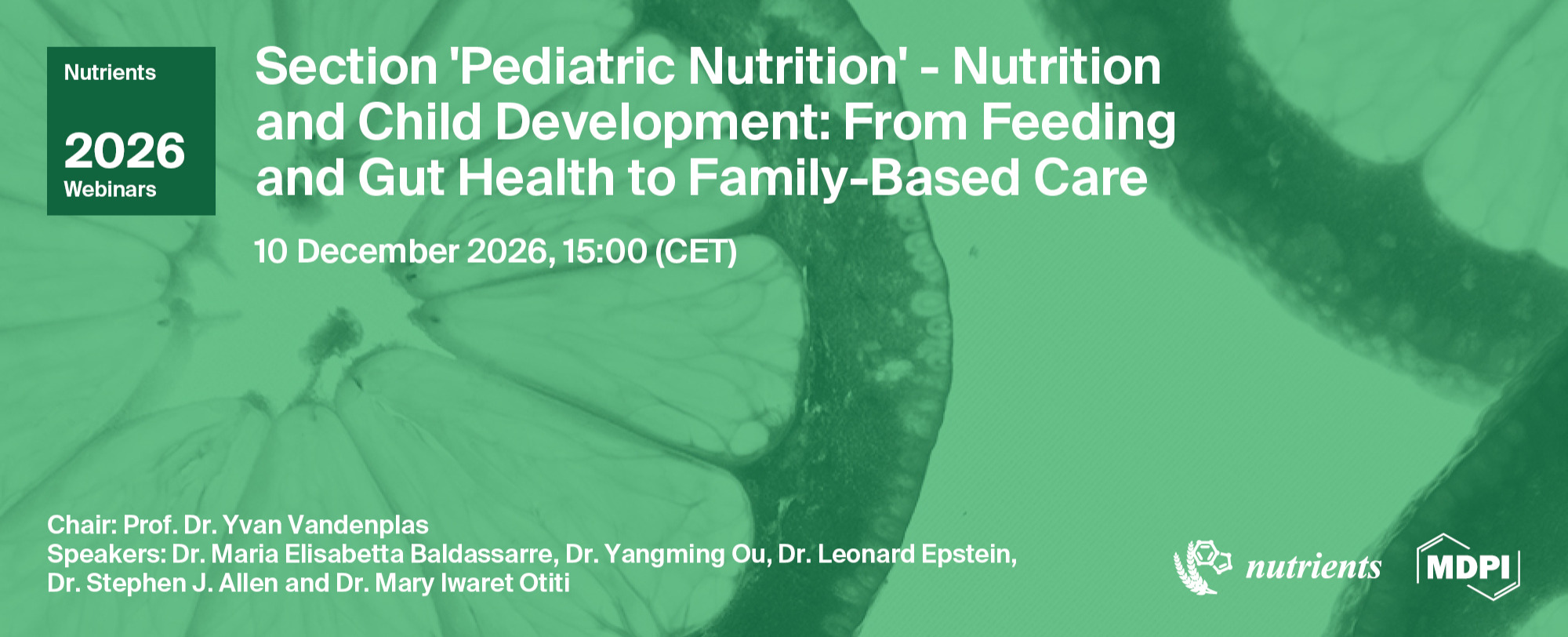
Nutrients Webinar | Section 'Pediatric Nutrition' - Nutrition and Child Development: From Feeding and Gut Health to Family-Based Care
the chair
32nd Nutrients Webinar
Section 'Pediatric Nutrition' - Nutrition and Child Development: From Feeding and Gut Health to Family-Based Care
The Pediatric Nutrition Section of Nutrients is pleased to announce an upcoming webinar dedicated to advancing research and clinical practice in pediatric nutrition. This webinar will bring together researchers, clinicians, and healthcare professionals to explore current evidence and emerging issues shaping nutritional care for children, from early life through to adolescence.
The Pediatric Nutrition Section focuses on all nutritional aspects concerning children, ranging from birth up to 18 years of age, paying particular attention to the first 1000 days and the long-term impact of early nutrition on later health. Topics of interest include infant and preterm nutrition, breastfeeding, infant formula, pediatric obesity, malnutrition, food allergy, microbiome development, and enteral and parenteral feeding in children.
This webinar will provide a platform for interdisciplinary exchange, featuring expert presentations and interactive discussion on the latest findings and practical strategies in pediatric nutrition. Researchers, clinicians, and students with an interest in child health and nutrition are invited to attend.
Date: 10 December 2026
Time: 15:00 (CET)
Webinar ID: 839 7778 8804
Webinar Secretariat: journal.webinar@mdpi.com
Meet Our Chair

KidZ Health Castle, UZ Brussel, Vrije Universiteit Brussel;Yvan Vandenplas studied medicine and trained in pediatrics (1981-1986) at the Vrije Universiteit Brussel. He became Head of the Unit for Pediatric Gastroenterology and Nutrition in 1987, and he was Head of the KidZ Health Castle at the University Hospital Brussels (UZ Brussel) and the Chair of Pediatrics from 1994 until 2021. Vandenplas’ main interests are gastro-esophageal reflux, infant nutrition, probiotics and prebiotics, cow’s milk protein allergy and disorder of gut-brain interaction. He has published many original research and review papers on these topics. He chaired the ESPGHAN Special Interest Group on "Gut Microbiota & Modifications" until 2026.
Meet Our Speakers

Department of Interdisciplinary Medicine, Neonatology and NICU Section, University of Bari Aldo Moro, Italy;Maria Elisabetta Baldassarre is an Associate Professor of Pediatrics at the Department of Interdisciplinary Medicine – Section of Neonatology and NICU, "Aldo Moro" University of Bari, a position she has held since February 2020. She teaches pediatrics across the institution’s medical, nursing, midwifery, and nutrition degree programs and heads the Master's Degree in Nursing and Midwifery Sciences program. Her clinical work centers on preterm infant follow-up, infants with gastrointestinal surgical problems, and nutritional management including home artificial nutrition; she is an expert in esophageal pH-impedance monitoring, skin electrogastrography, and the lactose breath test, and she leads the preterm infant outpatient clinic. Previously a researcher at the University of Bari's Neonatology Section (2001–2020) and head of the Pediatric Gastroenterology Outpatient and Day-Hospital (1990–2001), she has served on the SIGENP Board and as editorial director of its official journal. She is a member of the Italian Society of Pediatrics, the Italian Society of Neonatology, and ESPGHAN, and she has lectured at Harvard University and at international conferences. Her research is documented by numerous publications.

Department of Radiology, Harvard Medical School, USA;Division of Newborn Medicine, Boston Children’s Hospital, USA;Yangming Ou, PhD is an Associate Professor of Radiology and Informatics at Boston Children's Hospital and Harvard Medical School. His research group develops and uses big data AI tools to analyze medical images and clinical data to understand brain development across the human lifespan, both in health individuals and patients with disease.

Department of Pediatrics, Jacobs School of Medicine & Biomedical Sciences, University at Buffalo, USA;Leonard H. Epstein is a SUNY Distinguished Professor of Pediatrics in the Jacobs School of Medicine and Biomedical Sciences at the University at Buffalo. He is an internationally recognized authority on childhood and family obesity. He pioneered family-based behavioral treatment, an evidence-based, family-focused approach targeted to children who are obese or overweight and their parents. His Traffic Light Diet and Activity Plan helps families instill healthy eating and activity habits in overweight children, and it remains one of the few plans shown to produce long-term success for obese children. He was the first researcher to demonstrate a relationship between television watching and childhood obesity. In his National Institutes of Health-funded clinical trials, which have some of the longest follow up periods in the field, up to 70% of children treated achieved clinically meaningful change in their weight. Epstein has also published groundbreaking studies on how behavioral techniques, such as episodic future-thinking, might help people with prediabetes overcome their focus on short-term rewards in order to develop healthier behaviors. Epstein developed reinforcer pathology theory along with Warren Bickel, which helps understand why people focus on immediate gratification rather than long-term goals, and is developing treatments to overcome reinforcer pathology. Epstein also was the first to study lifestyle exercise, which builds activity into someone’s lifestyle to increase their level of physical activity. He is a fellow of the National Association for the Advancement of Science, received the Bar-Or Award for Excellence in Pediatric Obesity Research, The Obesity Society, the Hoebel Award for Creativity: Society for Study of Ingestive Behavior, and he has published over 600 papers in scientific journals and three books.

Department of Clinical Sciences, Liverpool School of Tropical Medicine, UK;Allen’s main interests are pediatric gastroenterology and nutrition. Recently, he evaluated pro- and synbiotics in improving gut health, reducing systemic inflammation and promoting growth and development in infants in western Kenya (https://doi.org/10.1016/j.xcrm.2026.102834) and Senegal (https://doi.org/10.1136/bmjpo-2022-001629). As gut health lead for the LSHTM Action Against Stunting Hub, we are assessing how poor gut health contributes to poor growth and development in birth cohorts in Senegal, India and Indonesia (DOI: 10.1136/bmjpo-2022-001637). In acute childhood diarrhea, Allen’s group assessed an intestinal absorbent in children in the Gambia (DOI: 10.1136/bmjpo-2024-003133); on-going research is assessing the effect of the absorbent on childhood diarrhea in Jakarta, Indonesia, and on functional abdominal pain in a multi-center study in the UK (https://link.springer.com/article/10.1186/s13063-026-09913-y). In 2021-2023, he was based at the Edward Francis Small Teaching Hospital, Banjul, The Gambia, supporting post-graduate training in pediatrics and building capacity for clinical research as chair of the hospital’s Research Ethics Committee. He was the Secretary of the Commonwealth Association of Paediatric Gastroenterology and Nutrition (https://www.capghan.net/) from 2019-2025 and remains on the Advisory Committee.

KEMRI Centre for Global Health Research, Kenya;Liverpool School of Tropical Medicine, UK;Otiti’s main interests are infant gut health and its influence on early immune and cognitive development in low-resource settings. Otiti managed the PROSYNK trial, in which pro/synbiotics given in early infancy reduced chronic systemic inflammation at six months, alongside improved gut health biomarkers and growth hormone concentrations (https://doi.org/10.1016/j.xcrm.2026.102834). The trial also described the onset and progression of environmental enteric dysfunction, systemic inflammation and growth hormone resistance through infancy (https://doi.org/10.1016/j.ajcnut.2025.10.012). Otiti’s doctoral research brings these issues together, asking how gut health, inflammation and brain development interact: whether the different pro/synbiotic consortia act through distinct immunological pathways and temporal windows; how gut health and systemic inflammation biomarkers relate to cognitive development at 24 months; and whether pro/synbiotics affect cognitive scores in these children in western Kenya. Alongside the trial, Otiti’s group assessed whether pro/synbiotics are acceptable to carers and health workers (https://doi.org/10.3390/nu17030495) and affordable in rural Kenya (https://doi.org/10.1136/bmjpo-2025-003635). Otiti has been based at the KEMRI Centre for Global Health Research in Kisumu since 2020, managing clinical trials in the Western Kenya region.
This is a FREE webinar. After registering, you will receive a confirmation email containing information on how to join the webinar. Registrations with academic institutional email addresses will be prioritized.
Certificates of attendance will be delivered to those who attend the live webinar.
Can’t attend? Register anyway and we’ll let you know when the recording is available to watch.
Register for free here!
| Speaker/Presentation | Time (CET) |
| Prof. Dr. Yvan Vandenplas Webinar Opening |
15:00–15:10 |
|
Dr. Maria Elisabetta Baldassarre Q&A |
15:10–15:40 |
|
Dr. Yangming Ou Q&A |
15:40–16:10 |
|
Dr. Leonard Epstein Q&A |
16:10–16:40 |
|
Dr. Stephen Allen and Dr. Mary Iwaret Otiti Q&A |
16:40–17:10 |
| Prof. Dr. Yvan Vandenplas Closing of Webinar |
17:10 –17:15 |