
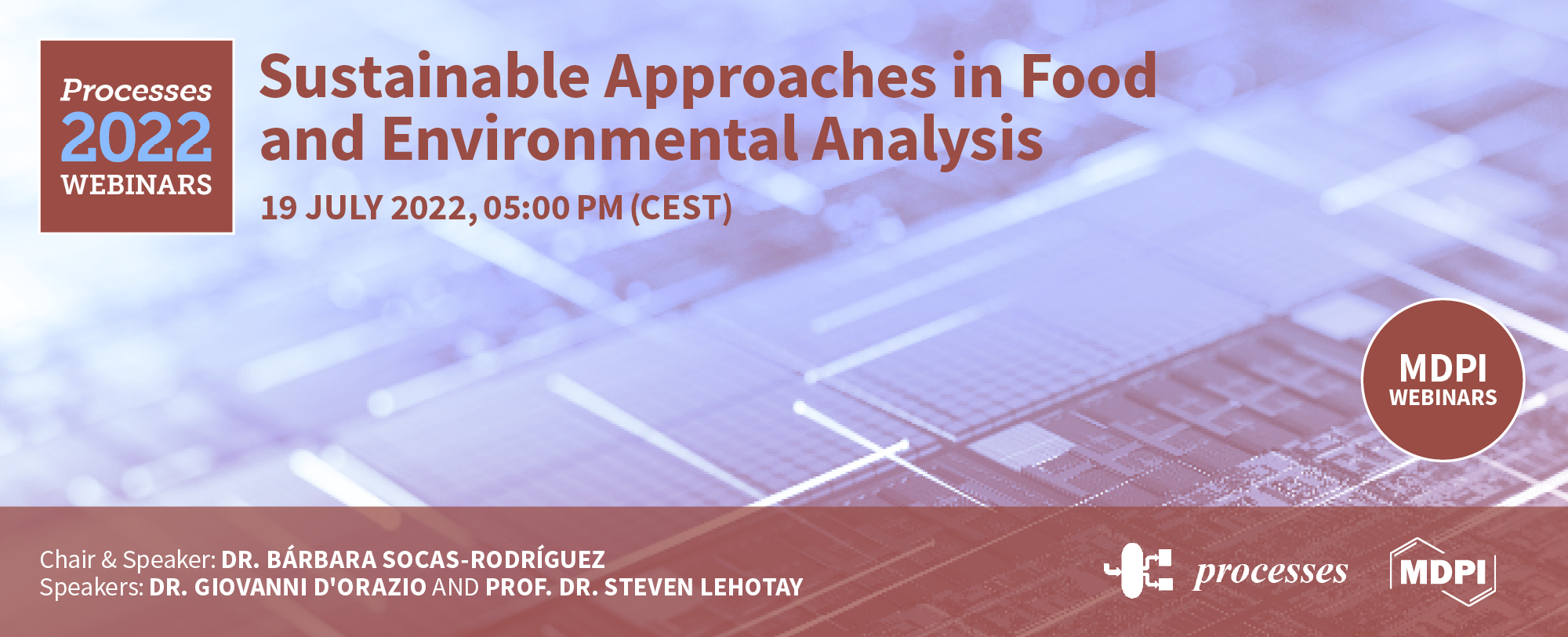
Processes Webinar | Sustainable Approaches in Food and Environmental Analysis
the chair
2nd Processes Webinar
Sustainable Approaches in Food and Environmental Analysis
The adaptation of the twelve principles of Green Chemistry to Analytical Chemistry is fundamental to achieve the development of sustainable procedures that contribute to assure the achievement of reliable results, particularly in critical areas such as food and environmental fields. The fully application of such principles could come up with an ideal method allows a remote, in situ, automated, and on-line analysis without consuming reagents or generating zero residues. Obviously, such approach is still far from the reality. However, it is crucial to continue searching new alternatives and approaches that allow for being closer to this objective. In this sense, it is of great importance to know the last advances and trends in this area to guarantee the searching of suitable green analytical methodologies that also provide reliable results in those areas.
Date: 19 July 2022
Time: 5:00 pm CEST | 11:00 am EDT | 11:00 pm CST Asia
Webinar ID: 813 5348 7869
Webinar Secretariat: processes.webinar@mdpi.com
Meet Our Speaker

University of La Laguna (ULL) Spain;Bárbara Socas Rodríguez has participated in several international, national, and regional research projects related to the application of sustainable procedures for the analysis of organic compounds. She carried out her PhD at the University of La Laguna focused on the development of new methodologies for the evaluation of estrogenic compounds in food and environmental samples. After that, she worked as a postdoctoral researcher at the Green Technology Group (GTG) in the Department of Chemistry at the University of Lund (Sweden) where she carried out the development of new methodologies for the determination of vitamin D and its metabolites in biological samples using supercritical fluids and mass spectrometry. Then she joined the Laboratory of Foodomics (CIAL, CSIC) centering her research on the safety evaluation of valorized food by-products. Currently she is working as Assistant Professor at the ULL and participates in different projects carrying out the evaluation of pesticides and plastic migrants in food and environmental matrices using green analytical techniques.

On Tuesday, 19 July 2022, MDPI and the Processes Journal organized the 2nd webinar on Processes, entitled "Sustainable Approaches in Food and Environmental Analysis".
The introduction was held by the Chair of the webinar, Dr. Bárbara Socas-Rodríguez. Currently, she is working as Assistant Professor at the ULL and participates in different projects carrying out the evaluation of pesticides and plastic migrants in food and environmental matrices using green analytical techniques.
The first speaker was Dr. Giovanni D'Orazio with his presentation "Miniaturization, a Green approach to Analytical Chemistry". He is permanent full-time contract as researcher at Istituto per i Sistemi Biologici (ISB) of CNR. (Consiglio Nazionale delle Ricerche), Rome.
He was followed by Dr. Bárbara Socas Rodríguez, who presented "Novel materials for the development of sustainable analytical methodologies".
The last presentation was held by Prof. Dr. Steven Lehotay with his presentation "Newest Developments in the QuEChERSER Mega-Method for Analysis of Contaminants in Food". He develops analytical methods for monitoring chemical contaminants in food for the USDA Agricultural Research Service (USDA ARS).
The presentations were followed by a Q&A and a discussion, moderated by the Chair Dr. Bárbara Socas-Rodríguez. The webinar was offered via Zoom and required registration to attend. The full recording can be found here on Sciforum website. In order to stay updated on the next webinars on Processes be sure to sign up for our newsletter by clicking on “Subscribe” at the top of the page.
Guest Editor: Dr. Bárbara Socas-Rodríguez
Deadline for manuscript submissions: 20 November 2022