Sensors Webinar | State-of-the-Art Photoplethysmography and Applications
the chair
21st Sensors Webinar
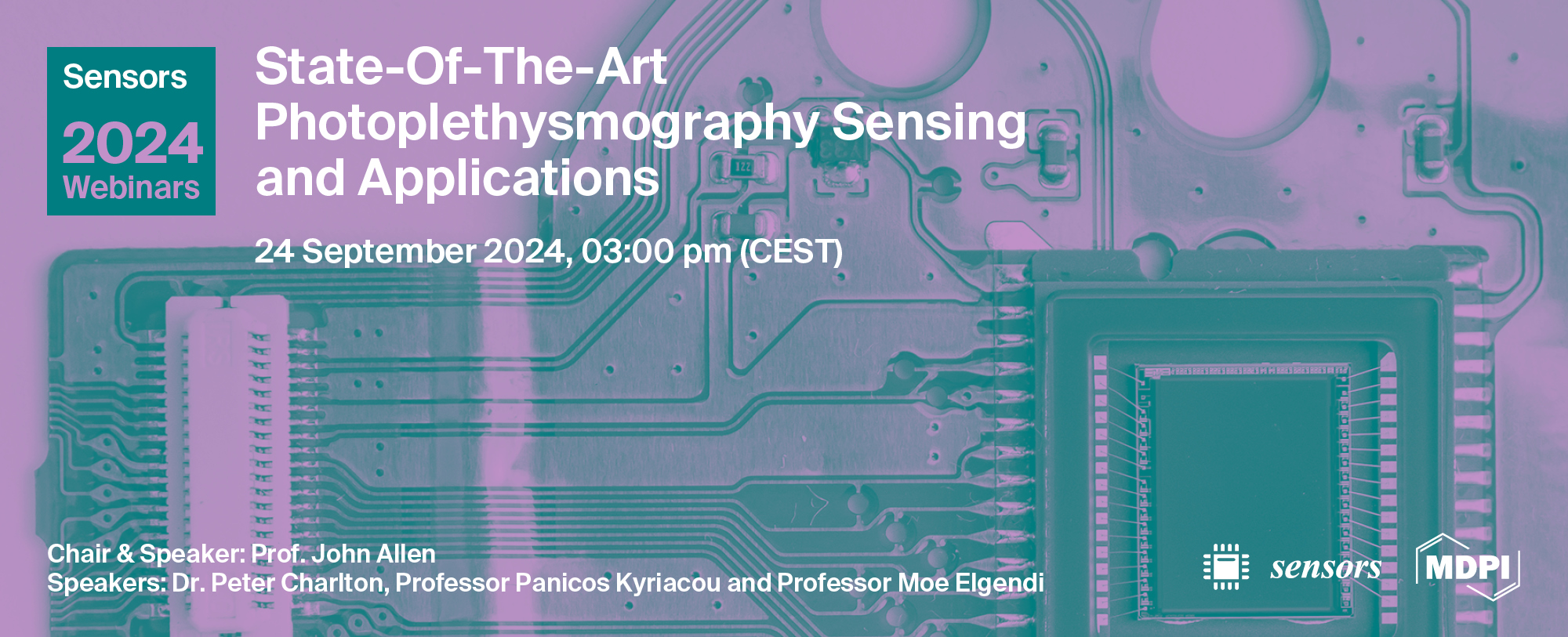
State-of-the-Art Photoplethysmography and Applications
It is my honour to serve as the Chair for this webinar session which is devoted to photoplethysmography, and it is a great pleasure to introduce world-leading speakers in the field and to host the discussion that follows.
Photoplethysmography (PPG) is a low cost and easy-to-conduct vascular optics measurement technique that can be used to detect blood volume changes in the microvascular bed of tissue. The technique is very popular and is found in a number of medical devices such as pulse oximeters and beat-to-beat blood pressure measurement systems; it is also found in a range of wearable devices such as smart watches. PPG can be used in a wide range of applications—particularly for assessment of the cardiovascular system and the monitoring of vital signs. Researchers continue to advance the biosignal analysis methods with PPG to extract biomarkers of disease and ageing for use in disease monitoring and patient classification, including modern AI-driven/machine learning PPG approaches. PPG and AI have a bright future together for the benefit of patients.
This state-of-the-art webinar will include sensing, novel analytical methodologies and clinical applcations. The first speaker will be myself and I will give a brief introduction to PPG and then provide an overview of “Opportunities for Photoplethysmography in Cardiovascular Assessment”, showing its broad potential in cardiovascular health. The second speaker is Peter Charlton, who will speak about “Equitable Photoplethysmography in Wearables: Accurate Data for All”, focusing on practical applications in wearables, emphasising inclusivity and data accuracy. The third speaker is Panicos Kyriacou, who will give a presentation on “Photoplethysmography in Cardiovascular and Neurocritical Care Applications” and will explore specific applications in critical care, showcasing advanced and specialised uses of PPG. The fourth and final speaker, Moe Elgendi, will focus on the ”State of the art of PPG Signal Analysis” and willconclude with the latest advancements and techniques, providing a hands-on, practical end to the webinar session.
Professor John Allen
Chair of the Sensors Webinar | State-of-the-Art Photoplethysmography and Applications
Date: 24 September 2024
Time: 3 pm CEST | 9 am EDT | 9 pm CST Asia
Webinar ID: 843 6486 6534
Webinar Secretariat: journal.webinar@mdpi.com
Meet Our Chair

Research Centre for Intelligent Healthcare, Coventry University, UK;John Allen is Professor of Intelligent Vascular Optics and Microvascular Sensing at the Centre for Intelligent Healthcare, Coventry University. Prof Allen is a recognised expert in the photoplethysmography (PPG) technique and has wider clinical expertise in using optical techniques to assess the microcirculation. His primary research focuses on the development and evaluation of novel sensing and analysis methods for PPG biosignals and microvascular imaging for cardiac and peripheral vascular assessments. He explores the power of light in medicine and its many opportunities when applied to microcirculation research for early disease detection. He is a Chartered Scientist and Engineer, HCPC-registered Clinical Scientist and a Fellow of the Royal Photographic Society (Accredited Senior Imaging Scientist). Prof Allen has authored and co-authored over 100 publications and has led major research projects and innovative measurement infrastructure projects on clinical vascular optics spaces in the NHS and academia. He collaborates with wide-ranging clinical, academic and industrial partners.
Meet Our Speakers

Department of Public Health and Primary Care, University of Cambridge, UK;Peter Charlton is a British Heart Foundation Research Fellow in the Department of Public Health and Primary Care, at the University of Cambridge. He develops biomedical signal processing techniques to analyse data from digital wearable devices for clinical decision making. Peter gained the degree of M.Eng. in Engineering Science in 2010 from the University of Oxford with first class honours. From 2010 to 2020, Peter conducted his research at King’s College London, developing techniques to use wearables to monitor cardiovascular and respiratory health. His Ph.D. focused on using signal processing and machine learning techniques to identify acute deteriorations in hospital patients. Peter is currently developing techniques to use clinical and consumer devices in screening for atrial fibrillation. He is leading a clinical study to assess the acceptability and performance of wearables in older adults. Peter works in collaboration with clinicians and industrial partners to translate his work into clinical practise.

Department of Engineering, University of London, UK;Panicos Kyriacou is a Professor of Biomedical Engineering and Director of the Biomedical Research Centre at City, University of London. Prof Kyriacou is considered a global leading expert in the fields of pulse oximetry and photoplethysmography. His primary research focuses on the understanding of the relation of photoplethysmography (PPG) and Spectrophotometry with haemodynamics, vascular mechanics and hemorheology. His main motivation is the utilisation of PPG and other optical-based modalities for the innovation of new disruptive sensor technologies for the early diagnosis of disease and the facilitation of unobtrusive health and fitness monitoring. Prof Kyriacou has authored and co-authored over 300 publications and has over 25 years of experience in leading major research projects, relating to healthcare technologies, funded by the main UK research bodies, the EU and the industry.

Healthcare Engineering Innovation Centre (HEIC), Department of Biomedical Engineering, Khalifa University, Abu Dhabi, UAE;Prof. Mohamed (Moe) Elgendi is an Assistant Professor at Khalifa University. He has extensive experience in Biomedical Engineering, having worked on photoplethysmography since 2005. His expertise includes machine learning, algorithm development, data analysis and knowledge translation, with training in data analytics from MIT. Previously, he was the Deputy Director of the Biomedical and Mobile Health Technology Lab at ETH Zurich, where he played a key role in establishing the lab, mentoring students and developing course materials. He has also held positions at Nanyang Technological University, the University of Alberta, and the University of British Columbia. In October 2023, he was ranked among the top 2% of scientists worldwide by Stanford University. Dr. Elgendi serves on editorial boards of several journals and has published over 170 scientific works. He has secured numerous competitive grants and contributed to global health initiatives. He has supervised over 40 MSc and BSc thesis students, many of whom have secured PhD scholarships at prestigious universities including MIT and Harvard.


The webinar was hosted via Zoom and required registration to attend. The full recording can be found below. In order to learn about future webinars, you can sign up to our newsletter by clicking “Subscribe” at the top of the page.
Articles published by Sensors
Photoplethysmography for the Assessment of Arterial Stiffness
Authors: Parmis Karimpour, James M. May and Panicos A. Kyriacou
Sensors 2023, 23(24), 9882; https://doi.org/10.3390/s23249882
Customisable Silicone Vessels and Tissue Phantoms for In Vitro Photoplethysmography Investigations into Cardiovascular Disease
Authors: Parmis Karimpour, Redjan Ferizoli, James M. May and Panicos A. Kyriacou
Sensors 2024, 24(5), 1681; https://doi.org/10.3390/s24051681
Energy-Efficient PPG-Based Respiratory Rate Estimation Using Spiking Neural Networks
Authors: Geunbo Yang, Youngshin Kang, Peter H. Charlton , Panayiotis A. Kyriacou, Ko Keun Kim, Ling Li and Cheolsoo Park
Sensors 2024, 24(12), 3980; https://doi.org/10.3390/s24123980
Articles published by Other Publishers
Allen, J. (2007). Photoplethysmography and its application in clinical physiological measurement. Physiological measurement, 28(3), R1.
Charlton, Peter H., et al. "Assessing hemodynamics from the photoplethysmogram to gain insights into vascular age: a review from VascAgeNet." American Journal of Physiology-Heart and Circulatory Physiology 322.4 (2022): H493-H522.
Charlton, Peter H., et al. "The 2023 wearable photoplethysmography roadmap." Physiological measurement 44.11 (2023): 111001.
Allen, J., & Kyriacou, P. A. (2024). Advances in basic and applied research in photoplethysmography. Frontiers in Physiology. Frontiers Media. https://www.frontiersin.org/research-topics/35155/advances-in-basic-and-applied-research-in-photoplethysmography/magazine
Elgendi, M., Haugg, F., Fletcher, R. R., Allen, J., Shin, H., Alian, A., & Menon, C. (2024). Recommendations for evaluating photoplethysmography-based algorithms for blood pressure assessment. Communications Medicine, 4, Article 140. https://doi.org/10.1038/s43856-024-00555-2
Sinaki, F. Y., Ward, R., Abbott, D., Allen, J., Fletcher, R. R., Menon, C., & Elgendi, M. (2022). Ethnic disparities in publicly-available pulse oximetry databases. Communications Medicine, 2(1), 59.
Elgendi, M., Fletcher, R. R., Tomar, H., Allen, J., Ward, R., & Menon, C. (2021). The striking need for age diverse pulse oximeter databases. Frontiers in Medicine, 8, 782422.
Relevant Books
Kyriacou, P. A., & Allen, J. (Eds.). (2021). Photoplethysmography: technology, signal analysis and applications. Academic Press.
Elgendi M. PPG Signal Analysis: An Introduction Using MATLAB. 1st Edition. CRC Press, Inc. 2021.