Applied Sciences Webinar | Sensing Based on Surface Plasmons
the chair
2nd Webinar of Applied Sciences
Sensing Based on Surface Plasmons
Plasmons are collective excitations in a gas or liquid of charged particles, most frequently electrons. Plasmon-related effects can be traced back to the beginning of the last century with theoretical works of A. Sommerfeld, J. Zanneck and Lord Rayleigh, although the term itself probably was coined in 1952 by D. Pines and D. Bohm. In the 1950s, the existence of self-sustained collective excitations at metal surfaces (named thereafter as surface plasmons) was demonstrated experimentally. About two decades later, in the 1970s, the phenomenon of surface-enhanced Raman scattering (SERS), closely related to surface plasmons, was reported for the first time. With the development of nanotechnologies, such as precise patterning of metallic surfaces and colloidal synthesis of metallic nanoparticles (NPs), and the demonstration of the unique properties of graphene, a monolayer-thick transparent conductor with tunable conductivity, nanoplasmonics became an area of intensive research.
Nowadays, materials that support surface plasmons (NPs and other metallic nanostructures, graphene and their combinations) are widely studied and used in several technological fields, such as near-field microscopy, plasmonic integrated circuitry, and nano-optoelectronics. Of particular interest is the capacity of surface plasmons (either localized in a particle or propagating along a surface) to enhance several light-matter interaction processes. These processes underlie the phenomena of Raman scattering, photocatalysis, chemical energy conversion, heat generation, photovoltaics, etc.); they also open new possibilities to detect different kinds of molecules and biomolecules using label-free sensing platforms and even to perform comprehensive biological imaging and photothermal therapies.
This webinar will focus on the discussion of theoretical backgrounds and the latest advances in plasmonic nanostructures based on noble metals or graphene, as well as on their application in molecular sensing. It will include three talks, devoted to (i) noble-metal NP-based sensors exploring the Localized Surface Plasmon Resonance (LSPR) effect, (ii) SERS platforms for ultrasensitive detection of a particular analyte (SARS-CoV-2 markers); and (iii) sensing capabilities of graphene-based structures, delivered by experts on these topics.
Chair: Prof. Dr. Mikhail I. Vasilevskiy
Date: 21 January 2022
Time: 3:00 pm CET丨9:00 am EST丨10:00 pm CST Asia
Webinar ID: 892 1498 2197
Webinar Secretariat: applsci.webinar@mdpi.com
Meet Our Speaker
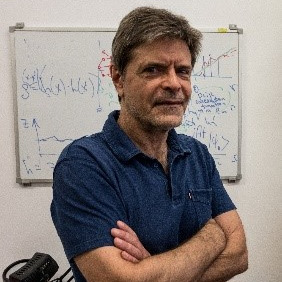
Prof. Dr. Mikhail I. Vasilevskiy
University of Minho, Portugal;Mikhail Vasilevskiy was graduated in Physics from N. I. Lobachevskiy University (Gorkiy, USSR). After receiving his PhD in 1985, he worked as an Associate Professor of Physics at the Lobachevskiy University and as a Senior Researcher at the Institute for Physics of Microstructures, RAS. He also was a post-doctorate researcher at the University of Essex, UK, and a visiting professor in several universities worldwide. Since 1999, Mikhail Vasilevskiy is a professor of Physics at the University of Minho (Full Professor since 2006) and a researcher of its Centre of Physics where he served as Director (2007-08, 2011-13 and 2016-20). Currently he also is an Associate Staff member of the INL, Braga. His scientific interests are focused on theory and modelling of plasmons, excitons and phonons in 2D materials, metal nanoparticles, quantum dots, etc, as well as on light-matter interaction with applications in optoelectronics and sensing. Recent activities also include quantum simulations of these physical phenomena using quantum algorithms. Mikhail Vasilevskiy (co-) authored one book, several book chapters, over 160 journal papers and 3 patents, with a current h=28. https://orcid.org/0000-0003-2930-9434

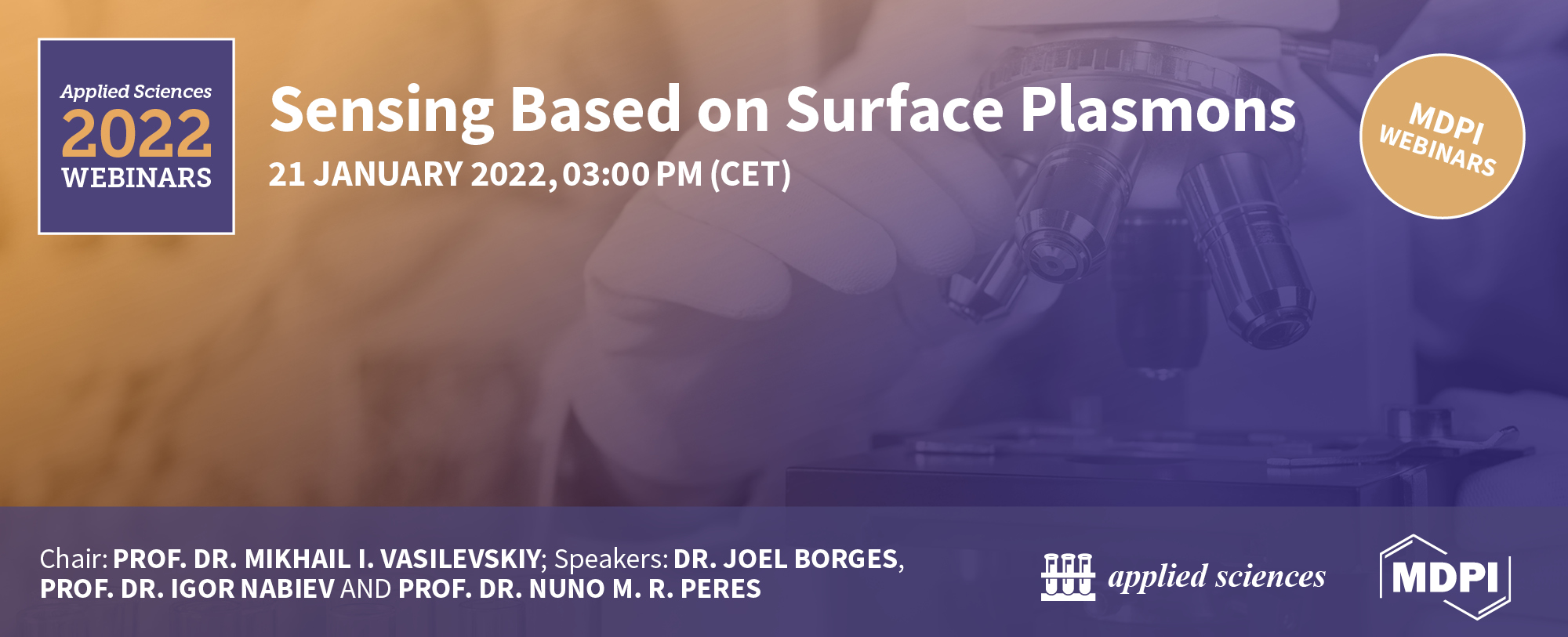
On Friday, 21 January 2022, MDPI and the Journal Applied Sciences organized the 2nd webinar on Applied Sciences, entitled "Sensing Based on Surface Plasmons".
The introduction was held by the Chair of the webinar, Prof. Dr. Mikhail I. Vasilevskiy. Since 1999, he is a professor of Physics at the University of Minho and a researcher of its Centre of Physics where he served as Director (2007-08, 2011-13 and 2016-20). Currently he also is an Associate Staff member of the INL, Braga.
The first speaker to quick off this webinar was Dr. Joel Borges, with his presentation "Nanoplasmonic Thin Films Containing Gold Nanoparticles Embedded in an Oxide Matrix for Sensing Applications". He is an Assistant Researcher at the Centre of Physics of the Universities of Minho and Porto (CF-UM-UP). His main research activity is related to the development of nanoplasmonic thin film materials composed by noble metal nanoparticles dispersed in dielectric/semiconductor matrixes possessing localized surface plasmon resonances (LSPR).
The second presentation with the title "Sensing Using SERS Spectroscopy: Basics and Examples of SARS-CoV-2 Key Protein Antigens Ultrasensitive Detection" was held by Prof. Dr. Igor Nabiev. After professorships in Georgia Tech in Atlanta and Pittsburgh University (USA), he was nominated in 1994 a Full Professor (Chair of Biophysics) in the University of Reims Champagne-Ardenne, France. In Reims University, Igor Nabiev is also director of Laboratoire de Recherche in Nanosciences.
The third presentation "The Plasmonics Properties of Graphene" by Prof. Dr. Nuno M. R. Peres. He is a theoretical condensed matter physicist working in two-dimensional materials and related structures since 2004. Nuno Peres is affiliated with the Department of Physics of the University of Minho and the Iberian International Nano Laboratory (Portugal).
The presentations were followed by a Q&A and a discussion, moderated by the Chair Prof. Dr. Mikhail I. Vasilevskiy. The webinar was offered via Zoom and required registration to attend. The full recording can be found here on Sciforum website. In order to stay updated on the next webinars on Applied Sciences be sure to sign up for our newsletter by clicking on “Subscribe” at the top of the page.
Plasma Science and Technology
Guest Editor:Dr. Mohammed Koubiti
Deadline for manuscript submissions: 25 February 2022
Feature Papers in Section "Surface Sciences and Technology
Guest Editor:Prof. Dr. Eiji Tokunaga
Deadline for manuscript submissions: 28 February 2022
Plasma: From Materials to Emerging Technologies II
Guest Editor: Prof. Dr. Mirosław Dors
Deadline for manuscript submissions: 10 May 2022
Progress on Laser Plasma Interaction
Guest Editors: Prof. Dr. Jianxing Li & Prof. Dr. Ye Tian
Deadline for manuscript submissions: 20 May 2022
Advancements in Plasmonics: Structures, Optical Properties and Applications
Guest Editors: Dr. Paola Di Pietro & Dr. Maria Caterina Giordano
Deadline for manuscript submissions: 25 May 2021
Low-Temperature Plasma and Its Applications
Guest Editor: Prof. Dr. Xinpei Lu
Deadline for manuscript submissions: 20 June 2021