
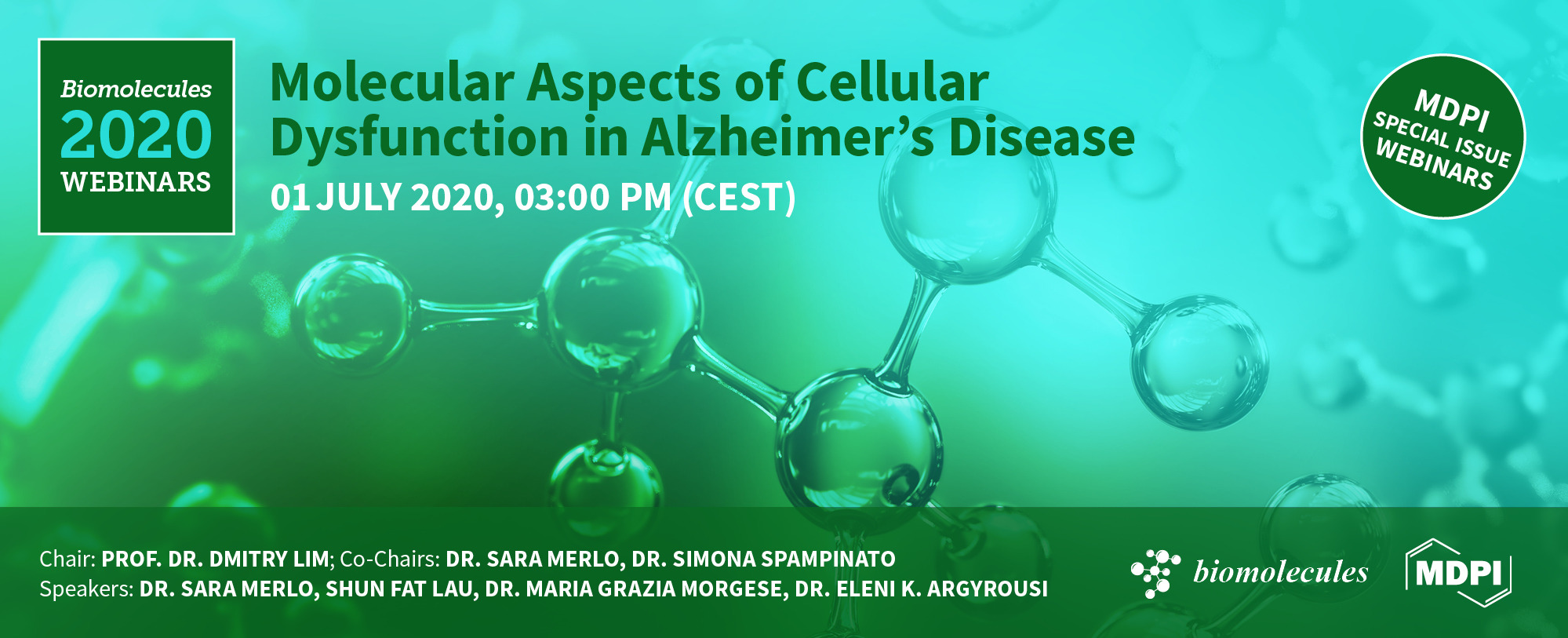
1st Webinar on Biomolecules: Molecular Aspects of Cellular Dysfunction in Alzheimer's Disease
Important Dates
30 Jun
2020
30 Jun
2020

1st Webinar Series on Biomolecules - an Open Access Journal
Molecular Aspects of Cellular Dysfunction in Alzheimer's Disease
Alzheimer’s disease (AD) is a worldwide emergency and represents a challenge for modern society. The increasing number of failed clinical trials and absence of preventive or disease-modifying therapies are urging the development of novel and innovative approaches in addition to better characterization of AD pathogenesis. AD is a complex, slowly developing disease in which synaptic plasticity is impaired, resulting in consequent neurodegeneration and comorbidities such as depression. These manifestations are a result of the interaction of key cellular and molecular components, which include microglial cells, amyloid-beta, and lipid metabolism. In this context, this webinar will discuss the mechanisms of amyloid-beta-induced plasticity impairment, the role of microglia-mediated inflammation, and the protective role of polyunsaturated fatty acids in association with depressive-like behavior in AD pathogenesis.
This Webinar is a part of the Special Issue Molecular Aspects of Cellular Dysfunction in Alzheimer's Disease.
Date & Time: 1 July 2020 3:00pm (CEST) | 9:00am (EDT) | 9:00pm (CST Asia)
Chair: Prof. Dr. Dmitry Lim
Co-chairs: Dr. Sara Merlo, Dr. Simona Federica Spampinato
Speakers: Dr. Sara Merlo, Mr. Shun Fat Lau, Dr. Maria Grazia Morgese, Dr. Eleni K. Argyrousi
Webinar ID: 827 4661 3931
Webinar Secretariat: biomolecules.webinar@mdpi.com
This webinar will include the following experts:





The first Biomolecules webinar, entitled ‘Molecular Aspects of Cellular Dysfunction in Alzheimer’s Disease’, was held on Wednesday 1 July 2020. It was chaired by Prof. Dr. Dmitry Lim, Dr. Sara Merlo, and Dr. Simona Federica Spampinato. This online seminar covered many aspects of Alzheimer’s disease—a disorder that remains incurable.
Dr. Sara Merlo was the first to present her research on ‘Beta-Amyloid and Microglia: Mechanisms for Neuroprotection’. Shun Fat Lau followed with a presentation on ‘The Functional Roles of IL33/ST2 Signaling in Modulating Microglial Phenotypes in Alzheimer’s Disease’. Dr. Maria Grazia Morgese then presented her research on ‘Depressive Like Behaviour Associated with Amyloid Beta: Protective Role of n-3 Polyunsaturated Fatty Acids’. Dr. Eleni K. Argyrousi was the final speaker and spoke about ‘Amyloid-Beta-Induced Impairment of Long-Term Synaptic Plasticity and Memory Is Tau Independent’. All presentations were followed by a discussion and Q&A session moderated by the three chairs.
To confidently face the challenges of Alzheimer’s disease, numerous details of its complex pathogenesis have to be considered together, including the role of non-neuronal cell types of the CNS, like microglial cells and astrocytes, and the interaction with peripheral systems and co-morbidities. This webinar compellingly suggested that the young generation of neuroscientists will be able to handle the Alzheimer’s disease challenge and that in the near future, they will assist with important discoveries toward the diagnosis, prevention, and therapy of Alzheimer’s and other neurological and neurodegenerative diseases.
The webinar was offered via Zoom and registration was required for attendance. The full recording can be found below.
To stay updated on upcoming Biomolecules webinars organized by MDPI, be sure to sign up for our newsletter by clicking on “Subscribe” at the top of the page.
Molecular Aspects of Cellular Dysfunction in Alzheimer's Disease
Guest Editors: Dr. Sara Merlo, Assoc. Prof. Dmitry Lim and Dr. Simona Federica Spampinato
Accepting submissions until 31 March 2021