-01.png)
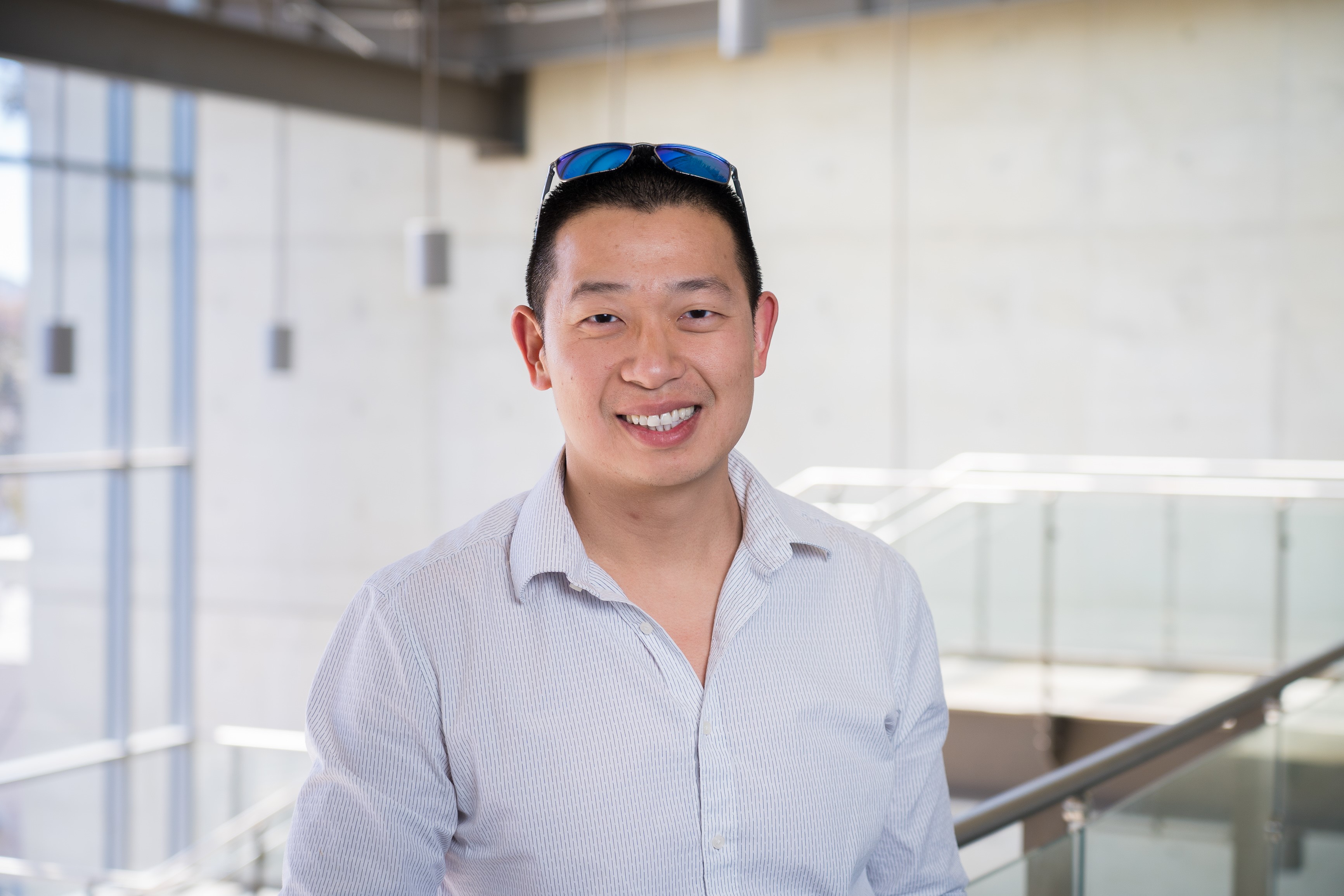 |
Ken Loh, Ph.D. |
Short Bio
Dr. Ken Loh is a Professor and Vice Chair of the Department of Structural Engineering at UC San Diego. He is the Director of the Active, Responsive, Multifunctional, and Ordered-materials Research (ARMOR) Lab and is the Associate Director of the UC San Diego, Jacobs School of Engineering, Center for Extreme Events Research (CEER). He is also an affiliate faculty member of the Materials Science & Engineering Program and the Center for Wearable Sensors. His research interests are in multifunctional and stimuli-responsive materials, tomographic imaging techniques, wearable sensors, active metamaterials, and soft material actuators. His group is particularly interested in research problems related to structural health monitoring and human performance assessment. Dr. Loh received his B.S. in Civil Engineering from Johns Hopkins University in 2004. His graduate studies were at the University of Michigan, where he completed two M.S. degrees in Structural Engineering (2005) and Materials Science & Engineering (2008), as well as a Ph.D. in Structural Engineering in 2008. He started his Assistant Professor career in January 2009 in the Department of Civil & Environmental Engineering at UC Davis, before moving to UC San Diego in January 2016.
Title: Wearable Sensors for Human Performance Assessment and Protection
Abstract
Military service members (whether in training or deployed) and athletes are exposed to extreme conditions that jeopardize their health, safety, and performance. New sensors that enable real-time monitoring of human motion and physiological conditions will not only enhance their performance but also prevent injuries. This presentation showcases how stimuli-responsive materials coupled with unique measurement strategies/algorithms can provide new data streams and insights on human health and performance. The focus will be on recent developments in nanocomposite wearable sensors for physical and physiological monitoring. In addition, densely distributed motion and muscular engagement monitoring can be achieved when wearable sensors are coupled with tomographic methods.
 |
Benedetto Vigna, |
Short Bio
Benedetto Vigna is STMicroelectronics’ President, Analog, MEMS and Sensors Group, and has held this position since January 2016. He is a member of ST’s Executive Committee since May 31st, 2018. Vigna joined ST in 1995 and launched the Company’s efforts in MEMS. Under his guidance, ST’s MEMS sensors established the Company’s leadership with large OEMs in motion-activated user interfaces. Vigna has piloted ST’s successful moves into microphones, e-compasses, and touch-screen controllers, as well as environmental sensors, micro-actuators, industrial and automotive sensors, and low-power radios for IoT. Vigna’s mandate was further expanded with analog ICs and RF products (2011) and smart-power devices for OEMs and mass market (2016). ST’s Imaging division moved under his management in late 2017. Vigna has more than 200 patents on micromachining, authored numerous publications, and sits on the boards of several EU-funded programs. Vigna’s contributions to the industry have been recognized with the MEMS Industry Group’s Executive of the Year Award (2013), the European SEMI Award (2013), the IEEE Frederik Philips Award (2015), and Manager of the Year 2017 by German magazine Markt & Technik. He joined the MEMS & Sensor Industry Group board in June 2019. Since February 2020, Vigna has been a member of Electronics Cluster Advisory Board (CAB) for the Agency for Science, Technology and Research (A*STAR) of Singapore. Since June 2020 he is also Member of the Board of Technical Advisors of Leonardo Company. Benedetto Vigna was born in Potenza, Italy, in 1969, and graduated cum laude with a degree in Subnuclear Physics from the University of Pisa, Italy.
Title: Sensors Enable Next Wave of Artificial Intelligence
Abstract
Semiconductor industry is only sixty years old. At the beginning the technical community started to integrate successfully on silicon many transistors aiming to mimic the function of the brain, the memory and the muscle of human beings. In the nineties instead new components, such as variable capacitors, variable resistors and photodiodes, started to become the core of miniaturized silicon sensors meant to mimic the five senses of human beings. In the last three decades, the pace of sensor development accelerated thanks to the progresses in microfabrication techniques and successful high-volume market applications. Nowadays transducers are all around us: in cars, in smartphones, in factories, in printers, in tablets, in satellites, in drones, in smart speakers, in watches and even in medical patches and shoes. There is no doubt we are living interesting times with many challenges and many opportunities in front of us. Internet of Things, Artificial Intelligence, 5G networks will boost the GDP of many countries and will enable new business models. Within the frame of this new blurred world, micromachined silicon sensors will play even a more important role than today. The world parameters, such as vibrations, sound, atmospheric pressure, pollution level, will reach the digital world without the need of people typing on a keyboard or moving a mouse or touching an advanced display. We are entering the wave of Sensing and Autonomous Artificial Intelligence and we need to pay attention that the Sensorization of the world around us will not limit our freedom, free will and our critical thinking. This talk will address the major milestones of the development of the sensors in the last three decades and which sensor features are required by the next waves of Artificial Intelligence.