
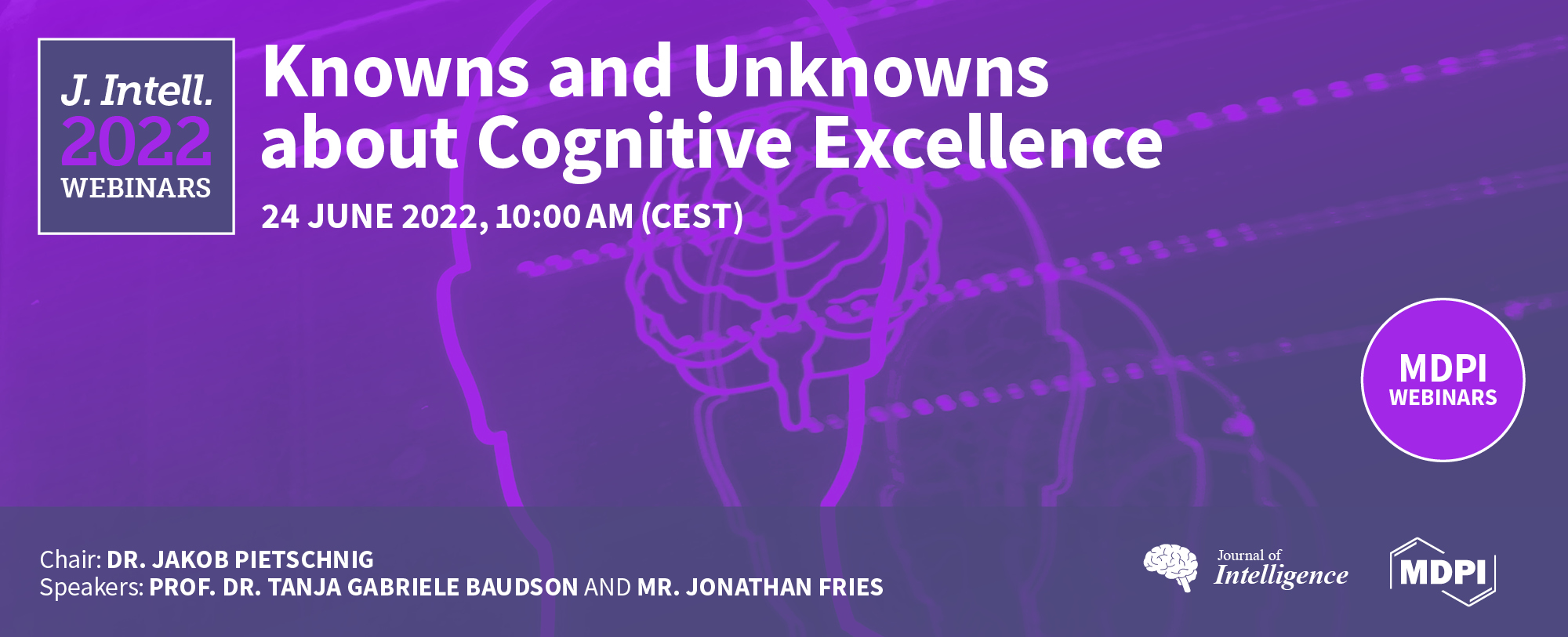
Journal of Intelligence | Knowns and Unknowns about Cognitive Excellence
the chair
1st Journal of Intelligence Webinar
Knowns and Unknowns about Cognitive Excellence
Research into characteristics of gifted individuals has shown that exceptionally high cognitive abilities are typically associated with desirable life outcomes. Large-scale efforts such as the Terman study or more recently the Study of Mathematically Precocious Youth (SMPY) consistently yielded positive correlations between cognitive abilities and, for instance, job prestige, salary, or self-reported life-satisfaction but negative ones with morbidity or mortality. Recent evidence, however, indicates the cognitive ability and desirable life outcome link may not be entirely unequivocal. In fact, some findings suggest that high cognitive abilities may conceivably represent a risk factor for cer-tain types of physical or psychological conditions (e.g., overexcitabilites). In the present webinar, two expert speakers discuss benefits and costs of being gifted and present novel empirical evidence about prevalences of physical and psychological overexcitabilities in two large samples of gifted individuals.
Date: 24 June 2022
Time: 10:00 am CEST | 4:00 am EDT | 4:00 pm CST Asia
Webinar ID: 822 8095 6050
Webinar Secretariat: jintell.webinar@mdpi.com
Meet Our Speaker

Department of Developmental and Educational Psychology, University of Vienna, Austria;Jakob heads the Individual Differences and Psychological Assessment Unit at the School of Psychology at the University of Vienna. In his research, he focusses on human intelligence, its cognitive bases, and generational IQ test score changes (i.e., the Flynn-effect).


On Friday, 24 June 2022, MDPI and the Journal of Intelligence organized the 1st webinar on Intelligence, entitled "Knowns and Unknowns about Cognitive Excellence".
The introduction was held by the Chair of the webinar, Dr. Jakob Pietschnig. He is head of the Individual Differences and Psychological Assessment Unit at the School of Psychology at the University of Vienna. In his research, he focusses on human intelligence, its cognitive bases, and generational IQ test score changes.
The first speaker was Prof. Dr. Tanja Gabriele Baudson with her presentation "The ambivalence of being gifted: Representative findings from Germany and what they mean". She is a professor of Differential Psychology and psychological giftedness research at the Fresenius University Heidelberg.
The second presentation was held by Mr. Jonathan Fries with his presentation "Gifted individuals exhibit elevated rates of mental health troubles: Evidence from an international survey of MENSA members". He is a pre-doctoral researcher currently working on the associations of intelligence and various aspects of physical and mental health.
The presentations were followed by a Q&A and a discussion, moderated by the Chair Dr. Jakob Pietschnig. The webinar was offered via Zoom and required registration to attend. The full recording can be found here on Sciforum website. In order to stay updated on the next webinars on Intelligence be sure to sign up for our newsletter by clicking on “Subscribe” at the top of the page.
Guest Editors: Dr. Jakob Pietschnig and Prof. Dr. Tanja Gabriele Baudson
Deadline for manuscript submissions: 30 September 2022