
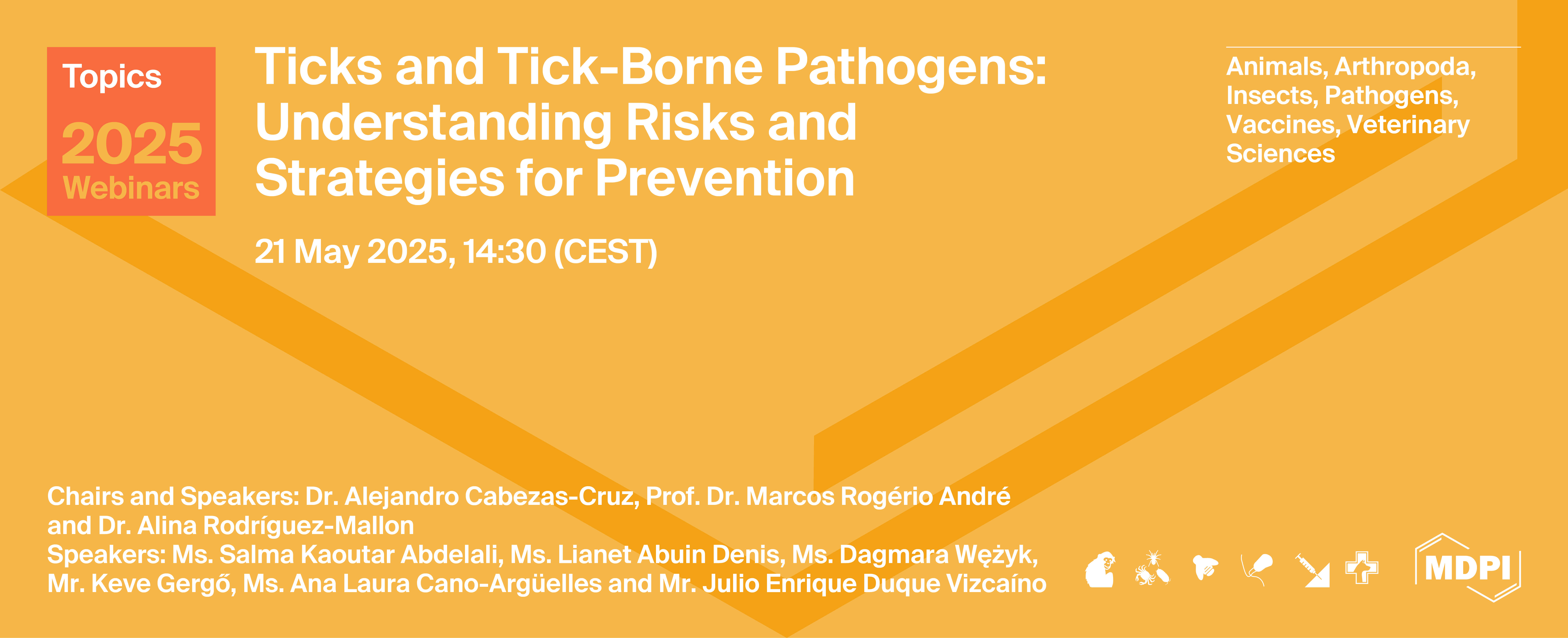
Topics Webinar | Ticks and Tick-Borne Pathogens: Understanding Risks and Strategies for Prevention
the chairs
We invite you to join our upcoming webinar on the topic of Ticks and Tick-Borne Pathogens. The main goal of this webinar is to summarize the first volume of our Special Topic on MDPI journals which was part of the sponsorship of this editorial to the TTP11 Conference and for promoting the second volume of this Topic set very recently following the success of the previous volume. This second volume continues to provide a platform for showcasing groundbreaking research, innovative methodologies, and promising discoveries in various facets of tick biology. The webinar will be organized in three key topics with a talk of a senior research and two presentations from PhD students actively working on each topic.
-
Tick microbiota
-
Latest trends in ticks and tick-borne disease surveillance
-
Effective prevention and control strategies.
Date: 21 May, 2025
Time: 2:30 pm CEST | 8:30 am EDT | 8:30 pm CST Asia
Webinar ID: 832 6108 8276
Webinar Secretariat: journal.webinar@mdpi.com
Don’t miss out on this opportunity to enhance your knowledge and stay updated on these important topics that are on the rise, making awareness and prevention more critical than ever. We encourage you to participate actively and submit your questions during the webinar.
Meet Our Chairs

UMR BIPAR (INRAE, Anses, EnvA);After graduation as Doctor in Veterinary Medicine in 2006, Alejandro joined the Center of Genetic Engineering and Biotechnology, in Havana, where he was involved in the study of molecular biology, genetic engineering and biotechnology applied to tick control. In 2010, he worked on the functional characterization of tick proteins with immunomodulatory effects in the laboratory of Prof. Pat Nuttall, at the University of Oxford. In 2012, Alejandro obtained a Marie Curie scholarship and joined an EU-funded project at the Institute of Parasitology in Czech Republic, under the supervision of Prof. Libor Grubhoffer. Within one-and-a-half-year he received his Master in Parasitology and enrolled in two PhD programs: one in Spain devoted to the study of the genetic diversity of Anaplasma, with Prof. José de la Fuente, and the other one in France devoted to the study of parasite epigenetics, with Prof. Raymond Pierce. Alejandro completed his second PhD in 2016 and, after a short postdoctoral position, he joined the French National Institute for Agricultural Research as a Principal Investigator. Since 2012, Alejandro has published over 100 manuscripts on different aspects of tick research. His scientific results have been recognized by the scientific community and in 2017 he was awarded the 'Odile Bain Memorial Prize' for his outstanding contribution to Parasitology.

UNESP, Campus de Jaboticabal;Graduated in Veterinary Medicine from São Paulo State University (UNESP) (2004). Master (2008) and Ph.D. (2012) in Veterinary Medicine at São Paulo State University, SP, Brazil, with a sandwich period at Johns Hopkins School of Medicine (Baltimore, MD, USA). Post-doc at São Paulo State University (UNESP) (2012-2013) and at the College of Veterinary Medicine - North Carolina State University (CVM-NCSU, Raleigh, NC, USA) (2020-2021). He has been working as an Associate Professor of Veterinary Parasitology since 2013 at São Paulo State University (UNESP). His research interests rely on the genetic diversity of vector-borne agents in domestic and wild animals, with focus on Piroplasmids, Anaplasmataceae agents, Bartonella, hemoplasmas, and hemogregarinids. He has published more than 295 research papers, and mentored more than 20 Master’s and 16 Ph.D. so far. Since 2020, it has been positioned in the Top Veterinary Scientists in the world’s List.

Center for Genetic Engineering and Biotechnology (CIGB), Havana, Cuba;Alina has a Bachelor in Biochemistry and a PhD in Molecular Biology at the Havana University in Cuba. She received post-doctoral training with an ICEGB fellowship at the Prof. Di Lauro’s laboratory in Naples, Italy and in the laboratory of Prof. Hans Shöeler at the European Molecular Biology Laboratories in Heilderberg, Germany on stem cell culture and knock out mice technology. Since her bachelor graduation in 1990, she has been a researcher in the Center for Genetic Engineering and Biotechnology in Havana, Cuba, working on molecular biology and genetic engineering. She is presently the head of the Animal Biotechnology Department at CIGB and the Principal Researcher in the “Animal Health” Projects. She is also Full Professor at the Faculty of Biology at the Havana University. She is a member of the Cuban Academy of Science. Alina and her group have been recognized on several occasions with Annual Awards from the Cuban Academy of Sciences for their contributions to Biotechnology in Cuba. She holds the Carlos J. Finlay order, which is the highest distinction awarded by the Cuban government to nationals and foreigners for their contributions to the development of science. She is interested in the study of ticks and tick-borne diseases, as well as the tool development for their control. She is also interested in the development of vaccines and diagnostic means for veterinary use in general.
Meet Our Speakers

Ms. Salma Kaoutar Abdelali
Laboratory of Research on the Improvement and Development of Animal and Plant Production, University of Ferhat Abbas, Setif, Algeria.;Salma Kaoutar Abdelali is a Ph.D. student in parasitology at Ferhat Abbas University, Algeria. She worked on the molecular aspects of tick-borne pathogens during a training at ANSES, Paris, France. Her research focuses on tick-borne pathogens, microbiome dynamics, and vector ecology, with an emphasis on Hyalomma ticks. She applies molecular and network-based approaches to investigate pathogen interactions and the influence of environmental factors.

Center for Genetic Engineering and Biotechnology (CIGB), Cuba UMR BIPAR (ANSES, INRAe, EnvA), France;Lianet Abuin Denis obtained her Bachelor's degree in Biochemistry and Molecular Biology from the University of Havana, Cuba, in 2018. She then joined the Center for Genetic Engineering and Biotechnology (CIGB). In 2020, she started working with Dr. Alina Rodríguez-Mallón on the identification of novel candidates for anti-tick vaccines. In 2021, through a collaboration between Dr. Cabezas-Cruz’s group and Dr. Rodríguez-Mallon, Lianet moved to France to pursue a Master's degree in Mycology-Parasitology at Sorbonne University, Paris. Currently, she is a PhD candidate in Biochemistry and Molecular Biology at the École Doctorale Agriculture, Alimentation, Biologie, Environnement et Santé (ABIES), associated to ANSES lab, under the supervision of Dr. Cabezas-Cruz. Her research focuses on the intricate interactions between pathogens and microbiota in ticks, a major vector of infectious diseases. By applying network-based approaches, she investigates complex microbial relationships across different host microbiomes, visualizing and analyzing connections between microorganisms and pathogens. This integrative perspective provides valuable insights into public health challenges associated with vector-borne diseases, with the ultimate goal of developing targeted interventions for improved disease control.

Ms. Dagmara Wężyk
Department of Eco-Epidemiology of Parasitic Diseases, Institute of Developmental Biology and Biomedical Sciences, Faculty of Biology, University of Warsaw, Poland;Dagmara Wężyk is a PhD student at the University of Warsaw. She obtained her MSc in molecular biology from the University of Warsaw in 2022, where she studied haematological indices and immune response profiles in dogs naturally infected and co-infected with Dirofilaria repens and Babesia canis. She obtained her bachelor's degree in biology from the School of Life Sciences in 2020. Her current research focuses on parasitology, in particular tick-borne pathogens such as Borrelia spp. and Babesia spp. In addition to her work on ticks in urban environments in Poland, she has also studied tick populations from Mongolia, Brazil and Africa, and their pathogens, contributing to a broader understanding of their epidemiological significance.

Mr. Keve Gergő
University of Veterinary Medicine Budapest, Hungary;Gergő Keve graduated as a veterinarian in 2021. He currently works at the Department of Parasitology and Zoology of the University of Veterinary Medicine (Budapest, Hungary) as a veterinary scientist. He is also doing his PhD studies there. His primary research area is the epidemiology of bloodsuckers, especially ticks that enter Hungary with migratory birds and the pathogens they transmit. He is a board member of the Hungarian Society of Parasitologists

Institute of Natural Resources and Agrobiology of Salamanca (IRNASA, CSIC), Spain;Ana Laura obtained her Bachelor's degree in Biochemistry and Molecular Biology from the University of Havana, Cuba, in 2017. She then joined the Center for Genetic Engineering and Biotechnology (CIGB), where she worked with Dr. Alina Rodriguez-Mallon on identifying novel candidates for anti-tick vaccines. In 2020, she received a scholarship for Latin American students to pursue a master's degree at the University of Salamanca, completing her Master’s in Molecular and Cellular Biology at the Institute of Neurosciences of Castile and Leon. Currently, she is a PhD candidate at the Institute of Natural Resources and Agrobiology of Salamanca (IRNASA) under the supervision of Dr. Ana Oleaga and Dr. Ricardo Pérez-Sánchez. Her research focuses on the parasite-host interface in Ornithodoros ticks and the development of anti-tick vaccines. She is a member of the Spanish Society of Parasitology.

Mr. Julio Enrique Duque Vizcaíno
Center for Genetic Engineering and Biotechnology (CIGB), Cuba;Julio Enrique is graduated as a Computer Engineer in 2015 from the Technological University of Havana "Jose Antonio Echeverría". He joined to the Center for Genetic Engineering and Biotechnology in 2016 as a webmaster. He has over seven years of experience in web development, showcasing his expertise in creating and managing websites. As part of his postgraduate program, he has been acquiring skills using computer vision, artificial intelligence, and software ecosystems applied to the agricultural and veterinary projects. His master project was the bioinformatic analyses of data from transcriptomic studies in plants. Currently, he is involved in his PhD project developing informatic tools to support integral management strategies to control ticks which include the immunological way.







Ticks and Tick-Borne Pathogens: 2nd Edition
The Topic Editors are Dr. Alina Rodríguez-Mallon and Dr. Alejandro Cabezas-Cruz
Deadline for Submission: 31 March 2026
The webinar was hosted via Zoom and required registration to attend. The full recording can be found below. In order to learn about future webinars, you can sign up to our newsletter by clicking “Subscribe” at the top of the page.
The webinar held on 21 May 2025 brought together leading experts and emerging researchers to explore key advances in tick microbiota, disease surveillance, and prevention strategies. With more than 100 participants, the event showcased cutting-edge insights into microbiota–pathogen interactions, pathogen genetic diversity, the role of avian hosts in the dispersal of vectors and pathogens, and innovative vaccine development approaches. Each session featured a senior researcher alongside PhD students, promoting dynamic knowledge exchange across experience levels. The interactive discussions reflected the high engagement and relevance of the topics, underscoring the urgency of integrated solutions to combat tick-borne diseases.