Event submissions
Published
This submission belongs to the session B. Development and Optimization of Animal Vaccines of the event The 1st International Online Conference on Veterinary Sciences
Published date
28 Nov, 2025
Academic Editor
'%3e%3cpath%20d='M12.6657%2010.9104C12.4185%2010.325%2012.0599%209.79327%2011.6097%209.34482C11.1609%208.89508%2010.6293%208.5365%2010.0442%208.28888C10.0389%208.28626%2010.0337%208.28495%2010.0285%208.28233C10.8446%207.69279%2011.3752%206.73249%2011.3752%205.64904C11.3752%203.8542%209.92103%202.39999%208.1262%202.39999C6.33136%202.39999%204.87715%203.8542%204.87715%205.64904C4.87715%206.73249%205.40774%207.69279%206.22393%208.28364C6.21869%208.28626%206.21345%208.28757%206.20821%208.29019C5.62129%208.5378%205.09463%208.89284%204.64265%209.34613C4.1929%209.79493%203.83432%2010.3266%203.58671%2010.9117C3.34345%2011.4845%203.21226%2012.0987%203.20023%2012.7209C3.19988%2012.7349%203.20233%2012.7488%203.20744%2012.7619C3.21255%2012.7749%203.22022%2012.7867%203.22998%2012.7968C3.23975%2012.8068%203.25142%2012.8147%203.26431%2012.8202C3.2772%2012.8256%203.29105%2012.8284%203.30504%2012.8284H4.09109C4.14874%2012.8284%204.19459%2012.7825%204.1959%2012.7262C4.2221%2011.7148%204.62823%2010.7676%205.34617%2010.0497C6.08899%209.30683%207.0755%208.89808%208.1262%208.89808C9.17689%208.89808%2010.1634%209.30683%2010.9062%2010.0497C11.6242%2010.7676%2012.0303%2011.7148%2012.0565%2012.7262C12.0578%2012.7838%2012.1037%2012.8284%2012.1613%2012.8284H12.9474C12.9613%2012.8284%2012.9752%2012.8256%2012.9881%2012.8202C13.001%2012.8147%2013.0126%2012.8068%2013.0224%2012.7968C13.0322%2012.7867%2013.0398%2012.7749%2013.0449%2012.7619C13.0501%2012.7488%2013.0525%2012.7349%2013.0522%2012.7209C13.0391%2012.0947%2012.9094%2011.4855%2012.6657%2010.9104ZM8.1262%207.9024C7.52486%207.9024%206.9589%207.6679%206.53312%207.24211C6.10733%206.81633%205.87283%206.25037%205.87283%205.64904C5.87283%205.0477%206.10733%204.48174%206.53312%204.05596C6.9589%203.63018%207.52486%203.39567%208.1262%203.39567C8.72753%203.39567%209.29349%203.63018%209.71927%204.05596C10.1451%204.48174%2010.3796%205.0477%2010.3796%205.64904C10.3796%206.25037%2010.1451%206.81633%209.71927%207.24211C9.29349%207.6679%208.72753%207.9024%208.1262%207.9024Z'%20fill='%235D1EE1'/%3e%3c/g%3e%3c/svg%3e) Francis O. Eko
Francis O. EkoCitation
Celia Alonso, Sandra Moreno, Aitor Nogales, Gema Lorenzo, Belen Borrego, Alejandro Brun, Safety assessment of Rift Valley fever vaccine candidate 40Fp8 reassortants rescued by reverse genetics, in Proceedings of The 1st International Online Conference on Veterinary Sciences, 3 December–5 December 2025, MDPI: Basel, Switzerland
Share
Email
Facebook
Twitter
LinkedIn
Safety assessment of Rift Valley fever vaccine candidate 40Fp8 reassortants rescued by reverse genetics
'%3e%3cpath%20d='M12.6647%2010.9104C12.4176%2010.325%2012.0589%209.7933%2011.6088%209.34485C11.16%208.89511%2010.6283%208.53653%2010.0432%208.28891C10.038%208.28629%2010.0327%208.28498%2010.0275%208.28236C10.8437%207.69282%2011.3743%206.73252%2011.3743%205.64907C11.3743%203.85423%209.92005%202.40002%208.12522%202.40002C6.33038%202.40002%204.87618%203.85423%204.87618%205.64907C4.87618%206.73252%205.40677%207.69282%206.22296%208.28367C6.21772%208.28629%206.21248%208.2876%206.20724%208.29022C5.62031%208.53783%205.09365%208.89287%204.64167%209.34616C4.19192%209.79496%203.83334%2010.3266%203.58573%2010.9117C3.34247%2011.4846%203.21128%2012.0987%203.19925%2012.721C3.1989%2012.735%203.20135%2012.7489%203.20646%2012.7619C3.21157%2012.7749%203.21924%2012.7868%203.22901%2012.7968C3.23877%2012.8068%203.25045%2012.8148%203.26334%2012.8202C3.27623%2012.8256%203.29007%2012.8284%203.30406%2012.8284H4.09012C4.14776%2012.8284%204.19362%2012.7825%204.19493%2012.7262C4.22113%2011.7148%204.62726%2010.7676%205.34519%2010.0497C6.08802%209.30686%207.07452%208.89811%208.12522%208.89811C9.17592%208.89811%2010.1624%209.30686%2010.9052%2010.0497C11.6232%2010.7676%2012.0293%2011.7148%2012.0555%2012.7262C12.0568%2012.7839%2012.1027%2012.8284%2012.1603%2012.8284H12.9464C12.9604%2012.8284%2012.9742%2012.8256%2012.9871%2012.8202C13%2012.8148%2013.0117%2012.8068%2013.0214%2012.7968C13.0312%2012.7868%2013.0389%2012.7749%2013.044%2012.7619C13.0491%2012.7489%2013.0515%2012.735%2013.0512%2012.721C13.0381%2012.0947%2012.9084%2011.4856%2012.6647%2010.9104ZM8.12522%207.90243C7.52388%207.90243%206.95792%207.66793%206.53214%207.24215C6.10636%206.81636%205.87185%206.2504%205.87185%205.64907C5.87185%205.04773%206.10636%204.48177%206.53214%204.05599C6.95792%203.63021%207.52388%203.3957%208.12522%203.3957C8.72655%203.3957%209.29252%203.63021%209.7183%204.05599C10.1441%204.48177%2010.3786%205.04773%2010.3786%205.64907C10.3786%206.2504%2010.1441%206.81636%209.7183%207.24215C9.29252%207.66793%208.72655%207.90243%208.12522%207.90243Z'%20fill='%235D1EE1'/%3e%3c/g%3e%3c/svg%3e)
Celia Alonso 1
Sandra Moreno 1
Aitor Nogales 1
Gema Lorenzo 1
Belen Borrego 1
Alejandro Brun 1
1. Department of Inmunoprofilaxis de enfermedades transmitidas por arbovirus y virus respiratorios, Centro de Investigación en Sanidad Animal, Consejo Superior de Investigaciones Científicas (CISA-INIA/CSIC), Valdeolmos, Madrid, 28130, Spain, Spain
Abstract
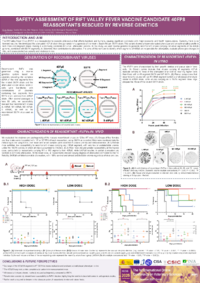
Rift Valley fever virus (RVFV; Genus Phlebovirus, Family Phenuiviridae, Order Hareavirales) is a mosquito-borne arbovirus that affects ruminants and humans. The RVFV genome consists of three single-stranded, negative-sense RNA segments: S (Small), M (Medium), and L (Large). The lack of a licensed vaccine with an optimal safety profile remains a major challenge for disease control. Previously, we generated an attenuated RVFV variant, 40Fp8, through random mutagenesis of the virulent South African strain 56/74. This variant showed a hyper-attenuated phenotype and an optimal safety profile in both mice and pregnant sheep, making it a strong candidate for a live attenuated vaccine (LAV). However, LAVs may pose risks in nature due to potential reversion to virulence and/or reassortment events in the case of segmented viruses. In this study, we analyzed the contribution of each 40Fp8 genomic segment to attenuation using a reverse genetics system. Recombinant viruses were generated by replacing one genomic segment of 56/74 with the corresponding segment from 40Fp8. In vitro, viruses carrying the 40Fp8 M segment displayed a small-plaque phenotype and higher replication kinetics like 40Fp8, whereas those with the 40Fp8 S or L segments behaved like the parental 56/74 strain. In vivo, sex-dependent differences were observed, with male mice more susceptible than females, likely due to hormonal, immunological, and genetic host factors. Notably, the virus carrying the 40Fp8 S segment conferred complete protection in both sexes and at all tested doses. Our data indicate that the 40Fp8 S segment is the primary determinant of attenuation, followed by the M and L segments, which provided partial protection, suggesting that coinfection events of circulating virulent RVFVs with 40Fp8 would likely preserve an attenuated phenotype and supporting the notion that the use of the 40Fp8 as an LAV would carry minimal risk in the event of reassortment in nature.
Keywords
RVFV
Reverse Genetics Systems
40Fp8
56/74
Live attenuated vaccines
Poster
Poster sciforum-142884.Alonso.pdf
MVA-NS1 vaccine candidate confers protection in IFNAR (-/-) mice against a homologous challenge with EHDV-8
Effective Induction of Cellular Immunity in Piglets Using a Single-Dose Bivalent Vaccine Against CSFV and PCV2