Event submissions
Published
This submission belongs to the session S2. Innovations in sports supplements of the event The 5th International Online Conference on Nutrients
Published date
05 Dec, 2025
Academic Editor
'%3e%3cpath%20d='M12.6657%2010.9104C12.4185%2010.325%2012.0599%209.79327%2011.6097%209.34482C11.1609%208.89508%2010.6293%208.5365%2010.0442%208.28888C10.0389%208.28626%2010.0337%208.28495%2010.0285%208.28233C10.8446%207.69279%2011.3752%206.73249%2011.3752%205.64904C11.3752%203.8542%209.92103%202.39999%208.1262%202.39999C6.33136%202.39999%204.87715%203.8542%204.87715%205.64904C4.87715%206.73249%205.40774%207.69279%206.22393%208.28364C6.21869%208.28626%206.21345%208.28757%206.20821%208.29019C5.62129%208.5378%205.09463%208.89284%204.64265%209.34613C4.1929%209.79493%203.83432%2010.3266%203.58671%2010.9117C3.34345%2011.4845%203.21226%2012.0987%203.20023%2012.7209C3.19988%2012.7349%203.20233%2012.7488%203.20744%2012.7619C3.21255%2012.7749%203.22022%2012.7867%203.22998%2012.7968C3.23975%2012.8068%203.25142%2012.8147%203.26431%2012.8202C3.2772%2012.8256%203.29105%2012.8284%203.30504%2012.8284H4.09109C4.14874%2012.8284%204.19459%2012.7825%204.1959%2012.7262C4.2221%2011.7148%204.62823%2010.7676%205.34617%2010.0497C6.08899%209.30683%207.0755%208.89808%208.1262%208.89808C9.17689%208.89808%2010.1634%209.30683%2010.9062%2010.0497C11.6242%2010.7676%2012.0303%2011.7148%2012.0565%2012.7262C12.0578%2012.7838%2012.1037%2012.8284%2012.1613%2012.8284H12.9474C12.9613%2012.8284%2012.9752%2012.8256%2012.9881%2012.8202C13.001%2012.8147%2013.0126%2012.8068%2013.0224%2012.7968C13.0322%2012.7867%2013.0398%2012.7749%2013.0449%2012.7619C13.0501%2012.7488%2013.0525%2012.7349%2013.0522%2012.7209C13.0391%2012.0947%2012.9094%2011.4855%2012.6657%2010.9104ZM8.1262%207.9024C7.52486%207.9024%206.9589%207.6679%206.53312%207.24211C6.10733%206.81633%205.87283%206.25037%205.87283%205.64904C5.87283%205.0477%206.10733%204.48174%206.53312%204.05596C6.9589%203.63018%207.52486%203.39567%208.1262%203.39567C8.72753%203.39567%209.29349%203.63018%209.71927%204.05596C10.1451%204.48174%2010.3796%205.0477%2010.3796%205.64904C10.3796%206.25037%2010.1451%206.81633%209.71927%207.24211C9.29349%207.6679%208.72753%207.9024%208.1262%207.9024Z'%20fill='%235D1EE1'/%3e%3c/g%3e%3c/svg%3e) Mauro Lombardo
Mauro LombardoCitation
Matias Rodríguez Elhordoy, Jessica Báez, Victoria Olt, Adriana Fernández, Natalia Martínez, María Dolores Del Castillo, Fiorella Iaquinta, Mariela Pistón, Daniel Vázquez, Alejandra Medrano, Nutritional characterization of Lupinus angustifolius flour and protein isolate as sustainable plant-based ingredients for sports supplements, in Proceedings of The 5th International Online Conference on Nutrients, 10 December–12 December 2025, MDPI: Basel, Switzerland
Share
Email
Facebook
Twitter
LinkedIn
Nutritional characterization of Lupinus angustifolius flour and protein isolate as sustainable plant-based ingredients for sports supplements

Matias Rodríguez Elhordoy 1

Jessica Báez 1

Victoria Olt 1
'%3e%3cpath%20d='M12.6647%2010.9104C12.4176%2010.325%2012.0589%209.7933%2011.6088%209.34485C11.16%208.89511%2010.6283%208.53653%2010.0432%208.28891C10.038%208.28629%2010.0327%208.28498%2010.0275%208.28236C10.8437%207.69282%2011.3743%206.73252%2011.3743%205.64907C11.3743%203.85423%209.92005%202.40002%208.12522%202.40002C6.33038%202.40002%204.87618%203.85423%204.87618%205.64907C4.87618%206.73252%205.40677%207.69282%206.22296%208.28367C6.21772%208.28629%206.21248%208.2876%206.20724%208.29022C5.62031%208.53783%205.09365%208.89287%204.64167%209.34616C4.19192%209.79496%203.83334%2010.3266%203.58573%2010.9117C3.34247%2011.4846%203.21128%2012.0987%203.19925%2012.721C3.1989%2012.735%203.20135%2012.7489%203.20646%2012.7619C3.21157%2012.7749%203.21924%2012.7868%203.22901%2012.7968C3.23877%2012.8068%203.25045%2012.8148%203.26334%2012.8202C3.27623%2012.8256%203.29007%2012.8284%203.30406%2012.8284H4.09012C4.14776%2012.8284%204.19362%2012.7825%204.19493%2012.7262C4.22113%2011.7148%204.62726%2010.7676%205.34519%2010.0497C6.08802%209.30686%207.07452%208.89811%208.12522%208.89811C9.17592%208.89811%2010.1624%209.30686%2010.9052%2010.0497C11.6232%2010.7676%2012.0293%2011.7148%2012.0555%2012.7262C12.0568%2012.7839%2012.1027%2012.8284%2012.1603%2012.8284H12.9464C12.9604%2012.8284%2012.9742%2012.8256%2012.9871%2012.8202C13%2012.8148%2013.0117%2012.8068%2013.0214%2012.7968C13.0312%2012.7868%2013.0389%2012.7749%2013.044%2012.7619C13.0491%2012.7489%2013.0515%2012.735%2013.0512%2012.721C13.0381%2012.0947%2012.9084%2011.4856%2012.6647%2010.9104ZM8.12522%207.90243C7.52388%207.90243%206.95792%207.66793%206.53214%207.24215C6.10636%206.81636%205.87185%206.2504%205.87185%205.64907C5.87185%205.04773%206.10636%204.48177%206.53214%204.05599C6.95792%203.63021%207.52388%203.3957%208.12522%203.3957C8.72655%203.3957%209.29252%203.63021%209.7183%204.05599C10.1441%204.48177%2010.3786%205.04773%2010.3786%205.64907C10.3786%206.2504%2010.1441%206.81636%209.7183%207.24215C9.29252%207.66793%208.72655%207.90243%208.12522%207.90243Z'%20fill='%235D1EE1'/%3e%3c/g%3e%3c/svg%3e)
Adriana Fernández 1
Natalia Martínez 2

María Dolores Del Castillo 3
Fiorella Iaquinta 4
Mariela Pistón 4
Daniel Vázquez 5

Alejandra Medrano 1
1. Laboratory of Food Bioactivity and Nanotechnology, Department of Food Science and Technology, Faculty of Chemistry, Universidad de la República, General Flores 2124, Montevideo 11800, Uruguay.
2. Fats and Oils Area, Department of Food Science and Technology, Faculty of Chemistry, Universidad de la República, General Flores 2124, Montevideo 11800, Uruguay.
3. Institute of Food Science Research (CIAL) (CSIC-UAM), Campus of the Autonomous University of Madrid, Nicolás Cabrera 9, 28049 Madrid, Spain.
4. Trace Element Analysis and Development of Simple Strategies for Sample Preparation Group (GATPREM), Analytical Chemistry, DEC, Faculty of Chemistry, Universidad de la República, General Flores 2124, Montevideo 11800, Uruguay.
5. National Institute of Agricultural Research (INIA), Experimental Station La Estanzuela, Route 50 km 11.5, 70006 Colonia, Uruguay.
Abstract
The Uruguayan agricultural system seeks profitable and sustainable crops, among which Lupinus angustifolius shows remarkable adaptability. Although its current use in the country is mainly restricted to animal feed, the growing demand for sports supplements based on innovative, protein-dense plant ingredients positions this species as a promising alternative. This work aimed to characterize the flour (LF) and protein isolate (LPI) from Lupinus angustifolius seeds to assess their potential in sports supplements.
Proximate analysis of both samples was carried out according to AOAC protocols (1999), fatty acids were determined by gas chromatography following IUPAC (1987, methods 2.301 and 2.304), and amino acids were analyzed using an automatic analyzer (Biochrom30, Biochrom Ltd., UK) by ion exchange chromatography with post-column ninhydrin derivatization (Spackman et al., 1958).
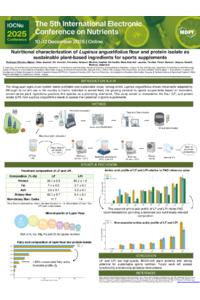
The characterization of LF revealed its content comprised 35.1±0.1% protein, 40.4±0.7% dietary fiber, and 7.4±0.2% lipids. The lipid fraction was dominated by unsaturated fatty acids, mainly oleic (39.2±0.0%) and linoleic (38.0±0.1%), together with α-linolenic (3.5±0.1%). The amino acid profile showed a balanced contribution, with leucine, lysine, and isoleucine exceeding FAO recommendations; glutamate and aspartate were also present in relevant amounts for energy metabolism and muscle recovery. LF provided essential minerals (mg/100g): calcium 265.5±17.9, magnesium 185.03±8.45, potassium 841.1±96.9, iron 6.23±0.01, and zinc 2.8±0.3.
LPI presented 85.2±1.6% protein, 6.4±0.3% fiber, and 3.7±0.0% lipids. Its amino acid profile was characterized by high levels (g/100g protein) of leucine (6.28±0.80), phenylalanine (4.10±0.50), and isoleucine (3.20±0.41), all associated with muscle protein synthesis. Despite the lower lipid content, unsaturated fatty acids remained predominant.
In conclusion, LF and LPI provide high-quality proteins enriched in essential and branched-chain amino acids, together with fiber, unsaturated fatty acids, and key minerals. These attributes align with current evidence supporting amino acids as ergogenic aids, positioning lupin as a sustainable source for developing plant-based supplements aimed at enhancing performance and recovery.
Keywords
Lupinus angustifolius
protein isolate
amino acids
composition
sports nutrition.
Poster
Poster sciforum-149580.pdf
Preclinical Evaluation of the Consumption of High-Protein Vegetable-based Cookies
The Mineral Content of Camellia japonica Leaves and Their Potential as a Functional Food in Sports Nutrition