Event submissions
Published
This submission belongs to the session S2. Environmental Impact and Risk Assessment of the event The 1st International Online Conference on Environments
Published date
27 Feb, 2026
Academic Editor
'%3e%3cpath%20d='M12.6657%2010.9104C12.4185%2010.325%2012.0599%209.79327%2011.6097%209.34482C11.1609%208.89508%2010.6293%208.5365%2010.0442%208.28888C10.0389%208.28626%2010.0337%208.28495%2010.0285%208.28233C10.8446%207.69279%2011.3752%206.73249%2011.3752%205.64904C11.3752%203.8542%209.92103%202.39999%208.1262%202.39999C6.33136%202.39999%204.87715%203.8542%204.87715%205.64904C4.87715%206.73249%205.40774%207.69279%206.22393%208.28364C6.21869%208.28626%206.21345%208.28757%206.20821%208.29019C5.62129%208.5378%205.09463%208.89284%204.64265%209.34613C4.1929%209.79493%203.83432%2010.3266%203.58671%2010.9117C3.34345%2011.4845%203.21226%2012.0987%203.20023%2012.7209C3.19988%2012.7349%203.20233%2012.7488%203.20744%2012.7619C3.21255%2012.7749%203.22022%2012.7867%203.22998%2012.7968C3.23975%2012.8068%203.25142%2012.8147%203.26431%2012.8202C3.2772%2012.8256%203.29105%2012.8284%203.30504%2012.8284H4.09109C4.14874%2012.8284%204.19459%2012.7825%204.1959%2012.7262C4.2221%2011.7148%204.62823%2010.7676%205.34617%2010.0497C6.08899%209.30683%207.0755%208.89808%208.1262%208.89808C9.17689%208.89808%2010.1634%209.30683%2010.9062%2010.0497C11.6242%2010.7676%2012.0303%2011.7148%2012.0565%2012.7262C12.0578%2012.7838%2012.1037%2012.8284%2012.1613%2012.8284H12.9474C12.9613%2012.8284%2012.9752%2012.8256%2012.9881%2012.8202C13.001%2012.8147%2013.0126%2012.8068%2013.0224%2012.7968C13.0322%2012.7867%2013.0398%2012.7749%2013.0449%2012.7619C13.0501%2012.7488%2013.0525%2012.7349%2013.0522%2012.7209C13.0391%2012.0947%2012.9094%2011.4855%2012.6657%2010.9104ZM8.1262%207.9024C7.52486%207.9024%206.9589%207.6679%206.53312%207.24211C6.10733%206.81633%205.87283%206.25037%205.87283%205.64904C5.87283%205.0477%206.10733%204.48174%206.53312%204.05596C6.9589%203.63018%207.52486%203.39567%208.1262%203.39567C8.72753%203.39567%209.29349%203.63018%209.71927%204.05596C10.1451%204.48174%2010.3796%205.0477%2010.3796%205.64904C10.3796%206.25037%2010.1451%206.81633%209.71927%207.24211C9.29349%207.6679%208.72753%207.9024%208.1262%207.9024Z'%20fill='%235D1EE1'/%3e%3c/g%3e%3c/svg%3e) Gianniantonio Petruzzelli
Gianniantonio PetruzzelliCitation
Cinthya Costa Lopes, Vera Slaveykova, Caroline Cristine Augusto, Tatiana Pedron, Maycom Cezar Valeriano, Mónica Benicia Mamián-López, Bruno Lemos Batista, Toxic, Essential, and Rare Earth Element Exposure from Chocolate: A Human Health Risk Assessment, in Proceedings of The 1st International Online Conference on Environments, 2 March–4 March 2026, MDPI: Basel, Switzerland
Share
Email
Facebook
Twitter
LinkedIn
Toxic, Essential, and Rare Earth Element Exposure from Chocolate: A Human Health Risk Assessment
'%3e%3cpath%20d='M12.6647%2010.9104C12.4176%2010.325%2012.0589%209.7933%2011.6088%209.34485C11.16%208.89511%2010.6283%208.53653%2010.0432%208.28891C10.038%208.28629%2010.0327%208.28498%2010.0275%208.28236C10.8437%207.69282%2011.3743%206.73252%2011.3743%205.64907C11.3743%203.85423%209.92005%202.40002%208.12522%202.40002C6.33038%202.40002%204.87618%203.85423%204.87618%205.64907C4.87618%206.73252%205.40677%207.69282%206.22296%208.28367C6.21772%208.28629%206.21248%208.2876%206.20724%208.29022C5.62031%208.53783%205.09365%208.89287%204.64167%209.34616C4.19192%209.79496%203.83334%2010.3266%203.58573%2010.9117C3.34247%2011.4846%203.21128%2012.0987%203.19925%2012.721C3.1989%2012.735%203.20135%2012.7489%203.20646%2012.7619C3.21157%2012.7749%203.21924%2012.7868%203.22901%2012.7968C3.23877%2012.8068%203.25045%2012.8148%203.26334%2012.8202C3.27623%2012.8256%203.29007%2012.8284%203.30406%2012.8284H4.09012C4.14776%2012.8284%204.19362%2012.7825%204.19493%2012.7262C4.22113%2011.7148%204.62726%2010.7676%205.34519%2010.0497C6.08802%209.30686%207.07452%208.89811%208.12522%208.89811C9.17592%208.89811%2010.1624%209.30686%2010.9052%2010.0497C11.6232%2010.7676%2012.0293%2011.7148%2012.0555%2012.7262C12.0568%2012.7839%2012.1027%2012.8284%2012.1603%2012.8284H12.9464C12.9604%2012.8284%2012.9742%2012.8256%2012.9871%2012.8202C13%2012.8148%2013.0117%2012.8068%2013.0214%2012.7968C13.0312%2012.7868%2013.0389%2012.7749%2013.044%2012.7619C13.0491%2012.7489%2013.0515%2012.735%2013.0512%2012.721C13.0381%2012.0947%2012.9084%2011.4856%2012.6647%2010.9104ZM8.12522%207.90243C7.52388%207.90243%206.95792%207.66793%206.53214%207.24215C6.10636%206.81636%205.87185%206.2504%205.87185%205.64907C5.87185%205.04773%206.10636%204.48177%206.53214%204.05599C6.95792%203.63021%207.52388%203.3957%208.12522%203.3957C8.72655%203.3957%209.29252%203.63021%209.7183%204.05599C10.1441%204.48177%2010.3786%205.04773%2010.3786%205.64907C10.3786%206.2504%2010.1441%206.81636%209.7183%207.24215C9.29252%207.66793%208.72655%207.90243%208.12522%207.90243Z'%20fill='%235D1EE1'/%3e%3c/g%3e%3c/svg%3e)
Cinthya Costa Lopes 1
Caroline Cristine Augusto 1
Maycom Cezar Valeriano 1
Mónica Benicia Mamián-López 2
Vera Slaveykova 3

Bruno Lemos Batista 1
Tatiana Pedron 1
1. Center for Natural and Human Sciences, Federal University of ABC, Santo André, 09280-560, Brazil, Brazil
2. Center for Natural and Human Sciences, Federal University of ABC, Santo André, 09280-560, Brazil, Colombia
3. Department F.-A. Forel for Environmental and Aquatic Sciences, University of Geneva, 66 Boulevard Carl-Vogt, CH-1211 Geneva, Switzerland, Switzerland
Abstract
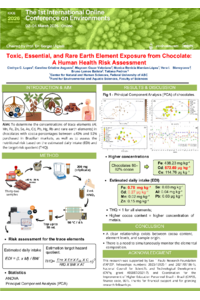
Cacao (Theobroma cacao) serves as the foundational raw material for all chocolate production. The burgeoning scientific interest in chocolate is driven not only by its substantial economic value but also by its complex nutritional profile and the potential benefits associated with its high cacao content. However, the co-occurrence of beneficial bioactive compounds with potentially toxic elements is a food safety concern. Consequently, this study was designed to quantify the concentrations of trace elements across a broad spectrum of commercially available chocolates (ranging from ≤40% to 92% cacao content) procured from Brazilian markets, and to rigorously assess the associated human health risk using the estimated daily intake (EDI) and the target hazard quotient (THQ). A total of thirty-two samples were analysed for Al, Mn, Fe, Zn, Se, As, Cd, Pb and Hg, and rare earth elements (REEs) using Inductively Coupled Plasma Mass Spectrometry (ICP-MS). The maximum measured concentrations were observed for Fe (438.23 mg kg⁻¹), Cd (672.69 μg kg⁻¹) and Ce (114.76 μg kg⁻¹) in chocolates with 80–82% cacao content. The maximum EDI values for the essential and non-essential elements Mn, Fe, Zn, and Se were calculated as 0.02, 0.78, 0.15 and 0.03 mg kg⁻¹ body weight day⁻¹, respectively, while Al reached 0.04 mg kg⁻¹ body weight day⁻¹. For the toxic elements As, Cd, Hg, and Pb, the maximum EDI values were 0.02, 0.27, 0.01 and 0.03 μg kg⁻¹ body weight day⁻¹, respectively. These elevated levels, particularly high in 70% and 82% cacao samples, suggest potential health risks. Despite these findings, the calculated THQ values for Al, As, Cd, Hg, and Pb remained below the threshold of 1. Principal component analysis (PCA) revealed a clear and significant relationship between cacao content, element levels, and the geographical origin of the samples. These results unequivocally underscore the critical need for simultaneous monitoring of both elemental composition and cacao percentage to effectively mitigate consumer exposure to toxic contaminants and ensure food safety standards.
Keywords
Cocoa bars
Trace elements
Rare earth elements
Chemometrics
ICP-MS.
Poster
Poster Cinthya C. Lopes.pdf
Seasonal Dynamics of Earthworm and Microarthropod Communities in rural Home Garden agroecosystems: Linking Soil Properties to Biological Soil Quality
Ecotoxicity threshold of bentazone towards Lactuca sativa under Albufera lake conditions