Event submissions
Published
This submission belongs to the session S6. Galaxies, Clusters and Compact Objects of the event The 3rd International Online Conference on Universe
Published date
27 Feb, 2026
Academic Editor
'%3e%3cpath%20d='M12.6657%2010.9104C12.4185%2010.325%2012.0599%209.79327%2011.6097%209.34482C11.1609%208.89508%2010.6293%208.5365%2010.0442%208.28888C10.0389%208.28626%2010.0337%208.28495%2010.0285%208.28233C10.8446%207.69279%2011.3752%206.73249%2011.3752%205.64904C11.3752%203.8542%209.92103%202.39999%208.1262%202.39999C6.33136%202.39999%204.87715%203.8542%204.87715%205.64904C4.87715%206.73249%205.40774%207.69279%206.22393%208.28364C6.21869%208.28626%206.21345%208.28757%206.20821%208.29019C5.62129%208.5378%205.09463%208.89284%204.64265%209.34613C4.1929%209.79493%203.83432%2010.3266%203.58671%2010.9117C3.34345%2011.4845%203.21226%2012.0987%203.20023%2012.7209C3.19988%2012.7349%203.20233%2012.7488%203.20744%2012.7619C3.21255%2012.7749%203.22022%2012.7867%203.22998%2012.7968C3.23975%2012.8068%203.25142%2012.8147%203.26431%2012.8202C3.2772%2012.8256%203.29105%2012.8284%203.30504%2012.8284H4.09109C4.14874%2012.8284%204.19459%2012.7825%204.1959%2012.7262C4.2221%2011.7148%204.62823%2010.7676%205.34617%2010.0497C6.08899%209.30683%207.0755%208.89808%208.1262%208.89808C9.17689%208.89808%2010.1634%209.30683%2010.9062%2010.0497C11.6242%2010.7676%2012.0303%2011.7148%2012.0565%2012.7262C12.0578%2012.7838%2012.1037%2012.8284%2012.1613%2012.8284H12.9474C12.9613%2012.8284%2012.9752%2012.8256%2012.9881%2012.8202C13.001%2012.8147%2013.0126%2012.8068%2013.0224%2012.7968C13.0322%2012.7867%2013.0398%2012.7749%2013.0449%2012.7619C13.0501%2012.7488%2013.0525%2012.7349%2013.0522%2012.7209C13.0391%2012.0947%2012.9094%2011.4855%2012.6657%2010.9104ZM8.1262%207.9024C7.52486%207.9024%206.9589%207.6679%206.53312%207.24211C6.10733%206.81633%205.87283%206.25037%205.87283%205.64904C5.87283%205.0477%206.10733%204.48174%206.53312%204.05596C6.9589%203.63018%207.52486%203.39567%208.1262%203.39567C8.72753%203.39567%209.29349%203.63018%209.71927%204.05596C10.1451%204.48174%2010.3796%205.0477%2010.3796%205.64904C10.3796%206.25037%2010.1451%206.81633%209.71927%207.24211C9.29349%207.6679%208.72753%207.9024%208.1262%207.9024Z'%20fill='%235D1EE1'/%3e%3c/g%3e%3c/svg%3e) Paola Marziani
Paola MarzianiCitation
Qin Han, Ellis Richard Owen, Kinwah Wu, Yoshiyuki Inoue, Tatsuki Fujiwara, Hayden Ng, The ‘forgotten’ neutrons: implications for the propagation of high-energy cosmic rays in magnetized astrophysical and cosmological structures , in Proceedings of The 3rd International Online Conference on Universe, 4 March–6 March 2026, MDPI: Basel, Switzerland
Share
Email
Facebook
Twitter
LinkedIn
The ‘forgotten’ neutrons: implications for the propagation of high-energy cosmic rays in magnetized astrophysical and cosmological structures
'%3e%3cpath%20d='M12.6647%2010.9104C12.4176%2010.325%2012.0589%209.7933%2011.6088%209.34485C11.16%208.89511%2010.6283%208.53653%2010.0432%208.28891C10.038%208.28629%2010.0327%208.28498%2010.0275%208.28236C10.8437%207.69282%2011.3743%206.73252%2011.3743%205.64907C11.3743%203.85423%209.92005%202.40002%208.12522%202.40002C6.33038%202.40002%204.87618%203.85423%204.87618%205.64907C4.87618%206.73252%205.40677%207.69282%206.22296%208.28367C6.21772%208.28629%206.21248%208.2876%206.20724%208.29022C5.62031%208.53783%205.09365%208.89287%204.64167%209.34616C4.19192%209.79496%203.83334%2010.3266%203.58573%2010.9117C3.34247%2011.4846%203.21128%2012.0987%203.19925%2012.721C3.1989%2012.735%203.20135%2012.7489%203.20646%2012.7619C3.21157%2012.7749%203.21924%2012.7868%203.22901%2012.7968C3.23877%2012.8068%203.25045%2012.8148%203.26334%2012.8202C3.27623%2012.8256%203.29007%2012.8284%203.30406%2012.8284H4.09012C4.14776%2012.8284%204.19362%2012.7825%204.19493%2012.7262C4.22113%2011.7148%204.62726%2010.7676%205.34519%2010.0497C6.08802%209.30686%207.07452%208.89811%208.12522%208.89811C9.17592%208.89811%2010.1624%209.30686%2010.9052%2010.0497C11.6232%2010.7676%2012.0293%2011.7148%2012.0555%2012.7262C12.0568%2012.7839%2012.1027%2012.8284%2012.1603%2012.8284H12.9464C12.9604%2012.8284%2012.9742%2012.8256%2012.9871%2012.8202C13%2012.8148%2013.0117%2012.8068%2013.0214%2012.7968C13.0312%2012.7868%2013.0389%2012.7749%2013.044%2012.7619C13.0491%2012.7489%2013.0515%2012.735%2013.0512%2012.721C13.0381%2012.0947%2012.9084%2011.4856%2012.6647%2010.9104ZM8.12522%207.90243C7.52388%207.90243%206.95792%207.66793%206.53214%207.24215C6.10636%206.81636%205.87185%206.2504%205.87185%205.64907C5.87185%205.04773%206.10636%204.48177%206.53214%204.05599C6.95792%203.63021%207.52388%203.3957%208.12522%203.3957C8.72655%203.3957%209.29252%203.63021%209.7183%204.05599C10.1441%204.48177%2010.3786%205.04773%2010.3786%205.64907C10.3786%206.2504%2010.1441%206.81636%209.7183%207.24215C9.29252%207.66793%208.72655%207.90243%208.12522%207.90243Z'%20fill='%235D1EE1'/%3e%3c/g%3e%3c/svg%3e)
Qin Han 1
Ellis Richard Owen 2,3
Kinwah Wu 4,5,6
Yoshiyuki Inoue 3,4,7
Tatsuki Fujiwara 3
Hayden Ng 8
1. Mullard Space Science Laboratory, University College London, Holmbury St Mary, Surrey, RH5 6NT, United Kingdom
2. Astrophysical Big Bang Laboratory (ABBL), RIKEN Pioneering Research Institute (PRI), Wak\bar{o}, Saitama 351-0198, Japan
3. Theoretical Astrophysics, Department of Earth and Space Science, Graduate School of Science, The University of Osaka, Toyonaka, Osaka 560-0043, Japan
4. Kavli Institute for the Physics and Mathematics of the Universe (WPI), UTIAS, The University of Tokyo, Kashiwa, Chiba 277-8583, Japan
5. Mullard Space Science Laboratory, University College London, Holmbury St. Mary, Surrey RH5 6NT, UK
6. Research School of Astronomy and Astrophysics, Australian National University, Canberra ACT 2611, Australia
7. Interdisciplinary Theoretical & Mathematical Science Program (iTHEMS), RIKEN, 2-1 Hirosawa, Saitama 351-0198, Japan
8. Department of Physics and Astronomy, University College London, Gower Street, London, WC1E 6BT, UK
Abstract
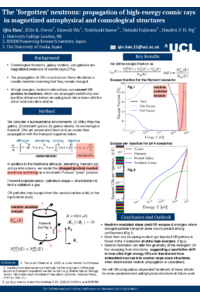
Cosmic rays (CRs) are accelerated in astrophysical systems, such as starburst galaxies, active galactic nuclei and large-scale shocks. These accelerators are usually embedded in the overdense part of the cosmic web, i.e., galaxy clusters and filaments, which are threaded with magnetic fields. Many studies only model the the transport of charged particles in magnetic fields and ignore the secondary neutrons. We explored an alternative route for CR escape—assisted by temporary charge neutral particles, i.e., neutrons. These neutrons are produced in the hadronic interactions of CR protons, and with the aid of time dilation, they may traverse distances larger than galactic scales before decaying into protons. We capture this alternative CR escape channel with a stochastic Poisson term in the transport equation, which also accounts for other processes that attenuate CR flux. We model the CR escape with the neutron-assisted channel for several test cases, representing host sites being a galaxy, galaxy cluster, and filament. We find that the neutron-assisted escape channel is most efficient for ultra-high-energy cosmic rays (E >~ 1e18 eV) and may modify the energy spectrum of CRs at the highest energies. I will present our methodology for modelling CR escape and highlight the importance of incorporating the physics of neutron-assisted CR escape.
Keywords
astroparticle physics
(galaxy) clusters
galaxies
cosmic rays
magnetic fields
cosmological filaments
hadronic interactions
Poster
IOCU2026-Qin-Han.pdf
Gamma-Ray Emission in Narrow-Line Seyfert 1 galaxies: A Fermi LAT study
Spectroscopic study of Ultra-long GRB 220627A