Event submissions
Published
This submission belongs to the session S2. Environmental Impact and Risk Assessment of the event The 1st International Online Conference on Environments
Published date
27 Feb, 2026
Academic Editor
'%3e%3cpath%20d='M12.6657%2010.9104C12.4185%2010.325%2012.0599%209.79327%2011.6097%209.34482C11.1609%208.89508%2010.6293%208.5365%2010.0442%208.28888C10.0389%208.28626%2010.0337%208.28495%2010.0285%208.28233C10.8446%207.69279%2011.3752%206.73249%2011.3752%205.64904C11.3752%203.8542%209.92103%202.39999%208.1262%202.39999C6.33136%202.39999%204.87715%203.8542%204.87715%205.64904C4.87715%206.73249%205.40774%207.69279%206.22393%208.28364C6.21869%208.28626%206.21345%208.28757%206.20821%208.29019C5.62129%208.5378%205.09463%208.89284%204.64265%209.34613C4.1929%209.79493%203.83432%2010.3266%203.58671%2010.9117C3.34345%2011.4845%203.21226%2012.0987%203.20023%2012.7209C3.19988%2012.7349%203.20233%2012.7488%203.20744%2012.7619C3.21255%2012.7749%203.22022%2012.7867%203.22998%2012.7968C3.23975%2012.8068%203.25142%2012.8147%203.26431%2012.8202C3.2772%2012.8256%203.29105%2012.8284%203.30504%2012.8284H4.09109C4.14874%2012.8284%204.19459%2012.7825%204.1959%2012.7262C4.2221%2011.7148%204.62823%2010.7676%205.34617%2010.0497C6.08899%209.30683%207.0755%208.89808%208.1262%208.89808C9.17689%208.89808%2010.1634%209.30683%2010.9062%2010.0497C11.6242%2010.7676%2012.0303%2011.7148%2012.0565%2012.7262C12.0578%2012.7838%2012.1037%2012.8284%2012.1613%2012.8284H12.9474C12.9613%2012.8284%2012.9752%2012.8256%2012.9881%2012.8202C13.001%2012.8147%2013.0126%2012.8068%2013.0224%2012.7968C13.0322%2012.7867%2013.0398%2012.7749%2013.0449%2012.7619C13.0501%2012.7488%2013.0525%2012.7349%2013.0522%2012.7209C13.0391%2012.0947%2012.9094%2011.4855%2012.6657%2010.9104ZM8.1262%207.9024C7.52486%207.9024%206.9589%207.6679%206.53312%207.24211C6.10733%206.81633%205.87283%206.25037%205.87283%205.64904C5.87283%205.0477%206.10733%204.48174%206.53312%204.05596C6.9589%203.63018%207.52486%203.39567%208.1262%203.39567C8.72753%203.39567%209.29349%203.63018%209.71927%204.05596C10.1451%204.48174%2010.3796%205.0477%2010.3796%205.64904C10.3796%206.25037%2010.1451%206.81633%209.71927%207.24211C9.29349%207.6679%208.72753%207.9024%208.1262%207.9024Z'%20fill='%235D1EE1'/%3e%3c/g%3e%3c/svg%3e) Ioannis Kalavrouziotis
Ioannis KalavrouziotisCitation
Isabela Simion, Raluca Maria Hlihor, Petronela Cozma, Alessandra Bonoli, From gray water to green solutions: Life Cycle Sustainability Assessment of heavy metals removal using inactive yeast, in Proceedings of The 1st International Online Conference on Environments, 2 March–4 March 2026, MDPI: Basel, Switzerland
Share
Email
Facebook
Twitter
LinkedIn
From gray water to green solutions: Life Cycle Sustainability Assessment of heavy metals removal using inactive yeast

Isabela Simion 1

Raluca Maria Hlihor 1

Petronela Cozma 2

Alessandra Bonoli 3
1. “Ion Ionescu de la Brad” Iasi University of Life Sciences, 3 Mihail Sadoveanu Alley, 700490 Iasi, Romania
2. “Gheorghe Asachi” Technical University of Iasi, 73 Prof. D. Mangeron Blvd., 700050 Iasi, Romania
3. Alma Mater Studiorum-Università di Bologna, Via Terracini, 28, 40131 Bologna
Abstract
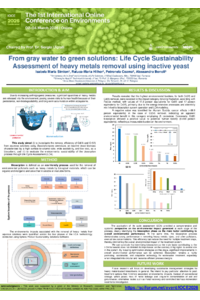
Due to increasing anthropogenic pressures, significant quantities of heavy metals are released into the environment, posing severe risks to human health because of their persistence, non-biodegradability, and long-term accumulation within ecosystems. This study aimed (i) to investigate the removal efficiency of Cd(II) and Cr(VI) from aqueous solutions using Saccharomyces cerevisiae, an inactive yeast biomass characterized by a high surface-to-volume ratio, wide availability, and low cost, as a biosorbent; and (ii) to evaluate the environmental sustainability of the biosorption process through Life Cycle Assessment (LCA).
The environmental impacts associated with biosorption were quantified across the four phases of the LCA methodology, conducted using Sphera Product Sustainability Solutions Software. The results revealed that the highest environmental burdens, for both Cr(VI) and Cd(II) removal, were recorded in the impact category Ionizing Radiation, with values of 17.8 person equivalents for Cd(II) and 17 person equivalents for Cr(VI), primarily due to the energy-intensive processes and electricity mix linked to biosorption system operation and LCA modeling.
A negative value was identified for Human Toxicity, cancer effects (–38.9 person equivalents) in the case of Cr(VI) removal indicating an apparent environmental benefit in this category employing S. cerevisiae. Conversely, Cd(II) biosorption showed a positive value to potential human toxicity (0.458 person equivalents), reflecting a measurable burden on the environment.
The application of LCA provided a comprehensive perspective on the environmental impacts generated at each stage, highlighting the biosorption phase as the main contributor to the overall environmental performance.
Keywords
Gray water
environmental impact
LCA methodology
Poster
Simion et al._Environments 2026.pdf
Water Governance in a Climate-Stressed Context: Benchmarking Morocco Against Four International Models
Leveraging Machine Learning for Early Detection and Monitoring of Xylella fastidiosa in Olive Cultivation: Implications for Technological Diffusion