Event submissions
Published
This submission belongs to the session S6. Ecological, Environmental and Circular Economics of the event The 1st International Online Conference on Environments
Published date
27 Feb, 2026
Academic Editor
'%3e%3cpath%20d='M12.6657%2010.9104C12.4185%2010.325%2012.0599%209.79327%2011.6097%209.34482C11.1609%208.89508%2010.6293%208.5365%2010.0442%208.28888C10.0389%208.28626%2010.0337%208.28495%2010.0285%208.28233C10.8446%207.69279%2011.3752%206.73249%2011.3752%205.64904C11.3752%203.8542%209.92103%202.39999%208.1262%202.39999C6.33136%202.39999%204.87715%203.8542%204.87715%205.64904C4.87715%206.73249%205.40774%207.69279%206.22393%208.28364C6.21869%208.28626%206.21345%208.28757%206.20821%208.29019C5.62129%208.5378%205.09463%208.89284%204.64265%209.34613C4.1929%209.79493%203.83432%2010.3266%203.58671%2010.9117C3.34345%2011.4845%203.21226%2012.0987%203.20023%2012.7209C3.19988%2012.7349%203.20233%2012.7488%203.20744%2012.7619C3.21255%2012.7749%203.22022%2012.7867%203.22998%2012.7968C3.23975%2012.8068%203.25142%2012.8147%203.26431%2012.8202C3.2772%2012.8256%203.29105%2012.8284%203.30504%2012.8284H4.09109C4.14874%2012.8284%204.19459%2012.7825%204.1959%2012.7262C4.2221%2011.7148%204.62823%2010.7676%205.34617%2010.0497C6.08899%209.30683%207.0755%208.89808%208.1262%208.89808C9.17689%208.89808%2010.1634%209.30683%2010.9062%2010.0497C11.6242%2010.7676%2012.0303%2011.7148%2012.0565%2012.7262C12.0578%2012.7838%2012.1037%2012.8284%2012.1613%2012.8284H12.9474C12.9613%2012.8284%2012.9752%2012.8256%2012.9881%2012.8202C13.001%2012.8147%2013.0126%2012.8068%2013.0224%2012.7968C13.0322%2012.7867%2013.0398%2012.7749%2013.0449%2012.7619C13.0501%2012.7488%2013.0525%2012.7349%2013.0522%2012.7209C13.0391%2012.0947%2012.9094%2011.4855%2012.6657%2010.9104ZM8.1262%207.9024C7.52486%207.9024%206.9589%207.6679%206.53312%207.24211C6.10733%206.81633%205.87283%206.25037%205.87283%205.64904C5.87283%205.0477%206.10733%204.48174%206.53312%204.05596C6.9589%203.63018%207.52486%203.39567%208.1262%203.39567C8.72753%203.39567%209.29349%203.63018%209.71927%204.05596C10.1451%204.48174%2010.3796%205.0477%2010.3796%205.64904C10.3796%206.25037%2010.1451%206.81633%209.71927%207.24211C9.29349%207.6679%208.72753%207.9024%208.1262%207.9024Z'%20fill='%235D1EE1'/%3e%3c/g%3e%3c/svg%3e) WALTER ALBERTO PENGUE
WALTER ALBERTO PENGUECitation
Sue Ira, Robyn Simcock, Iresh Jayawardena, Reframing Nature-based Solution Valuation through Complexity and Life-Cycle Planning: Evidence from Raingarden Performance in Auckland, New Zealand, in Proceedings of The 1st International Online Conference on Environments, 2 March–4 March 2026, MDPI: Basel, Switzerland
Share
Email
Facebook
Twitter
LinkedIn
Reframing Nature-based Solution Valuation through Complexity and Life-Cycle Planning: Evidence from Raingarden Performance in Auckland, New Zealand
'%3e%3cpath%20d='M12.6647%2010.9104C12.4176%2010.325%2012.0589%209.7933%2011.6088%209.34485C11.16%208.89511%2010.6283%208.53653%2010.0432%208.28891C10.038%208.28629%2010.0327%208.28498%2010.0275%208.28236C10.8437%207.69282%2011.3743%206.73252%2011.3743%205.64907C11.3743%203.85423%209.92005%202.40002%208.12522%202.40002C6.33038%202.40002%204.87618%203.85423%204.87618%205.64907C4.87618%206.73252%205.40677%207.69282%206.22296%208.28367C6.21772%208.28629%206.21248%208.2876%206.20724%208.29022C5.62031%208.53783%205.09365%208.89287%204.64167%209.34616C4.19192%209.79496%203.83334%2010.3266%203.58573%2010.9117C3.34247%2011.4846%203.21128%2012.0987%203.19925%2012.721C3.1989%2012.735%203.20135%2012.7489%203.20646%2012.7619C3.21157%2012.7749%203.21924%2012.7868%203.22901%2012.7968C3.23877%2012.8068%203.25045%2012.8148%203.26334%2012.8202C3.27623%2012.8256%203.29007%2012.8284%203.30406%2012.8284H4.09012C4.14776%2012.8284%204.19362%2012.7825%204.19493%2012.7262C4.22113%2011.7148%204.62726%2010.7676%205.34519%2010.0497C6.08802%209.30686%207.07452%208.89811%208.12522%208.89811C9.17592%208.89811%2010.1624%209.30686%2010.9052%2010.0497C11.6232%2010.7676%2012.0293%2011.7148%2012.0555%2012.7262C12.0568%2012.7839%2012.1027%2012.8284%2012.1603%2012.8284H12.9464C12.9604%2012.8284%2012.9742%2012.8256%2012.9871%2012.8202C13%2012.8148%2013.0117%2012.8068%2013.0214%2012.7968C13.0312%2012.7868%2013.0389%2012.7749%2013.044%2012.7619C13.0491%2012.7489%2013.0515%2012.735%2013.0512%2012.721C13.0381%2012.0947%2012.9084%2011.4856%2012.6647%2010.9104ZM8.12522%207.90243C7.52388%207.90243%206.95792%207.66793%206.53214%207.24215C6.10636%206.81636%205.87185%206.2504%205.87185%205.64907C5.87185%205.04773%206.10636%204.48177%206.53214%204.05599C6.95792%203.63021%207.52388%203.3957%208.12522%203.3957C8.72655%203.3957%209.29252%203.63021%209.7183%204.05599C10.1441%204.48177%2010.3786%205.04773%2010.3786%205.64907C10.3786%206.2504%2010.1441%206.81636%209.7183%207.24215C9.29252%207.66793%208.72655%207.90243%208.12522%207.90243Z'%20fill='%235D1EE1'/%3e%3c/g%3e%3c/svg%3e)
Sue Ira 1
Robyn Simcock 2
Iresh Jayawardena 1
1. Faculty of Engineering and Design, Architecture and Planning, University of Auckland, Auckland 1142, New Zealand, New Zealand
2. Manaaki Whenua - Landcare Research Group, Bioeconomy Science Institute, Auckland 1072, New Zealand, New Zealand
Abstract
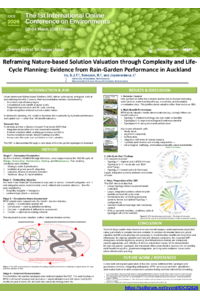
Urban Nature-based Solutions (NbSs) offer multiple hydrological, ecological, cultural, and wellbeing benefits, yet their uptake remains constrained by economic appraisal frameworks that prioritise monetised, short-term outcomes and overlook wider co-benefits. Building on a recently developed economic valuation Decision Support Framework (DSF), this doctoral research advances a holistic approach that integrates measurable and non-measurable benefits across the life cycle of stormwater infrastructure. The framework is applied to a detailed raingarden typology case study in Auckland, New Zealand. Four raingarden typologies were identified across greenfield developments through field surveys, distinguished by size, configuration, and location. The DSF’s complexity-aware decision pathway (adapted from Cynefin) was used to identify the appropriate valuation methods. This led to a combined qualitative and semi-quantitative assessment of benefits using the More Than Water (MTW) framework, alongside a life-cycle cost (LCC) evaluation. The DSF enabled explicit alignment of benefit types with decision-making contexts, revealing where monetised assessment is suitable (e.g., avoided material costs) and where semi-quantitative or qualitative valuation is required (e.g., biodiversity enhancement, urban cooling, shading, safety, placemaking). MTW results showed that raingarden typology strongly influences both the type and magnitude of multi-benefit outcomes, with media depth, vegetation complexity, and surface area emerging as dominant drivers of non-water benefits. While hydraulic and water-quality performance was broadly comparable across typologies, more complex designs generated markedly greater ecological, resilience, and wellbeing outcomes — benefits typically overlooked in conventional cost-efficiency analysis. LCC results further indicated that larger typologies achieve lower life-cycle costs due to economies of scale. The case study demonstrates that the DSF offers a practical, transferable method for embedding plural valuation and complexity-aware decision-making into stormwater planning. Its application reveals patterns of benefit realisation not captured by traditional cost–benefit analysis, supporting a shift toward more resilient, equitable, and system-aligned NbS investment in New Zealand and internationally.
Keywords
Nature-based solutions
benefits
costs
Cynefin
decision support frame-work
rain gardens
Poster
sciforum-162097.pdf
Regeneration of Modified Abies marocana Biosorbents for Methylene Blue Removal: Advancing Circular Economy in Sustainable Wastewater Treatment
Greywater footprint reduction by agro-industrial biochar for brewery wastewater treatment: A data-driven parametric model