Event submissions
Published
This submission belongs to the session S4. Urban Systems and Ecosystems: Dynamics and Functioning of the event The 1st International Online Conference on Environments
Published date
27 Feb, 2026
Academic Editor
'%3e%3cpath%20d='M12.6657%2010.9104C12.4185%2010.325%2012.0599%209.79327%2011.6097%209.34482C11.1609%208.89508%2010.6293%208.5365%2010.0442%208.28888C10.0389%208.28626%2010.0337%208.28495%2010.0285%208.28233C10.8446%207.69279%2011.3752%206.73249%2011.3752%205.64904C11.3752%203.8542%209.92103%202.39999%208.1262%202.39999C6.33136%202.39999%204.87715%203.8542%204.87715%205.64904C4.87715%206.73249%205.40774%207.69279%206.22393%208.28364C6.21869%208.28626%206.21345%208.28757%206.20821%208.29019C5.62129%208.5378%205.09463%208.89284%204.64265%209.34613C4.1929%209.79493%203.83432%2010.3266%203.58671%2010.9117C3.34345%2011.4845%203.21226%2012.0987%203.20023%2012.7209C3.19988%2012.7349%203.20233%2012.7488%203.20744%2012.7619C3.21255%2012.7749%203.22022%2012.7867%203.22998%2012.7968C3.23975%2012.8068%203.25142%2012.8147%203.26431%2012.8202C3.2772%2012.8256%203.29105%2012.8284%203.30504%2012.8284H4.09109C4.14874%2012.8284%204.19459%2012.7825%204.1959%2012.7262C4.2221%2011.7148%204.62823%2010.7676%205.34617%2010.0497C6.08899%209.30683%207.0755%208.89808%208.1262%208.89808C9.17689%208.89808%2010.1634%209.30683%2010.9062%2010.0497C11.6242%2010.7676%2012.0303%2011.7148%2012.0565%2012.7262C12.0578%2012.7838%2012.1037%2012.8284%2012.1613%2012.8284H12.9474C12.9613%2012.8284%2012.9752%2012.8256%2012.9881%2012.8202C13.001%2012.8147%2013.0126%2012.8068%2013.0224%2012.7968C13.0322%2012.7867%2013.0398%2012.7749%2013.0449%2012.7619C13.0501%2012.7488%2013.0525%2012.7349%2013.0522%2012.7209C13.0391%2012.0947%2012.9094%2011.4855%2012.6657%2010.9104ZM8.1262%207.9024C7.52486%207.9024%206.9589%207.6679%206.53312%207.24211C6.10733%206.81633%205.87283%206.25037%205.87283%205.64904C5.87283%205.0477%206.10733%204.48174%206.53312%204.05596C6.9589%203.63018%207.52486%203.39567%208.1262%203.39567C8.72753%203.39567%209.29349%203.63018%209.71927%204.05596C10.1451%204.48174%2010.3796%205.0477%2010.3796%205.64904C10.3796%206.25037%2010.1451%206.81633%209.71927%207.24211C9.29349%207.6679%208.72753%207.9024%208.1262%207.9024Z'%20fill='%235D1EE1'/%3e%3c/g%3e%3c/svg%3e) Brian Fath
Brian FathCitation
Mithila Mattoo, Virendra Kumar Paul, Quantifying Dignity in Urban Ecosystems: A Framework for Inclusive and Sustainable Aging in Indian Cities, in Proceedings of The 1st International Online Conference on Environments, 2 March–4 March 2026, MDPI: Basel, Switzerland
Share
Email
Facebook
Twitter
LinkedIn
Quantifying Dignity in Urban Ecosystems: A Framework for Inclusive and Sustainable Aging in Indian Cities

Mithila Mattoo 1
'%3e%3cpath%20d='M12.6647%2010.9104C12.4176%2010.325%2012.0589%209.7933%2011.6088%209.34485C11.16%208.89511%2010.6283%208.53653%2010.0432%208.28891C10.038%208.28629%2010.0327%208.28498%2010.0275%208.28236C10.8437%207.69282%2011.3743%206.73252%2011.3743%205.64907C11.3743%203.85423%209.92005%202.40002%208.12522%202.40002C6.33038%202.40002%204.87618%203.85423%204.87618%205.64907C4.87618%206.73252%205.40677%207.69282%206.22296%208.28367C6.21772%208.28629%206.21248%208.2876%206.20724%208.29022C5.62031%208.53783%205.09365%208.89287%204.64167%209.34616C4.19192%209.79496%203.83334%2010.3266%203.58573%2010.9117C3.34247%2011.4846%203.21128%2012.0987%203.19925%2012.721C3.1989%2012.735%203.20135%2012.7489%203.20646%2012.7619C3.21157%2012.7749%203.21924%2012.7868%203.22901%2012.7968C3.23877%2012.8068%203.25045%2012.8148%203.26334%2012.8202C3.27623%2012.8256%203.29007%2012.8284%203.30406%2012.8284H4.09012C4.14776%2012.8284%204.19362%2012.7825%204.19493%2012.7262C4.22113%2011.7148%204.62726%2010.7676%205.34519%2010.0497C6.08802%209.30686%207.07452%208.89811%208.12522%208.89811C9.17592%208.89811%2010.1624%209.30686%2010.9052%2010.0497C11.6232%2010.7676%2012.0293%2011.7148%2012.0555%2012.7262C12.0568%2012.7839%2012.1027%2012.8284%2012.1603%2012.8284H12.9464C12.9604%2012.8284%2012.9742%2012.8256%2012.9871%2012.8202C13%2012.8148%2013.0117%2012.8068%2013.0214%2012.7968C13.0312%2012.7868%2013.0389%2012.7749%2013.044%2012.7619C13.0491%2012.7489%2013.0515%2012.735%2013.0512%2012.721C13.0381%2012.0947%2012.9084%2011.4856%2012.6647%2010.9104ZM8.12522%207.90243C7.52388%207.90243%206.95792%207.66793%206.53214%207.24215C6.10636%206.81636%205.87185%206.2504%205.87185%205.64907C5.87185%205.04773%206.10636%204.48177%206.53214%204.05599C6.95792%203.63021%207.52388%203.3957%208.12522%203.3957C8.72655%203.3957%209.29252%203.63021%209.7183%204.05599C10.1441%204.48177%2010.3786%205.04773%2010.3786%205.64907C10.3786%206.2504%2010.1441%206.81636%209.7183%207.24215C9.29252%207.66793%208.72655%207.90243%208.12522%207.90243Z'%20fill='%235D1EE1'/%3e%3c/g%3e%3c/svg%3e)
Virendra Kumar Paul 1
1. Department of Building Engineering and Management, School of Planning and Architecture, Delhi, New Delhi, 110002, India
Abstract
According to the UNFPA, India's ageing population is expected to reach 347 million by 2050. Despite these demographic changes, the urban systems continue to prioritise "planning for the car" and digital efficiency over empathy, accessibility, social inclusion, and human-centred design. This study introduces dignity as a quantifiable indicator of the urban ecosystem functioning, bridging sustainability, spatial justice, and the lived experience of the ageing population. By building upon available age-friendly frameworks, the research develops an assessment tool to measure how urban ecosystems collectively sustain or impede dignity.
The study focuses on Jammu, a Smart City under India's Smart City mission, with a higher life expectancy than the national average, as a representative case study of infrastructural modernisation, in contrast to the socio-spatial inequalities.
A mixed-methods design combines qualitative interviews with the ageing population (n~ 30) to capture their lived experiences with quantitative surveys (n~ 150) that operationalise these perceptions into measurable indicators such as mobility, accessibility, walkability, safety, social participation, urban green spaces, digital inclusion, and more. Spatial mapping and correlation analyses are employed to examine how these indicators interact to shape the perceived dignity and ecosystem functioning across Jammu's various neighbourhoods.
Findings suggest that dignity can be quantified and spatially represented through these determinants. In Jammu, despite progress in digital infrastructure, accessibility, safety, and citizen participation remain largely overlooked, resulting in isolated “pockets of inclusion” and widespread inequity. The proposed framework advances age-friendly design by (i) establishing dignity as an equitable and quantifiable construct, (ii) integrating subjective lived experience with spatially explicit indicators, and (iii) embedding dignity metrics within the city-scale Smart City paradigm by assessing how technology and infrastructure collectively shape older adults’ autonomy, safety, and dignity, rather than limiting technology to smart homes. This provides a replicable framework for assessing and shaping compassionate, inclusive, and truly ageless cities.
Keywords
Dignity
Urban ecosystems
Age-friendly cities
Smart Cities Mission
Inclusive aging
Sustainable urbanism
Walkability
Accessibility
Human-centered Design
Affordances
Poster
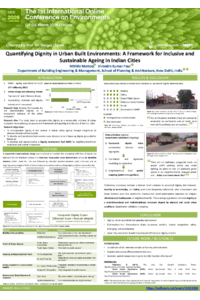
Article ID_sciforum 158364_Mithila Mattoo_Virendra Kumar Paul_260326.pdf
Decoupling Traffic Growth and Air Pollution: Evidence-Based Strategies for Sustainable Urban Mobility in Jakarta
Towards a Green City in the Face of Climate Change: Biodiversity Restoration of an Urban Park in a North African Mediterranean Context