Event submissions
Published
This submission belongs to the session 7. Agroecology and Sustainable Plant Protection Practices of the event The 1st International Electronic Conference on Plant Protection
Published date
01 Mar, 2026
Academic Editor
'%3e%3cpath%20d='M12.6657%2010.9104C12.4185%2010.325%2012.0599%209.79327%2011.6097%209.34482C11.1609%208.89508%2010.6293%208.5365%2010.0442%208.28888C10.0389%208.28626%2010.0337%208.28495%2010.0285%208.28233C10.8446%207.69279%2011.3752%206.73249%2011.3752%205.64904C11.3752%203.8542%209.92103%202.39999%208.1262%202.39999C6.33136%202.39999%204.87715%203.8542%204.87715%205.64904C4.87715%206.73249%205.40774%207.69279%206.22393%208.28364C6.21869%208.28626%206.21345%208.28757%206.20821%208.29019C5.62129%208.5378%205.09463%208.89284%204.64265%209.34613C4.1929%209.79493%203.83432%2010.3266%203.58671%2010.9117C3.34345%2011.4845%203.21226%2012.0987%203.20023%2012.7209C3.19988%2012.7349%203.20233%2012.7488%203.20744%2012.7619C3.21255%2012.7749%203.22022%2012.7867%203.22998%2012.7968C3.23975%2012.8068%203.25142%2012.8147%203.26431%2012.8202C3.2772%2012.8256%203.29105%2012.8284%203.30504%2012.8284H4.09109C4.14874%2012.8284%204.19459%2012.7825%204.1959%2012.7262C4.2221%2011.7148%204.62823%2010.7676%205.34617%2010.0497C6.08899%209.30683%207.0755%208.89808%208.1262%208.89808C9.17689%208.89808%2010.1634%209.30683%2010.9062%2010.0497C11.6242%2010.7676%2012.0303%2011.7148%2012.0565%2012.7262C12.0578%2012.7838%2012.1037%2012.8284%2012.1613%2012.8284H12.9474C12.9613%2012.8284%2012.9752%2012.8256%2012.9881%2012.8202C13.001%2012.8147%2013.0126%2012.8068%2013.0224%2012.7968C13.0322%2012.7867%2013.0398%2012.7749%2013.0449%2012.7619C13.0501%2012.7488%2013.0525%2012.7349%2013.0522%2012.7209C13.0391%2012.0947%2012.9094%2011.4855%2012.6657%2010.9104ZM8.1262%207.9024C7.52486%207.9024%206.9589%207.6679%206.53312%207.24211C6.10733%206.81633%205.87283%206.25037%205.87283%205.64904C5.87283%205.0477%206.10733%204.48174%206.53312%204.05596C6.9589%203.63018%207.52486%203.39567%208.1262%203.39567C8.72753%203.39567%209.29349%203.63018%209.71927%204.05596C10.1451%204.48174%2010.3796%205.0477%2010.3796%205.64904C10.3796%206.25037%2010.1451%206.81633%209.71927%207.24211C9.29349%207.6679%208.72753%207.9024%208.1262%207.9024Z'%20fill='%235D1EE1'/%3e%3c/g%3e%3c/svg%3e) Jorge M. S. Faria
Jorge M. S. FariaCitation
Dario Gaudioso, Chiara Pastacaldi, Cosimo Beltrami, Leone Boatto, Lorenzo Giorgi, Stefania Tegli, Dose- and species-dependent effects of wood vinegar as a biostimulant in soilless cultivation systems, in Proceedings of The 1st International Electronic Conference on Plant Protection, 2 March–8 March 2026, MDPI: Basel, Switzerland
Share
Email
Facebook
Twitter
LinkedIn
Dose- and species-dependent effects of wood vinegar as a biostimulant in soilless cultivation systems

Dario Gaudioso 1
'%3e%3cpath%20d='M12.6647%2010.9104C12.4176%2010.325%2012.0589%209.7933%2011.6088%209.34485C11.16%208.89511%2010.6283%208.53653%2010.0432%208.28891C10.038%208.28629%2010.0327%208.28498%2010.0275%208.28236C10.8437%207.69282%2011.3743%206.73252%2011.3743%205.64907C11.3743%203.85423%209.92005%202.40002%208.12522%202.40002C6.33038%202.40002%204.87618%203.85423%204.87618%205.64907C4.87618%206.73252%205.40677%207.69282%206.22296%208.28367C6.21772%208.28629%206.21248%208.2876%206.20724%208.29022C5.62031%208.53783%205.09365%208.89287%204.64167%209.34616C4.19192%209.79496%203.83334%2010.3266%203.58573%2010.9117C3.34247%2011.4846%203.21128%2012.0987%203.19925%2012.721C3.1989%2012.735%203.20135%2012.7489%203.20646%2012.7619C3.21157%2012.7749%203.21924%2012.7868%203.22901%2012.7968C3.23877%2012.8068%203.25045%2012.8148%203.26334%2012.8202C3.27623%2012.8256%203.29007%2012.8284%203.30406%2012.8284H4.09012C4.14776%2012.8284%204.19362%2012.7825%204.19493%2012.7262C4.22113%2011.7148%204.62726%2010.7676%205.34519%2010.0497C6.08802%209.30686%207.07452%208.89811%208.12522%208.89811C9.17592%208.89811%2010.1624%209.30686%2010.9052%2010.0497C11.6232%2010.7676%2012.0293%2011.7148%2012.0555%2012.7262C12.0568%2012.7839%2012.1027%2012.8284%2012.1603%2012.8284H12.9464C12.9604%2012.8284%2012.9742%2012.8256%2012.9871%2012.8202C13%2012.8148%2013.0117%2012.8068%2013.0214%2012.7968C13.0312%2012.7868%2013.0389%2012.7749%2013.044%2012.7619C13.0491%2012.7489%2013.0515%2012.735%2013.0512%2012.721C13.0381%2012.0947%2012.9084%2011.4856%2012.6647%2010.9104ZM8.12522%207.90243C7.52388%207.90243%206.95792%207.66793%206.53214%207.24215C6.10636%206.81636%205.87185%206.2504%205.87185%205.64907C5.87185%205.04773%206.10636%204.48177%206.53214%204.05599C6.95792%203.63021%207.52388%203.3957%208.12522%203.3957C8.72655%203.3957%209.29252%203.63021%209.7183%204.05599C10.1441%204.48177%2010.3786%205.04773%2010.3786%205.64907C10.3786%206.2504%2010.1441%206.81636%209.7183%207.24215C9.29252%207.66793%208.72655%207.90243%208.12522%207.90243Z'%20fill='%235D1EE1'/%3e%3c/g%3e%3c/svg%3e)
Chiara Pastacaldi 2
Cosimo Beltrami 2
Leone Boatto 2
Lorenzo Giorgi 2

Stefania Tegli 2
1. University of Florence, Italy
2. Laboratorio di Patologia Vegetale Molecolare, Dipartimento di Scienze e Tecnologie Agrarie, Alimentari Ambientali e Forestali (DAGRI), Università degli Studi di Firenze, Florence, Italy, Italy
Abstract
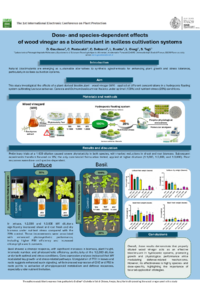
Natural biostimulants represent a sustainable alternative to synthetic agrochemicals for improving plant growth and resilience, particularly in soilless cultivation systems. This study evaluated the effects of three plant-derived biostimulants—wood vinegar (WV), willow extract, and eucalyptus extract—applied at different concentrations in a hydroponic floating system for the cultivation of Lactuca sativa var. Canasta and Ocimum basilicum var. Italiano, under both optimal nutrient supply (100%) and nutrient-stress (20%) conditions.
Preliminary applications at a 1:600 dilution induced marked phytotoxic effects in both species, resulting in significant reductions in shoot and root biomass. Consequently, subsequent experiments focused on WV, the only commercial product among those tested, applied at higher dilutions (1:1,000, 1:2,000, and 1:3,000). Plant responses were strongly dose- and species-dependent. In lettuce, the 1:2,000 and 1:3,000 WV dilutions significantly enhanced leaf and root fresh and dry biomass under nutrient-stress conditions compared with the 20% control, alongside improved photosynthetic performance, as evidenced by increased PSII efficiency and higher chlorophyll a and b contents determined spectrophotometrically.
Basil exhibited an even more pronounced response, showing significant increases in shoot and root biomass, plant height, internode number, and photosynthetic efficiency, particularly at the 1:2,000 dilution under both optimal and stress conditions. Molecular analyses revealed that WV modulated the expression of genes associated with growth and stress responses. Increased expression of TIR1 in both leaves and roots suggests enhanced auxin signaling, while upregulation of CHS and PR5 in roots indicates activation of phenylpropanoid metabolism and defense-related pathways, especially under nutrient stress.
Overall, these findings demonstrate that appropriately diluted wood vinegar can function as an effective biostimulant in hydroponic systems by enhancing plant growth and modulating physiological and defense mechanisms. However, its efficacy is highly species- and dose-dependent, emphasizing the need for crop-specific application strategies.
Keywords
Wood vinegar
plant biostimulants
hydroponic cultivation
nutrient stress
Poster
IECP_Dario_Gaudioso_2026.pdf
Harnessing chestnut-derived bioproducts to strengthen plant defense mechanisms
Assessment of entomopathogenic fungi as a biocontrol agent against green leafhopper in Douro vineyards