Event submissions
Published
This submission belongs to the session S3. Nanominerals and Clays: Emerging Applications in Materials Science of the event The 3rd International Online Conference on Mineral Science
Published date
06 Mar, 2026
Academic Editor
'%3e%3cpath%20d='M12.6657%2010.9104C12.4185%2010.325%2012.0599%209.79327%2011.6097%209.34482C11.1609%208.89508%2010.6293%208.5365%2010.0442%208.28888C10.0389%208.28626%2010.0337%208.28495%2010.0285%208.28233C10.8446%207.69279%2011.3752%206.73249%2011.3752%205.64904C11.3752%203.8542%209.92103%202.39999%208.1262%202.39999C6.33136%202.39999%204.87715%203.8542%204.87715%205.64904C4.87715%206.73249%205.40774%207.69279%206.22393%208.28364C6.21869%208.28626%206.21345%208.28757%206.20821%208.29019C5.62129%208.5378%205.09463%208.89284%204.64265%209.34613C4.1929%209.79493%203.83432%2010.3266%203.58671%2010.9117C3.34345%2011.4845%203.21226%2012.0987%203.20023%2012.7209C3.19988%2012.7349%203.20233%2012.7488%203.20744%2012.7619C3.21255%2012.7749%203.22022%2012.7867%203.22998%2012.7968C3.23975%2012.8068%203.25142%2012.8147%203.26431%2012.8202C3.2772%2012.8256%203.29105%2012.8284%203.30504%2012.8284H4.09109C4.14874%2012.8284%204.19459%2012.7825%204.1959%2012.7262C4.2221%2011.7148%204.62823%2010.7676%205.34617%2010.0497C6.08899%209.30683%207.0755%208.89808%208.1262%208.89808C9.17689%208.89808%2010.1634%209.30683%2010.9062%2010.0497C11.6242%2010.7676%2012.0303%2011.7148%2012.0565%2012.7262C12.0578%2012.7838%2012.1037%2012.8284%2012.1613%2012.8284H12.9474C12.9613%2012.8284%2012.9752%2012.8256%2012.9881%2012.8202C13.001%2012.8147%2013.0126%2012.8068%2013.0224%2012.7968C13.0322%2012.7867%2013.0398%2012.7749%2013.0449%2012.7619C13.0501%2012.7488%2013.0525%2012.7349%2013.0522%2012.7209C13.0391%2012.0947%2012.9094%2011.4855%2012.6657%2010.9104ZM8.1262%207.9024C7.52486%207.9024%206.9589%207.6679%206.53312%207.24211C6.10733%206.81633%205.87283%206.25037%205.87283%205.64904C5.87283%205.0477%206.10733%204.48174%206.53312%204.05596C6.9589%203.63018%207.52486%203.39567%208.1262%203.39567C8.72753%203.39567%209.29349%203.63018%209.71927%204.05596C10.1451%204.48174%2010.3796%205.0477%2010.3796%205.64904C10.3796%206.25037%2010.1451%206.81633%209.71927%207.24211C9.29349%207.6679%208.72753%207.9024%208.1262%207.9024Z'%20fill='%235D1EE1'/%3e%3c/g%3e%3c/svg%3e) Andrey Kalinichev
Andrey KalinichevCitation
Sevinj Natiq Hamidova, Lala Rasim Gahramanlı, Thermal Behaviour and Structural Optimization of SiC-Reinforced Polypropylene and Polystyrene Nanocomposites: Mineral-Based Fillers for Advanced Thermal-Management Materials, in Proceedings of The 3rd International Online Conference on Mineral Science, 10 March–12 March 2026, MDPI: Basel, Switzerland
Share
Email
Facebook
Twitter
LinkedIn
Thermal Behaviour and Structural Optimization of SiC-Reinforced Polypropylene and Polystyrene Nanocomposites: Mineral-Based Fillers for Advanced Thermal-Management Materials
Thermal Behaviour and Structural Optimization of SiC-Reinforced Polypropylene and Polystyrene Nanocomposites: Mineral-Based Fillers for Advanced Thermal-Management Materials
'%3e%3cpath%20d='M12.6647%2010.9104C12.4176%2010.325%2012.0589%209.7933%2011.6088%209.34485C11.16%208.89511%2010.6283%208.53653%2010.0432%208.28891C10.038%208.28629%2010.0327%208.28498%2010.0275%208.28236C10.8437%207.69282%2011.3743%206.73252%2011.3743%205.64907C11.3743%203.85423%209.92005%202.40002%208.12522%202.40002C6.33038%202.40002%204.87618%203.85423%204.87618%205.64907C4.87618%206.73252%205.40677%207.69282%206.22296%208.28367C6.21772%208.28629%206.21248%208.2876%206.20724%208.29022C5.62031%208.53783%205.09365%208.89287%204.64167%209.34616C4.19192%209.79496%203.83334%2010.3266%203.58573%2010.9117C3.34247%2011.4846%203.21128%2012.0987%203.19925%2012.721C3.1989%2012.735%203.20135%2012.7489%203.20646%2012.7619C3.21157%2012.7749%203.21924%2012.7868%203.22901%2012.7968C3.23877%2012.8068%203.25045%2012.8148%203.26334%2012.8202C3.27623%2012.8256%203.29007%2012.8284%203.30406%2012.8284H4.09012C4.14776%2012.8284%204.19362%2012.7825%204.19493%2012.7262C4.22113%2011.7148%204.62726%2010.7676%205.34519%2010.0497C6.08802%209.30686%207.07452%208.89811%208.12522%208.89811C9.17592%208.89811%2010.1624%209.30686%2010.9052%2010.0497C11.6232%2010.7676%2012.0293%2011.7148%2012.0555%2012.7262C12.0568%2012.7839%2012.1027%2012.8284%2012.1603%2012.8284H12.9464C12.9604%2012.8284%2012.9742%2012.8256%2012.9871%2012.8202C13%2012.8148%2013.0117%2012.8068%2013.0214%2012.7968C13.0312%2012.7868%2013.0389%2012.7749%2013.044%2012.7619C13.0491%2012.7489%2013.0515%2012.735%2013.0512%2012.721C13.0381%2012.0947%2012.9084%2011.4856%2012.6647%2010.9104ZM8.12522%207.90243C7.52388%207.90243%206.95792%207.66793%206.53214%207.24215C6.10636%206.81636%205.87185%206.2504%205.87185%205.64907C5.87185%205.04773%206.10636%204.48177%206.53214%204.05599C6.95792%203.63021%207.52388%203.3957%208.12522%203.3957C8.72655%203.3957%209.29252%203.63021%209.7183%204.05599C10.1441%204.48177%2010.3786%205.04773%2010.3786%205.64907C10.3786%206.2504%2010.1441%206.81636%209.7183%207.24215C9.29252%207.66793%208.72655%207.90243%208.12522%207.90243Z'%20fill='%235D1EE1'/%3e%3c/g%3e%3c/svg%3e)
Sevinj Natiq Hamidova 1
Lala Rasim Gahramanlı 2
1. Faculty of Physics, Baku State University, Baku, Azerbaijan, Azerbaijan
2. Nano Research Laboratory, Excellent Center, Baku State University, Academic Zahid Khalilov St. 23, Baku AZ1148, Azerbaijan, Azerbaijan
Abstract
Silicon carbide (SiC), a mineral-derived non-oxide ceramic, has recently gained significant interest as a nanostructured filler for thermal-management materials due to its high thermal conductivity (~490 W·m⁻¹·K⁻¹), chemical stability, wide band gap, and exceptional resistance to oxidation and thermal degradation. When dispersed in polymer matrices, SiC nanostructures function as thermally conductive nodes capable of forming phonon-transport pathways and restricting chain mobility, thereby enhancing heat dissipation and structural robustness. Although several studies have explored SiC-reinforced polymeric systems, systematic comparisons across different host polymers remain limited, particularly with regard to filler-content optimization and thermal response under varying loading conditions. In this work, SiC nanoparticles were incorporated into polypropylene (PP) and polystyrene (PS) matrices at 1–10 wt% via melt blending, enabling evaluation of the influence of nanofiller loading on morphology, crystallization behaviour, and thermal endurance. Differential scanning calorimetry (DSC) and thermogravimetric analysis (TGA) revealed a notable increase in glass transition and decomposition temperatures, confirming improved thermal resistance and molecular confinement at the SiC–polymer interface. SEM further verified uniform filler dispersion at low contents and the development of thermally conductive micro-networks at 5–7 wt%, correlating with enhanced heat-dissipation efficiency. At higher concentrations, partial aggregation was observed, resulting in increased interfacial phonon scattering and reduced thermal transport efficiency relative to the optimum. The results demonstrate that both PP/SiC and PS/SiC nanocomposites show substantial thermal stabilization and improved structural retention, with optimal performance achieved between 5–7 wt%. This work contributes to the expanding field of mineral-reinforced polymer nanocomposites, providing a route toward lightweight, thermally stable materials suitable for electronics packaging, heat-resistant components, and next-generation thermal-management applications.
Keywords
Mineral-derived nanofillers
PP/SiC composites
PS/SiC composites
Poster
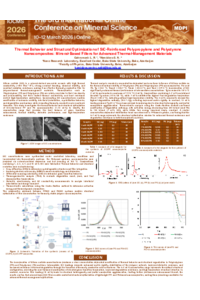
Sevinj Hamidova poster.PDF
Physicochemical and ceramic properties of clay materials from Barangay Tikalaan and Barangay Libertad (Talakag, Bukidnon, Philippines) and their suitability for ceramic bodies
Multi-Stage Magmatic Evolution in the Central Urumieh–Dokhtar Magmatic Arc (NE Saveh, Iran): Evidence from Zircon U-Pb Dating, Lu-Hf Isotopes, and Whole-Rock Geochemistry