Event submissions
Published
This submission belongs to the session S1. Mineral Geochemistry: Environmental Applications and Recent Advances of the event The 3rd International Online Conference on Mineral Science
Published date
06 Mar, 2026
Academic Editor
'%3e%3cpath%20d='M12.6657%2010.9104C12.4185%2010.325%2012.0599%209.79327%2011.6097%209.34482C11.1609%208.89508%2010.6293%208.5365%2010.0442%208.28888C10.0389%208.28626%2010.0337%208.28495%2010.0285%208.28233C10.8446%207.69279%2011.3752%206.73249%2011.3752%205.64904C11.3752%203.8542%209.92103%202.39999%208.1262%202.39999C6.33136%202.39999%204.87715%203.8542%204.87715%205.64904C4.87715%206.73249%205.40774%207.69279%206.22393%208.28364C6.21869%208.28626%206.21345%208.28757%206.20821%208.29019C5.62129%208.5378%205.09463%208.89284%204.64265%209.34613C4.1929%209.79493%203.83432%2010.3266%203.58671%2010.9117C3.34345%2011.4845%203.21226%2012.0987%203.20023%2012.7209C3.19988%2012.7349%203.20233%2012.7488%203.20744%2012.7619C3.21255%2012.7749%203.22022%2012.7867%203.22998%2012.7968C3.23975%2012.8068%203.25142%2012.8147%203.26431%2012.8202C3.2772%2012.8256%203.29105%2012.8284%203.30504%2012.8284H4.09109C4.14874%2012.8284%204.19459%2012.7825%204.1959%2012.7262C4.2221%2011.7148%204.62823%2010.7676%205.34617%2010.0497C6.08899%209.30683%207.0755%208.89808%208.1262%208.89808C9.17689%208.89808%2010.1634%209.30683%2010.9062%2010.0497C11.6242%2010.7676%2012.0303%2011.7148%2012.0565%2012.7262C12.0578%2012.7838%2012.1037%2012.8284%2012.1613%2012.8284H12.9474C12.9613%2012.8284%2012.9752%2012.8256%2012.9881%2012.8202C13.001%2012.8147%2013.0126%2012.8068%2013.0224%2012.7968C13.0322%2012.7867%2013.0398%2012.7749%2013.0449%2012.7619C13.0501%2012.7488%2013.0525%2012.7349%2013.0522%2012.7209C13.0391%2012.0947%2012.9094%2011.4855%2012.6657%2010.9104ZM8.1262%207.9024C7.52486%207.9024%206.9589%207.6679%206.53312%207.24211C6.10733%206.81633%205.87283%206.25037%205.87283%205.64904C5.87283%205.0477%206.10733%204.48174%206.53312%204.05596C6.9589%203.63018%207.52486%203.39567%208.1262%203.39567C8.72753%203.39567%209.29349%203.63018%209.71927%204.05596C10.1451%204.48174%2010.3796%205.0477%2010.3796%205.64904C10.3796%206.25037%2010.1451%206.81633%209.71927%207.24211C9.29349%207.6679%208.72753%207.9024%208.1262%207.9024Z'%20fill='%235D1EE1'/%3e%3c/g%3e%3c/svg%3e) Urs Klötzli
Urs KlötzliCitation
Muhammad Hammad Rasool, Maqsood Ahmad, Numair Ahmed Siddiqui, Plagioclase vs. Olivine: Which mineral is more reactive in driving in situ mineralization of CO₂ in Basalt?, in Proceedings of The 3rd International Online Conference on Mineral Science, 10 March–12 March 2026, MDPI: Basel, Switzerland
Share
Email
Facebook
Twitter
LinkedIn
Plagioclase vs. Olivine: Which mineral is more reactive in driving in situ mineralization of CO2 in Basalt?

Muhammad Hammad Rasool 1
'%3e%3cpath%20d='M12.6647%2010.9104C12.4176%2010.325%2012.0589%209.7933%2011.6088%209.34485C11.16%208.89511%2010.6283%208.53653%2010.0432%208.28891C10.038%208.28629%2010.0327%208.28498%2010.0275%208.28236C10.8437%207.69282%2011.3743%206.73252%2011.3743%205.64907C11.3743%203.85423%209.92005%202.40002%208.12522%202.40002C6.33038%202.40002%204.87618%203.85423%204.87618%205.64907C4.87618%206.73252%205.40677%207.69282%206.22296%208.28367C6.21772%208.28629%206.21248%208.2876%206.20724%208.29022C5.62031%208.53783%205.09365%208.89287%204.64167%209.34616C4.19192%209.79496%203.83334%2010.3266%203.58573%2010.9117C3.34247%2011.4846%203.21128%2012.0987%203.19925%2012.721C3.1989%2012.735%203.20135%2012.7489%203.20646%2012.7619C3.21157%2012.7749%203.21924%2012.7868%203.22901%2012.7968C3.23877%2012.8068%203.25045%2012.8148%203.26334%2012.8202C3.27623%2012.8256%203.29007%2012.8284%203.30406%2012.8284H4.09012C4.14776%2012.8284%204.19362%2012.7825%204.19493%2012.7262C4.22113%2011.7148%204.62726%2010.7676%205.34519%2010.0497C6.08802%209.30686%207.07452%208.89811%208.12522%208.89811C9.17592%208.89811%2010.1624%209.30686%2010.9052%2010.0497C11.6232%2010.7676%2012.0293%2011.7148%2012.0555%2012.7262C12.0568%2012.7839%2012.1027%2012.8284%2012.1603%2012.8284H12.9464C12.9604%2012.8284%2012.9742%2012.8256%2012.9871%2012.8202C13%2012.8148%2013.0117%2012.8068%2013.0214%2012.7968C13.0312%2012.7868%2013.0389%2012.7749%2013.044%2012.7619C13.0491%2012.7489%2013.0515%2012.735%2013.0512%2012.721C13.0381%2012.0947%2012.9084%2011.4856%2012.6647%2010.9104ZM8.12522%207.90243C7.52388%207.90243%206.95792%207.66793%206.53214%207.24215C6.10636%206.81636%205.87185%206.2504%205.87185%205.64907C5.87185%205.04773%206.10636%204.48177%206.53214%204.05599C6.95792%203.63021%207.52388%203.3957%208.12522%203.3957C8.72655%203.3957%209.29252%203.63021%209.7183%204.05599C10.1441%204.48177%2010.3786%205.04773%2010.3786%205.64907C10.3786%206.2504%2010.1441%206.81636%209.7183%207.24215C9.29252%207.66793%208.72655%207.90243%208.12522%207.90243Z'%20fill='%235D1EE1'/%3e%3c/g%3e%3c/svg%3e)
Maqsood Ahmad 1
Numair Ahmed Siddiqui 1
1. Petroleum Geoscience Department, Universiti Teknologi PETRONAS, Seri Iskandar 32610, Malaysia, Malaysia
Abstract
The reactivity of basaltic minerals toward CO₂ mineralization remains debated: laboratory studies at low temperatures identify plagioclase as the most reactive, while reservoir-scale experiments emphasize olivine. This study reconciles the apparent contradiction by establishing that mineral reactivity is not an intrinsic property but a condition-dependent outcome governed by temperature, pressure, pCO₂, and fluid chemistry. Through a synthesis of experimental and modelling evidence, we construct a unified framework incorporating five key controls: dissolution kinetics, surface accessibility, geochemical environment, cation stoichiometry, and reaction timescale. Under near-surface laboratory conditions (25–50 °C, acidic pH), plagioclase dissolves rapidly via proton-promoted hydrolysis, releasing Ca for early carbonate formation. At reservoir conditions (100–200 °C, high pCO₂, saline or wet supercritical CO₂), olivine dominates, showing 1–2 orders of magnitude higher dissolution rates and facilitating fast Mg-carbonate precipitation before silica passivation slows reactivity. Intermediate conditions (50–100 °C) yield mixed Ca- and Mg-carbonates, highlighting the futility of single-mineral extrapolations. Pyroxenes remain kinetically sluggish in all regimes. This perspective demonstrates that successful in situ mineralization depends on engineering reservoir conditions, optimizing temperature, salinity, and fluid pathways rather than simply selecting mineral-rich targets. By reframing mineral reactivity as a dynamic, environment-driven function, this study provides a mechanistic foundation for improved experimental design, predictive modelling, and site selection in CO₂ storage operations within basaltic formations.
Keywords
Basalt
In-situ mineralization
CO2 sequestration
Olivine
Plagioclase
Poster
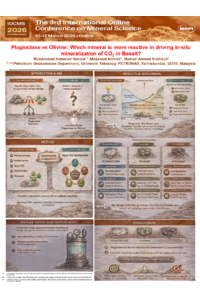
HAMMAD POSTER.pdf
Assessment of Xanthan Gum as Potential Dust Suppressant on Lateritic Mine Haul Roads
Zeolite-Based Removal of Thallium from Synthetic and Real Waters: Comparative Study of L, 13X, and Protonated Ferrierite