Event submissions
Published
This submission belongs to the session S2. Mineral Systems and Ore Deposits: From Formation to Exploration of the event The 3rd International Online Conference on Mineral Science
Published date
06 Mar, 2026
Academic Editor
'%3e%3cpath%20d='M12.6657%2010.9104C12.4185%2010.325%2012.0599%209.79327%2011.6097%209.34482C11.1609%208.89508%2010.6293%208.5365%2010.0442%208.28888C10.0389%208.28626%2010.0337%208.28495%2010.0285%208.28233C10.8446%207.69279%2011.3752%206.73249%2011.3752%205.64904C11.3752%203.8542%209.92103%202.39999%208.1262%202.39999C6.33136%202.39999%204.87715%203.8542%204.87715%205.64904C4.87715%206.73249%205.40774%207.69279%206.22393%208.28364C6.21869%208.28626%206.21345%208.28757%206.20821%208.29019C5.62129%208.5378%205.09463%208.89284%204.64265%209.34613C4.1929%209.79493%203.83432%2010.3266%203.58671%2010.9117C3.34345%2011.4845%203.21226%2012.0987%203.20023%2012.7209C3.19988%2012.7349%203.20233%2012.7488%203.20744%2012.7619C3.21255%2012.7749%203.22022%2012.7867%203.22998%2012.7968C3.23975%2012.8068%203.25142%2012.8147%203.26431%2012.8202C3.2772%2012.8256%203.29105%2012.8284%203.30504%2012.8284H4.09109C4.14874%2012.8284%204.19459%2012.7825%204.1959%2012.7262C4.2221%2011.7148%204.62823%2010.7676%205.34617%2010.0497C6.08899%209.30683%207.0755%208.89808%208.1262%208.89808C9.17689%208.89808%2010.1634%209.30683%2010.9062%2010.0497C11.6242%2010.7676%2012.0303%2011.7148%2012.0565%2012.7262C12.0578%2012.7838%2012.1037%2012.8284%2012.1613%2012.8284H12.9474C12.9613%2012.8284%2012.9752%2012.8256%2012.9881%2012.8202C13.001%2012.8147%2013.0126%2012.8068%2013.0224%2012.7968C13.0322%2012.7867%2013.0398%2012.7749%2013.0449%2012.7619C13.0501%2012.7488%2013.0525%2012.7349%2013.0522%2012.7209C13.0391%2012.0947%2012.9094%2011.4855%2012.6657%2010.9104ZM8.1262%207.9024C7.52486%207.9024%206.9589%207.6679%206.53312%207.24211C6.10733%206.81633%205.87283%206.25037%205.87283%205.64904C5.87283%205.0477%206.10733%204.48174%206.53312%204.05596C6.9589%203.63018%207.52486%203.39567%208.1262%203.39567C8.72753%203.39567%209.29349%203.63018%209.71927%204.05596C10.1451%204.48174%2010.3796%205.0477%2010.3796%205.64904C10.3796%206.25037%2010.1451%206.81633%209.71927%207.24211C9.29349%207.6679%208.72753%207.9024%208.1262%207.9024Z'%20fill='%235D1EE1'/%3e%3c/g%3e%3c/svg%3e) Theodore Bornhorst
Theodore BornhorstCitation
Musa Mohammed Musa Mina, Gabriella B. Kiss, The mineralization of Brannberget (Central Norwegian Caledonides): Mineral paragenesis, geochemistry, and genesis, in Proceedings of The 3rd International Online Conference on Mineral Science, 10 March–12 March 2026, MDPI: Basel, Switzerland
Share
Email
Facebook
Twitter
LinkedIn
The mineralization of Brannberget (Central Norwegian Caledonides): Mineral paragenesis, geochemistry, and genesis

Musa Mohammed Musa Mina 1
'%3e%3cpath%20d='M12.6647%2010.9104C12.4176%2010.325%2012.0589%209.7933%2011.6088%209.34485C11.16%208.89511%2010.6283%208.53653%2010.0432%208.28891C10.038%208.28629%2010.0327%208.28498%2010.0275%208.28236C10.8437%207.69282%2011.3743%206.73252%2011.3743%205.64907C11.3743%203.85423%209.92005%202.40002%208.12522%202.40002C6.33038%202.40002%204.87618%203.85423%204.87618%205.64907C4.87618%206.73252%205.40677%207.69282%206.22296%208.28367C6.21772%208.28629%206.21248%208.2876%206.20724%208.29022C5.62031%208.53783%205.09365%208.89287%204.64167%209.34616C4.19192%209.79496%203.83334%2010.3266%203.58573%2010.9117C3.34247%2011.4846%203.21128%2012.0987%203.19925%2012.721C3.1989%2012.735%203.20135%2012.7489%203.20646%2012.7619C3.21157%2012.7749%203.21924%2012.7868%203.22901%2012.7968C3.23877%2012.8068%203.25045%2012.8148%203.26334%2012.8202C3.27623%2012.8256%203.29007%2012.8284%203.30406%2012.8284H4.09012C4.14776%2012.8284%204.19362%2012.7825%204.19493%2012.7262C4.22113%2011.7148%204.62726%2010.7676%205.34519%2010.0497C6.08802%209.30686%207.07452%208.89811%208.12522%208.89811C9.17592%208.89811%2010.1624%209.30686%2010.9052%2010.0497C11.6232%2010.7676%2012.0293%2011.7148%2012.0555%2012.7262C12.0568%2012.7839%2012.1027%2012.8284%2012.1603%2012.8284H12.9464C12.9604%2012.8284%2012.9742%2012.8256%2012.9871%2012.8202C13%2012.8148%2013.0117%2012.8068%2013.0214%2012.7968C13.0312%2012.7868%2013.0389%2012.7749%2013.044%2012.7619C13.0491%2012.7489%2013.0515%2012.735%2013.0512%2012.721C13.0381%2012.0947%2012.9084%2011.4856%2012.6647%2010.9104ZM8.12522%207.90243C7.52388%207.90243%206.95792%207.66793%206.53214%207.24215C6.10636%206.81636%205.87185%206.2504%205.87185%205.64907C5.87185%205.04773%206.10636%204.48177%206.53214%204.05599C6.95792%203.63021%207.52388%203.3957%208.12522%203.3957C8.72655%203.3957%209.29252%203.63021%209.7183%204.05599C10.1441%204.48177%2010.3786%205.04773%2010.3786%205.64907C10.3786%206.2504%2010.1441%206.81636%209.7183%207.24215C9.29252%207.66793%208.72655%207.90243%208.12522%207.90243Z'%20fill='%235D1EE1'/%3e%3c/g%3e%3c/svg%3e)
Gabriella B. Kiss 1
1. Department of Mineralogy, Institute of Geography and Earth Sciences, Faculty of Sciences, ELTE Eötvös Loránd University, 1117 Budapest, Hungary, Hungary
Abstract
Brannberget is found close to the world-famous Løkken volcanogenic massive sulfide deposit (VMS), within the Løkken Ophiolites, Central Norwegian Caledonides (Grenne, 1989). Based on the Norwegian Geological Survey database, the study area represents a minor sulfide-quartz-bearing mineralization. Despite the historical mining activity at this location, no modern studies have been reported.
Field observations, petrographic investigations, mineral chemistry, and preliminary whole-rock geochemistry analyses were performed to characterize this mineralization. A network of ~3-5 cm thick quartz veins with Fe-oxyhydroxide and clay mineral-bearing alteration halo forms stockwork mineralization in the metabasaltic–doleritic greenstone. This rock is altered to albite, sericite, chlorite, and quartz. The quartz veins also contain iron-rich clay minerals, K-feldspar, disseminated pyrite, and chalcopyrite. The geochemical data revealed elevated concentrations of Cu (~ 7270 ppm), Zn (~236 ppm), and Bi (~ 74 ppm) in the quartz vein-bearing rock, compared to the host greenstone.
The observed mineral assemblage reveals high-temperature albitization, followed by intensive chloritization and lower-temperature silicification and sericitization as the fluid cooled owing to water–rock interaction. This multi-stage hydrothermal evolution, the appearing sulfides, and the observed geochemical data are typical of VMS stockwork feeder zones. Therefore, our study provides insights into the deep stockwork zones of this Ordovician VMS system. Further study is suggested to better understand the critical raw material potential of the locality, as our results prove that this stockwork zone might contain promising Cu amounts.
Acknowledgement
Sabina Strmić-Palinkaš, Máté Biró, and Tibor Németh are thanked for fruitful fieldwork conversations, SEM-EDS, and XRD analysis support, respectively. The ELTE Talent Fund supported the fieldwork.
Reference
Grenne, T. (1989): Econ Geol, 84/8: 2173-295
Keywords
Løkken Ophiolite
VMS stockwork
Trondheim Nappe Complex
hydrothermal alteration
quartz–sulfide veins
Cu mineralization.
Poster
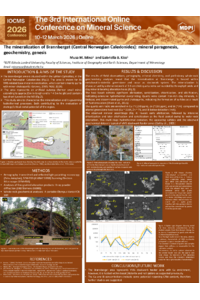
Poster_IOCMS_2026_Final.pdf
Eco-Efficient Utilization of Calcite-Rich Phosphate Waste for Feed-Grade Phosphate Production and Integrated CO₂ Sequestration
Modeling single-particle breakage by slow compression