Event submissions
Published
This submission belongs to the session S6. Emerging Frontiers in Mineral Science: Breakthrough Areas and Future Directions of the event The 3rd International Online Conference on Mineral Science
Published date
06 Mar, 2026
Academic Editor
'%3e%3cpath%20d='M12.6657%2010.9104C12.4185%2010.325%2012.0599%209.79327%2011.6097%209.34482C11.1609%208.89508%2010.6293%208.5365%2010.0442%208.28888C10.0389%208.28626%2010.0337%208.28495%2010.0285%208.28233C10.8446%207.69279%2011.3752%206.73249%2011.3752%205.64904C11.3752%203.8542%209.92103%202.39999%208.1262%202.39999C6.33136%202.39999%204.87715%203.8542%204.87715%205.64904C4.87715%206.73249%205.40774%207.69279%206.22393%208.28364C6.21869%208.28626%206.21345%208.28757%206.20821%208.29019C5.62129%208.5378%205.09463%208.89284%204.64265%209.34613C4.1929%209.79493%203.83432%2010.3266%203.58671%2010.9117C3.34345%2011.4845%203.21226%2012.0987%203.20023%2012.7209C3.19988%2012.7349%203.20233%2012.7488%203.20744%2012.7619C3.21255%2012.7749%203.22022%2012.7867%203.22998%2012.7968C3.23975%2012.8068%203.25142%2012.8147%203.26431%2012.8202C3.2772%2012.8256%203.29105%2012.8284%203.30504%2012.8284H4.09109C4.14874%2012.8284%204.19459%2012.7825%204.1959%2012.7262C4.2221%2011.7148%204.62823%2010.7676%205.34617%2010.0497C6.08899%209.30683%207.0755%208.89808%208.1262%208.89808C9.17689%208.89808%2010.1634%209.30683%2010.9062%2010.0497C11.6242%2010.7676%2012.0303%2011.7148%2012.0565%2012.7262C12.0578%2012.7838%2012.1037%2012.8284%2012.1613%2012.8284H12.9474C12.9613%2012.8284%2012.9752%2012.8256%2012.9881%2012.8202C13.001%2012.8147%2013.0126%2012.8068%2013.0224%2012.7968C13.0322%2012.7867%2013.0398%2012.7749%2013.0449%2012.7619C13.0501%2012.7488%2013.0525%2012.7349%2013.0522%2012.7209C13.0391%2012.0947%2012.9094%2011.4855%2012.6657%2010.9104ZM8.1262%207.9024C7.52486%207.9024%206.9589%207.6679%206.53312%207.24211C6.10733%206.81633%205.87283%206.25037%205.87283%205.64904C5.87283%205.0477%206.10733%204.48174%206.53312%204.05596C6.9589%203.63018%207.52486%203.39567%208.1262%203.39567C8.72753%203.39567%209.29349%203.63018%209.71927%204.05596C10.1451%204.48174%2010.3796%205.0477%2010.3796%205.64904C10.3796%206.25037%2010.1451%206.81633%209.71927%207.24211C9.29349%207.6679%208.72753%207.9024%208.1262%207.9024Z'%20fill='%235D1EE1'/%3e%3c/g%3e%3c/svg%3e) Leonid Dubrovinsky
Leonid DubrovinskyCitation
Rodric Carpio Luceño, Algen Secula, Harvey Melendrez, Raymond Virtudazo, Jason Jon Joshua Paraguya, Arnold Lubguban, Masayoshi Fuji, Exploring Waste-derived Resources for Concrete Development: Mechanical and Thermal Performance of Coconut Shell Ash Integration, in Proceedings of The 3rd International Online Conference on Mineral Science, 10 March–12 March 2026, MDPI: Basel, Switzerland
Share
Email
Facebook
Twitter
LinkedIn
Exploring Waste-derived Resources for Concrete Development: Mechanical and Thermal Performance of Coconut Shell Ash Integration
'%3e%3cpath%20d='M12.6647%2010.9104C12.4176%2010.325%2012.0589%209.7933%2011.6088%209.34485C11.16%208.89511%2010.6283%208.53653%2010.0432%208.28891C10.038%208.28629%2010.0327%208.28498%2010.0275%208.28236C10.8437%207.69282%2011.3743%206.73252%2011.3743%205.64907C11.3743%203.85423%209.92005%202.40002%208.12522%202.40002C6.33038%202.40002%204.87618%203.85423%204.87618%205.64907C4.87618%206.73252%205.40677%207.69282%206.22296%208.28367C6.21772%208.28629%206.21248%208.2876%206.20724%208.29022C5.62031%208.53783%205.09365%208.89287%204.64167%209.34616C4.19192%209.79496%203.83334%2010.3266%203.58573%2010.9117C3.34247%2011.4846%203.21128%2012.0987%203.19925%2012.721C3.1989%2012.735%203.20135%2012.7489%203.20646%2012.7619C3.21157%2012.7749%203.21924%2012.7868%203.22901%2012.7968C3.23877%2012.8068%203.25045%2012.8148%203.26334%2012.8202C3.27623%2012.8256%203.29007%2012.8284%203.30406%2012.8284H4.09012C4.14776%2012.8284%204.19362%2012.7825%204.19493%2012.7262C4.22113%2011.7148%204.62726%2010.7676%205.34519%2010.0497C6.08802%209.30686%207.07452%208.89811%208.12522%208.89811C9.17592%208.89811%2010.1624%209.30686%2010.9052%2010.0497C11.6232%2010.7676%2012.0293%2011.7148%2012.0555%2012.7262C12.0568%2012.7839%2012.1027%2012.8284%2012.1603%2012.8284H12.9464C12.9604%2012.8284%2012.9742%2012.8256%2012.9871%2012.8202C13%2012.8148%2013.0117%2012.8068%2013.0214%2012.7968C13.0312%2012.7868%2013.0389%2012.7749%2013.044%2012.7619C13.0491%2012.7489%2013.0515%2012.735%2013.0512%2012.721C13.0381%2012.0947%2012.9084%2011.4856%2012.6647%2010.9104ZM8.12522%207.90243C7.52388%207.90243%206.95792%207.66793%206.53214%207.24215C6.10636%206.81636%205.87185%206.2504%205.87185%205.64907C5.87185%205.04773%206.10636%204.48177%206.53214%204.05599C6.95792%203.63021%207.52388%203.3957%208.12522%203.3957C8.72655%203.3957%209.29252%203.63021%209.7183%204.05599C10.1441%204.48177%2010.3786%205.04773%2010.3786%205.64907C10.3786%206.2504%2010.1441%206.81636%209.7183%207.24215C9.29252%207.66793%208.72655%207.90243%208.12522%207.90243Z'%20fill='%235D1EE1'/%3e%3c/g%3e%3c/svg%3e)
Rodric Carpio Luceño 1
Algen Secula 2
Harvey Melendrez 3
Jason Jon Joshua Paraguya 4

Arnold Lubguban 4
Raymond Virtudazo 2
Masayoshi Fuji 5
1. Research Center for Advanced Ceramics (RCAC), Mindanao State University-Iligan Institute of Technology, Iligan City, 9200, Lanao Del Norte, Philippines, Philippines
2. Department of Materials and Resources Engineering and Technology, College of Engineering, Mindanao State University-Iligan Institute of Technology, Iligan City, 9200, Lanao Del Norte, Philippines, Philippines
3. Resource Processing and Technology Center, Mindanao State University – Iligan Institute of Technology, Iligan City, 9200, Lanao Del Norte, Philippines, Philippines
4. Center for Sustainable Polymers, Mindanao State University-Iligan Institute of Technology, Iligan City, 9200, Lanao Del Norte, Philippines, Philippines
5. Advanced Ceramics Research Center, Nagoya Institute of Technology, Tajimi City, 507-0033, Japan, Japan
Abstract
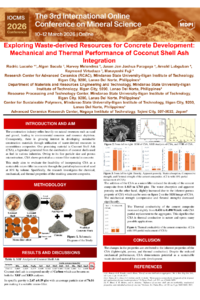
Advancements in materials development continue to drive innovations in sustainable and resource-efficient construction materials. Coconut shell ash (CSA), a byproduct of using coconut shells as fuel in industries, is a good resource to utilize because of its abundance. This study explores the potential of waste-derived coconut shell ash (CSA) as a material resource-based micro-filler for concrete, aligning with emerging frontiers in waste resource utilization. CSA was incorporated at 10% by volume as a partial sand replacement to evaluate its influence on the physical, mechanical, and thermal performance of the composite. Comprehensive chemical, mineralogical, and morphological analyses were conducted on both CSA and CSA-modified concrete.
Results show that CSA addition slightly reduced concrete density from 1.813 to 1.760 g/cm³ and increased apparent porosity and water absorption to 1.77% and 7.68%, respectively. Mechanical performance decreased moderately, with flexural strength declining from 4.60 MPa to 4.02 MPa and compressive strength from 6.76 MPa to 6.04 MPa. Thermal conductivity, on the other hand, increased from 0.451 to 0.490 W/mK, attributed to the intrinsic porous microstructure of CSA, as shown in Figure 1.
Overall, CSA incorporation significantly influences the physical and thermomechanical behavior of concrete. While the mechanical properties slightly decrease, the findings highlight the potential of CSA as a viable waste-derived resource for developing greener, low-impact construction materials, contributing to breakthrough directions in sustainable material/mineral engineering.
Keywords
Coconut shell ash
Industrial Waste
Material Resource
Poster
Luceno_IOCMS_Poster.pdf
Transforming Agro-Industrial Waste into Synthetic Minerals: Rapid Sol–Gel-Derived Alkali Feldspar particles for Thermal Management Applications
Pushing the limits of diamond research