Event submissions
Published
This submission belongs to the session 2. One health: Improve Disease Manifestation and Management in Animals, Humans, and the Environment of the event The 4th International Online Conference on Animals
Published date
12 Mar, 2026
Academic Editor
'%3e%3cpath%20d='M12.6657%2010.9104C12.4185%2010.325%2012.0599%209.79327%2011.6097%209.34482C11.1609%208.89508%2010.6293%208.5365%2010.0442%208.28888C10.0389%208.28626%2010.0337%208.28495%2010.0285%208.28233C10.8446%207.69279%2011.3752%206.73249%2011.3752%205.64904C11.3752%203.8542%209.92103%202.39999%208.1262%202.39999C6.33136%202.39999%204.87715%203.8542%204.87715%205.64904C4.87715%206.73249%205.40774%207.69279%206.22393%208.28364C6.21869%208.28626%206.21345%208.28757%206.20821%208.29019C5.62129%208.5378%205.09463%208.89284%204.64265%209.34613C4.1929%209.79493%203.83432%2010.3266%203.58671%2010.9117C3.34345%2011.4845%203.21226%2012.0987%203.20023%2012.7209C3.19988%2012.7349%203.20233%2012.7488%203.20744%2012.7619C3.21255%2012.7749%203.22022%2012.7867%203.22998%2012.7968C3.23975%2012.8068%203.25142%2012.8147%203.26431%2012.8202C3.2772%2012.8256%203.29105%2012.8284%203.30504%2012.8284H4.09109C4.14874%2012.8284%204.19459%2012.7825%204.1959%2012.7262C4.2221%2011.7148%204.62823%2010.7676%205.34617%2010.0497C6.08899%209.30683%207.0755%208.89808%208.1262%208.89808C9.17689%208.89808%2010.1634%209.30683%2010.9062%2010.0497C11.6242%2010.7676%2012.0303%2011.7148%2012.0565%2012.7262C12.0578%2012.7838%2012.1037%2012.8284%2012.1613%2012.8284H12.9474C12.9613%2012.8284%2012.9752%2012.8256%2012.9881%2012.8202C13.001%2012.8147%2013.0126%2012.8068%2013.0224%2012.7968C13.0322%2012.7867%2013.0398%2012.7749%2013.0449%2012.7619C13.0501%2012.7488%2013.0525%2012.7349%2013.0522%2012.7209C13.0391%2012.0947%2012.9094%2011.4855%2012.6657%2010.9104ZM8.1262%207.9024C7.52486%207.9024%206.9589%207.6679%206.53312%207.24211C6.10733%206.81633%205.87283%206.25037%205.87283%205.64904C5.87283%205.0477%206.10733%204.48174%206.53312%204.05596C6.9589%203.63018%207.52486%203.39567%208.1262%203.39567C8.72753%203.39567%209.29349%203.63018%209.71927%204.05596C10.1451%204.48174%2010.3796%205.0477%2010.3796%205.64904C10.3796%206.25037%2010.1451%206.81633%209.71927%207.24211C9.29349%207.6679%208.72753%207.9024%208.1262%207.9024Z'%20fill='%235D1EE1'/%3e%3c/g%3e%3c/svg%3e) Levon Abrahamyan
Levon AbrahamyanCitation
Chiara Nogarol, Walter Martelli, Annalisa Accorsi, Serena Robetto, Rosaria Possidente, Maria Lucia Mandola, WEST NILE AND USUTU VIRUSES: A NEW CHALLENGE FOR A ONE-HEALTH APPROACH DURING 4-YEAR SURVEILLANCE IN NORTH-WEST ITALY, in Proceedings of The 4th International Online Conference on Animals, 17 March–19 March 2026, MDPI: Basel, Switzerland
Share
Email
Facebook
Twitter
LinkedIn
WEST NILE AND USUTU VIRUSES: A NEW CHALLENGE FOR A ONE-HEALTH APPROACH DURING 4-YEAR SURVEILLANCE IN NORTH-WEST ITALY
'%3e%3cpath%20d='M12.6647%2010.9104C12.4176%2010.325%2012.0589%209.7933%2011.6088%209.34485C11.16%208.89511%2010.6283%208.53653%2010.0432%208.28891C10.038%208.28629%2010.0327%208.28498%2010.0275%208.28236C10.8437%207.69282%2011.3743%206.73252%2011.3743%205.64907C11.3743%203.85423%209.92005%202.40002%208.12522%202.40002C6.33038%202.40002%204.87618%203.85423%204.87618%205.64907C4.87618%206.73252%205.40677%207.69282%206.22296%208.28367C6.21772%208.28629%206.21248%208.2876%206.20724%208.29022C5.62031%208.53783%205.09365%208.89287%204.64167%209.34616C4.19192%209.79496%203.83334%2010.3266%203.58573%2010.9117C3.34247%2011.4846%203.21128%2012.0987%203.19925%2012.721C3.1989%2012.735%203.20135%2012.7489%203.20646%2012.7619C3.21157%2012.7749%203.21924%2012.7868%203.22901%2012.7968C3.23877%2012.8068%203.25045%2012.8148%203.26334%2012.8202C3.27623%2012.8256%203.29007%2012.8284%203.30406%2012.8284H4.09012C4.14776%2012.8284%204.19362%2012.7825%204.19493%2012.7262C4.22113%2011.7148%204.62726%2010.7676%205.34519%2010.0497C6.08802%209.30686%207.07452%208.89811%208.12522%208.89811C9.17592%208.89811%2010.1624%209.30686%2010.9052%2010.0497C11.6232%2010.7676%2012.0293%2011.7148%2012.0555%2012.7262C12.0568%2012.7839%2012.1027%2012.8284%2012.1603%2012.8284H12.9464C12.9604%2012.8284%2012.9742%2012.8256%2012.9871%2012.8202C13%2012.8148%2013.0117%2012.8068%2013.0214%2012.7968C13.0312%2012.7868%2013.0389%2012.7749%2013.044%2012.7619C13.0491%2012.7489%2013.0515%2012.735%2013.0512%2012.721C13.0381%2012.0947%2012.9084%2011.4856%2012.6647%2010.9104ZM8.12522%207.90243C7.52388%207.90243%206.95792%207.66793%206.53214%207.24215C6.10636%206.81636%205.87185%206.2504%205.87185%205.64907C5.87185%205.04773%206.10636%204.48177%206.53214%204.05599C6.95792%203.63021%207.52388%203.3957%208.12522%203.3957C8.72655%203.3957%209.29252%203.63021%209.7183%204.05599C10.1441%204.48177%2010.3786%205.04773%2010.3786%205.64907C10.3786%206.2504%2010.1441%206.81636%209.7183%207.24215C9.29252%207.66793%208.72655%207.90243%208.12522%207.90243Z'%20fill='%235D1EE1'/%3e%3c/g%3e%3c/svg%3e)
Chiara Nogarol 1
Walter Martelli 2
Annalisa Accorsi 3
Serena Robetto 4
Rosaria Possidente 2

Maria Lucia Mandola 1
1. SS Virologia Specialistica, Istituto Zooprofilattico Sperimentale del Piemonte, Liguria e Valle d'Aosta, Torino, 10154, Italy
2. SS Epidemiologia Sanità Animale, Istituto Zooprofilattico Sperimentale del Piemonte, Liguria e Valle d'Aosta, Torino, 10154, Italy
3. SC Liguria, Istituto Zooprofilattico Sperimentale del Piemonte, Liguria e Valle d'Aosta, Torino, 10154, Italy
4. SC Valle d’Aosta, Istituto Zooprofilattico Sperimentale del Piemonte, Liguria e Valle d'Aosta, Torino, 10154, Italy
Abstract
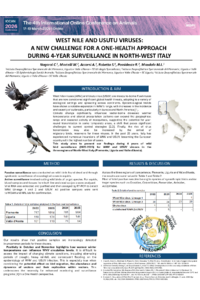
In recent years, new global health threats have been linked to climate change and vector-borne diseases; West Nile viruses (WNV) and Usutu virus (USUV) are Flaviviridae viruses, involved in several outbreaks all over the world. Warmer temperatures and altered precipitation patterns can expand the geographical range and seasonal activity of mosquitoes. Italy has experienced numerous incursions of WNV and USUV, becoming the European country with the highest number of cases. This study aims to present our findings during 4 years of wild bird surveillance for WNV and USUV viruses in the three regions of northwest Italy.
In this study, we carried out both passive (wild birds found dead, syndromic surveillance. and neurological cases in equids) and active surveillance (culling wild birds of target species). After RNA extraction, we performed two RT-PCR to detect WNV Lineage 1 and 2 and USUV.
A total of 1026 animals underwent analysis in 2022; 20 animals tested positive for WNVL2, with only one positive for USUV. In 2023, a total of 1307 animals were tested; 24 animals were positive for WNVL2, 5 were positive for USUV, and 5 were co-infected with WNVL2 and USUV. In 2024, a total of 995 animals underwent testing; 25 animals tested positive for WNVL2. Finally, in 2025, a total of 1184 animals were analyzed; we detected a total of 20-WNVL2 positive samples and 1 WNVL1-positive sample.
Our results show that positive samples are increasingly detected in uncommon periods for these viruses. Currently, it remains difficult to assess the impact of this change on the viruses' dynamics and epidemiology through vectors in relation to the last alternating pattern of periods of the complete absence of rain and subsequent periods of heavy flooding. Finally, we must consider the effect on bird migration and on the balance between viruses and vectors. This is a One-Health concern; public health monitoring requires more integrated plans and actions to anticipate zoonotic viral diffusion.
Keywords
West Nile virus
Usutu virus
bird
Poster
Nogarol et al_IOCAN2026.pdf
Emerging contaminants: presence of BPA analogues in mussels and risks associated with their consumption
Long-Read Metagenomic Analysis of Milking Filters as a Tool for Dairy Herds’ Resistome Monitoring