Event submissions
Published
This submission belongs to the session S1. Digital Health Adoption and Innovation—A Vision for the Future of Healthcare of the event The 1st International Online Conference on Healthcare
Published date
20 Mar, 2026
Academic Editor
'%3e%3cpath%20d='M12.6657%2010.9104C12.4185%2010.325%2012.0599%209.79327%2011.6097%209.34482C11.1609%208.89508%2010.6293%208.5365%2010.0442%208.28888C10.0389%208.28626%2010.0337%208.28495%2010.0285%208.28233C10.8446%207.69279%2011.3752%206.73249%2011.3752%205.64904C11.3752%203.8542%209.92103%202.39999%208.1262%202.39999C6.33136%202.39999%204.87715%203.8542%204.87715%205.64904C4.87715%206.73249%205.40774%207.69279%206.22393%208.28364C6.21869%208.28626%206.21345%208.28757%206.20821%208.29019C5.62129%208.5378%205.09463%208.89284%204.64265%209.34613C4.1929%209.79493%203.83432%2010.3266%203.58671%2010.9117C3.34345%2011.4845%203.21226%2012.0987%203.20023%2012.7209C3.19988%2012.7349%203.20233%2012.7488%203.20744%2012.7619C3.21255%2012.7749%203.22022%2012.7867%203.22998%2012.7968C3.23975%2012.8068%203.25142%2012.8147%203.26431%2012.8202C3.2772%2012.8256%203.29105%2012.8284%203.30504%2012.8284H4.09109C4.14874%2012.8284%204.19459%2012.7825%204.1959%2012.7262C4.2221%2011.7148%204.62823%2010.7676%205.34617%2010.0497C6.08899%209.30683%207.0755%208.89808%208.1262%208.89808C9.17689%208.89808%2010.1634%209.30683%2010.9062%2010.0497C11.6242%2010.7676%2012.0303%2011.7148%2012.0565%2012.7262C12.0578%2012.7838%2012.1037%2012.8284%2012.1613%2012.8284H12.9474C12.9613%2012.8284%2012.9752%2012.8256%2012.9881%2012.8202C13.001%2012.8147%2013.0126%2012.8068%2013.0224%2012.7968C13.0322%2012.7867%2013.0398%2012.7749%2013.0449%2012.7619C13.0501%2012.7488%2013.0525%2012.7349%2013.0522%2012.7209C13.0391%2012.0947%2012.9094%2011.4855%2012.6657%2010.9104ZM8.1262%207.9024C7.52486%207.9024%206.9589%207.6679%206.53312%207.24211C6.10733%206.81633%205.87283%206.25037%205.87283%205.64904C5.87283%205.0477%206.10733%204.48174%206.53312%204.05596C6.9589%203.63018%207.52486%203.39567%208.1262%203.39567C8.72753%203.39567%209.29349%203.63018%209.71927%204.05596C10.1451%204.48174%2010.3796%205.0477%2010.3796%205.64904C10.3796%206.25037%2010.1451%206.81633%209.71927%207.24211C9.29349%207.6679%208.72753%207.9024%208.1262%207.9024Z'%20fill='%235D1EE1'/%3e%3c/g%3e%3c/svg%3e) James Chow
James ChowCitation
Antonio David Martin-Barrado, Diego Gomez-Baya, Digital Engagement and Positive Youth Development: A Systematic Review., in Proceedings of The 1st International Online Conference on Healthcare, 25 March–26 March 2026, MDPI: Basel, Switzerland
Share
Email
Facebook
Twitter
LinkedIn
Digital Engagement and Positive Youth Development: A Systematic Review.

Antonio David Martin-Barrado 1

Diego Gomez-Baya 1
1. Department of Social, Developmental and Educational Psychology, Universidad de Huelva, CP 21071 Huelva, Spain, Spain
Abstract
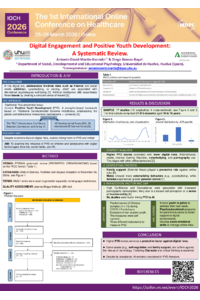
Introduction: Extensive research has addressed the adverse effects of excessive Internet use on mental well-being. However, there is a critical need to understand these digital behaviors through the lens of Positive Youth Development (PYD), a model centered on cultivating strengths rather than merely preventing risks. This study aims to examine the influence of PYD assets on digital behaviors and identify critical research gaps regarding emerging technologies.
Method: A systematic search was performed following PRISMA guidelines across the Web of Science, Scopus, and PubMed databases (inception to December 2024). Keywords included Internet, social media, artificial intelligence, adolescent, child, student, Positive Youth Development, PYD, and Developmental Assets.
Results: The analysis included 17 eligible studies (13 longitudinal, 4 cross-sectional) published from 2012 to 2024, assessed using the Joanna Briggs Institute checklist, comprising 37,015 adolescents (aged 10–19). Geographically, samples were predominantly Asian (n = 15), with only two studies from Europe. Notably, 13 studies identified PYD as a protective factor against Internet addiction and gaming disorders. However, specific dimensions showed nuanced effects: the Connection dimension was associated with reduced sexting, whereas high Competence and Confidence levels correlated with increased pornography consumption in specific contexts. Additionally, family support and emotional self-regulation emerged as crucial moderators. Finally, no studies addressed artificial intelligence (AI) interactions.
Discussion: As one of the first systematic reviews on this topic, this study suggests that PYD offers effective tools to promote responsible technology use. Nevertheless, the reliance on predominantly Chinese samples necessitates cross-cultural validation. Furthermore, the lack of research linking PYD to AI interactions highlights a new frontier for investigation. These insights provide a foundation for designing more inclusive interventions to foster digital skills among youth in the digital age.
Keywords
Internet use
digital behaviors
Positive Youth Development
social media
family support.
Poster
Poster_Digital Engagement and PYD SystematicReview.pdf
Healthcare Regulatory Compliance: A Generative AI Framework for Identifying and Mitigating Risks
Comparative Evaluation of mHealth Awareness, Usage Patterns, and Preventive Behaviours Among Dental, Nursing, and Engineering Undergraduates in Himachal Pradesh