Event submissions
Published
This submission belongs to the session S1. Digital Health Adoption and Innovation—A Vision for the Future of Healthcare of the event The 1st International Online Conference on Healthcare
Published date
20 Mar, 2026
Academic Editor
'%3e%3cpath%20d='M12.6657%2010.9104C12.4185%2010.325%2012.0599%209.79327%2011.6097%209.34482C11.1609%208.89508%2010.6293%208.5365%2010.0442%208.28888C10.0389%208.28626%2010.0337%208.28495%2010.0285%208.28233C10.8446%207.69279%2011.3752%206.73249%2011.3752%205.64904C11.3752%203.8542%209.92103%202.39999%208.1262%202.39999C6.33136%202.39999%204.87715%203.8542%204.87715%205.64904C4.87715%206.73249%205.40774%207.69279%206.22393%208.28364C6.21869%208.28626%206.21345%208.28757%206.20821%208.29019C5.62129%208.5378%205.09463%208.89284%204.64265%209.34613C4.1929%209.79493%203.83432%2010.3266%203.58671%2010.9117C3.34345%2011.4845%203.21226%2012.0987%203.20023%2012.7209C3.19988%2012.7349%203.20233%2012.7488%203.20744%2012.7619C3.21255%2012.7749%203.22022%2012.7867%203.22998%2012.7968C3.23975%2012.8068%203.25142%2012.8147%203.26431%2012.8202C3.2772%2012.8256%203.29105%2012.8284%203.30504%2012.8284H4.09109C4.14874%2012.8284%204.19459%2012.7825%204.1959%2012.7262C4.2221%2011.7148%204.62823%2010.7676%205.34617%2010.0497C6.08899%209.30683%207.0755%208.89808%208.1262%208.89808C9.17689%208.89808%2010.1634%209.30683%2010.9062%2010.0497C11.6242%2010.7676%2012.0303%2011.7148%2012.0565%2012.7262C12.0578%2012.7838%2012.1037%2012.8284%2012.1613%2012.8284H12.9474C12.9613%2012.8284%2012.9752%2012.8256%2012.9881%2012.8202C13.001%2012.8147%2013.0126%2012.8068%2013.0224%2012.7968C13.0322%2012.7867%2013.0398%2012.7749%2013.0449%2012.7619C13.0501%2012.7488%2013.0525%2012.7349%2013.0522%2012.7209C13.0391%2012.0947%2012.9094%2011.4855%2012.6657%2010.9104ZM8.1262%207.9024C7.52486%207.9024%206.9589%207.6679%206.53312%207.24211C6.10733%206.81633%205.87283%206.25037%205.87283%205.64904C5.87283%205.0477%206.10733%204.48174%206.53312%204.05596C6.9589%203.63018%207.52486%203.39567%208.1262%203.39567C8.72753%203.39567%209.29349%203.63018%209.71927%204.05596C10.1451%204.48174%2010.3796%205.0477%2010.3796%205.64904C10.3796%206.25037%2010.1451%206.81633%209.71927%207.24211C9.29349%207.6679%208.72753%207.9024%208.1262%207.9024Z'%20fill='%235D1EE1'/%3e%3c/g%3e%3c/svg%3e) James Chow
James ChowCitation
Tahreem Tanweer, Minnah Hafeez, Shamseen Dara, Ayesha Khalid, Sidra Shahid, Awareness and Health Outcomes Related to Ergonomic Practices Amid Digital Transformation: A Survey of Remote Workers in Islamabad, Pakistan, in Proceedings of The 1st International Online Conference on Healthcare, 25 March–26 March 2026, MDPI: Basel, Switzerland
Share
Email
Facebook
Twitter
LinkedIn
Awareness and Health Outcomes Related to Ergonomic Practices Amid Digital Transformation: A Survey of Remote Workers in Islamabad, Pakistan
'%3e%3cpath%20d='M12.6647%2010.9104C12.4176%2010.325%2012.0589%209.7933%2011.6088%209.34485C11.16%208.89511%2010.6283%208.53653%2010.0432%208.28891C10.038%208.28629%2010.0327%208.28498%2010.0275%208.28236C10.8437%207.69282%2011.3743%206.73252%2011.3743%205.64907C11.3743%203.85423%209.92005%202.40002%208.12522%202.40002C6.33038%202.40002%204.87618%203.85423%204.87618%205.64907C4.87618%206.73252%205.40677%207.69282%206.22296%208.28367C6.21772%208.28629%206.21248%208.2876%206.20724%208.29022C5.62031%208.53783%205.09365%208.89287%204.64167%209.34616C4.19192%209.79496%203.83334%2010.3266%203.58573%2010.9117C3.34247%2011.4846%203.21128%2012.0987%203.19925%2012.721C3.1989%2012.735%203.20135%2012.7489%203.20646%2012.7619C3.21157%2012.7749%203.21924%2012.7868%203.22901%2012.7968C3.23877%2012.8068%203.25045%2012.8148%203.26334%2012.8202C3.27623%2012.8256%203.29007%2012.8284%203.30406%2012.8284H4.09012C4.14776%2012.8284%204.19362%2012.7825%204.19493%2012.7262C4.22113%2011.7148%204.62726%2010.7676%205.34519%2010.0497C6.08802%209.30686%207.07452%208.89811%208.12522%208.89811C9.17592%208.89811%2010.1624%209.30686%2010.9052%2010.0497C11.6232%2010.7676%2012.0293%2011.7148%2012.0555%2012.7262C12.0568%2012.7839%2012.1027%2012.8284%2012.1603%2012.8284H12.9464C12.9604%2012.8284%2012.9742%2012.8256%2012.9871%2012.8202C13%2012.8148%2013.0117%2012.8068%2013.0214%2012.7968C13.0312%2012.7868%2013.0389%2012.7749%2013.044%2012.7619C13.0491%2012.7489%2013.0515%2012.735%2013.0512%2012.721C13.0381%2012.0947%2012.9084%2011.4856%2012.6647%2010.9104ZM8.12522%207.90243C7.52388%207.90243%206.95792%207.66793%206.53214%207.24215C6.10636%206.81636%205.87185%206.2504%205.87185%205.64907C5.87185%205.04773%206.10636%204.48177%206.53214%204.05599C6.95792%203.63021%207.52388%203.3957%208.12522%203.3957C8.72655%203.3957%209.29252%203.63021%209.7183%204.05599C10.1441%204.48177%2010.3786%205.04773%2010.3786%205.64907C10.3786%206.2504%2010.1441%206.81636%209.7183%207.24215C9.29252%207.66793%208.72655%207.90243%208.12522%207.90243Z'%20fill='%235D1EE1'/%3e%3c/g%3e%3c/svg%3e)
Minnah Hafeez 1
Shamseen Dara 1
Ayesha Khalid 1
Tahreem Tanweer 2,3
Sidra Shahid 1
1. Humanities and Social Sciences Department, Bahria University, E-8 Campus, Islamabad, 44000, Pakistan, Pakistan
2. Department of Biomedical Engineering and sciences, School of Mechanical and Manufacturing Engineering, National University of Sciences and Technology (NUST), Islamabad, 44000, Pakistan, Pakistan
3. Department of Humanities and Social Sciences, Faculty of Public health, Bahria University, E 8 campus, Islamabad, 44000, Pakistan
Abstract
Introduction:
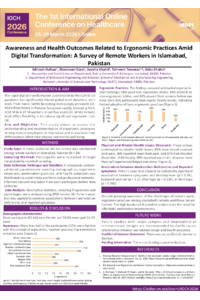
The rapid digital transformation accelerated by the COVID-19 pandemic has significantly altered global work dynamics, with work-from-home (WFH) becoming increasingly prevalent. This study aimed to assess the understanding and implementation of ergonomic principles among remote employees in Islamabad and to evaluate how WFH practices affect their physical and mental well-being.
Methodology:
A cross-sectional online survey was conducted among remote workers in Islamabad (N = 34). Participants were recruited through nonprobability snowball sampling. A structured, content-validated questionnaire covering demographics, ergonomic awareness, workstation practices, and health symptoms was distributed via social media platforms and professional networks. Descriptive statistics, including frequencies and percentages, were analyzed using SPSS version 18. Fisher’s exact test was applied to examine associations between workstation deficiencies and reported symptoms.
Results:
Most participants (82.4%) were female, and 58.8% were aged 20–25 years. The findings revealed substantial ergonomic shortcomings: 58% used non-ergonomic chairs, 44% worked on non-ergonomic tables, and 62% placed their screens below eye level. Only 32% participants took regular hourly breaks, indicating limited adoption of basic ergonomic practices. These setups contributed to notable health issues: 61% experienced constant neck pain, 56% reported lower back pain, and 47% had shoulder discomfort. Additionally, 68% reported eye strain, whereas more than half experienced fatigue and stress. Fisher’s exact test showed no statistically significant association between symptoms and desktop level (p = 0.34), keyboard position (p = 1.1), chair type (p = 0.310), or desk type (p = 0.366).
Conclusion:
Despite growing awareness of the challenges of remote work, ergonomic practices among Islamabad’s remote workforce remain limited. The high burden of discomfort underscores the need for affordable workstation improvements. Future studies with larger samples and longitudinal or interventional designs are recommended to clarify causal relationships between workstation design and health outcomes.
Keywords
Digital transformation
Health
work force
Ergonomics
Poster
Ergonomis Poster.pdf
Beyond innovation: How frontline clinical innovators shape digital care
PathoCast: An Explainable AI Framework for Predicting Daily Dengue Risk in Low-Resource Urban Settings