Event submissions
Published
This submission belongs to the session S1. Digital Health Adoption and Innovation—A Vision for the Future of Healthcare of the event The 1st International Online Conference on Healthcare
Published date
20 Mar, 2026
Academic Editor
'%3e%3cpath%20d='M12.6657%2010.9104C12.4185%2010.325%2012.0599%209.79327%2011.6097%209.34482C11.1609%208.89508%2010.6293%208.5365%2010.0442%208.28888C10.0389%208.28626%2010.0337%208.28495%2010.0285%208.28233C10.8446%207.69279%2011.3752%206.73249%2011.3752%205.64904C11.3752%203.8542%209.92103%202.39999%208.1262%202.39999C6.33136%202.39999%204.87715%203.8542%204.87715%205.64904C4.87715%206.73249%205.40774%207.69279%206.22393%208.28364C6.21869%208.28626%206.21345%208.28757%206.20821%208.29019C5.62129%208.5378%205.09463%208.89284%204.64265%209.34613C4.1929%209.79493%203.83432%2010.3266%203.58671%2010.9117C3.34345%2011.4845%203.21226%2012.0987%203.20023%2012.7209C3.19988%2012.7349%203.20233%2012.7488%203.20744%2012.7619C3.21255%2012.7749%203.22022%2012.7867%203.22998%2012.7968C3.23975%2012.8068%203.25142%2012.8147%203.26431%2012.8202C3.2772%2012.8256%203.29105%2012.8284%203.30504%2012.8284H4.09109C4.14874%2012.8284%204.19459%2012.7825%204.1959%2012.7262C4.2221%2011.7148%204.62823%2010.7676%205.34617%2010.0497C6.08899%209.30683%207.0755%208.89808%208.1262%208.89808C9.17689%208.89808%2010.1634%209.30683%2010.9062%2010.0497C11.6242%2010.7676%2012.0303%2011.7148%2012.0565%2012.7262C12.0578%2012.7838%2012.1037%2012.8284%2012.1613%2012.8284H12.9474C12.9613%2012.8284%2012.9752%2012.8256%2012.9881%2012.8202C13.001%2012.8147%2013.0126%2012.8068%2013.0224%2012.7968C13.0322%2012.7867%2013.0398%2012.7749%2013.0449%2012.7619C13.0501%2012.7488%2013.0525%2012.7349%2013.0522%2012.7209C13.0391%2012.0947%2012.9094%2011.4855%2012.6657%2010.9104ZM8.1262%207.9024C7.52486%207.9024%206.9589%207.6679%206.53312%207.24211C6.10733%206.81633%205.87283%206.25037%205.87283%205.64904C5.87283%205.0477%206.10733%204.48174%206.53312%204.05596C6.9589%203.63018%207.52486%203.39567%208.1262%203.39567C8.72753%203.39567%209.29349%203.63018%209.71927%204.05596C10.1451%204.48174%2010.3796%205.0477%2010.3796%205.64904C10.3796%206.25037%2010.1451%206.81633%209.71927%207.24211C9.29349%207.6679%208.72753%207.9024%208.1262%207.9024Z'%20fill='%235D1EE1'/%3e%3c/g%3e%3c/svg%3e) James Chow
James ChowCitation
TUN WEI HUANG, YU HUA HO, Opportunities and Challenges in Integrating Smart Healthcare into Taiwan’s Long-Term Care System: A Physicians’ Perspective, in Proceedings of The 1st International Online Conference on Healthcare, 25 March–26 March 2026, MDPI: Basel, Switzerland
Share
Email
Facebook
Twitter
LinkedIn
Opportunities and Challenges in Integrating Smart Healthcare into Taiwan’s Long-Term Care System: A Physicians’ Perspective
'%3e%3cpath%20d='M12.6647%2010.9104C12.4176%2010.325%2012.0589%209.7933%2011.6088%209.34485C11.16%208.89511%2010.6283%208.53653%2010.0432%208.28891C10.038%208.28629%2010.0327%208.28498%2010.0275%208.28236C10.8437%207.69282%2011.3743%206.73252%2011.3743%205.64907C11.3743%203.85423%209.92005%202.40002%208.12522%202.40002C6.33038%202.40002%204.87618%203.85423%204.87618%205.64907C4.87618%206.73252%205.40677%207.69282%206.22296%208.28367C6.21772%208.28629%206.21248%208.2876%206.20724%208.29022C5.62031%208.53783%205.09365%208.89287%204.64167%209.34616C4.19192%209.79496%203.83334%2010.3266%203.58573%2010.9117C3.34247%2011.4846%203.21128%2012.0987%203.19925%2012.721C3.1989%2012.735%203.20135%2012.7489%203.20646%2012.7619C3.21157%2012.7749%203.21924%2012.7868%203.22901%2012.7968C3.23877%2012.8068%203.25045%2012.8148%203.26334%2012.8202C3.27623%2012.8256%203.29007%2012.8284%203.30406%2012.8284H4.09012C4.14776%2012.8284%204.19362%2012.7825%204.19493%2012.7262C4.22113%2011.7148%204.62726%2010.7676%205.34519%2010.0497C6.08802%209.30686%207.07452%208.89811%208.12522%208.89811C9.17592%208.89811%2010.1624%209.30686%2010.9052%2010.0497C11.6232%2010.7676%2012.0293%2011.7148%2012.0555%2012.7262C12.0568%2012.7839%2012.1027%2012.8284%2012.1603%2012.8284H12.9464C12.9604%2012.8284%2012.9742%2012.8256%2012.9871%2012.8202C13%2012.8148%2013.0117%2012.8068%2013.0214%2012.7968C13.0312%2012.7868%2013.0389%2012.7749%2013.044%2012.7619C13.0491%2012.7489%2013.0515%2012.735%2013.0512%2012.721C13.0381%2012.0947%2012.9084%2011.4856%2012.6647%2010.9104ZM8.12522%207.90243C7.52388%207.90243%206.95792%207.66793%206.53214%207.24215C6.10636%206.81636%205.87185%206.2504%205.87185%205.64907C5.87185%205.04773%206.10636%204.48177%206.53214%204.05599C6.95792%203.63021%207.52388%203.3957%208.12522%203.3957C8.72655%203.3957%209.29252%203.63021%209.7183%204.05599C10.1441%204.48177%2010.3786%205.04773%2010.3786%205.64907C10.3786%206.2504%2010.1441%206.81636%209.7183%207.24215C9.29252%207.66793%208.72655%207.90243%208.12522%207.90243Z'%20fill='%235D1EE1'/%3e%3c/g%3e%3c/svg%3e)
TUN WEI HUANG 1
YU HUA HO 1
1. Department of Nursing, Chung Shan Medical University, Taichung, 402306, Taiwan, Taiwan
Abstract
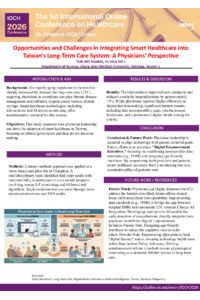
Background:The rapidly aging population in Taiwan has sharply increased the demand for long-term care. Physicians must coordinate chronic disease management (e.g., blood glucose control for diabetes, long-term monitoring for hypertension and heart failure, inhalation therapy and exacerbation prevention for chronic obstructive pulmonary disease), preventive services, and palliative support across hospitals, communities, and home settings. Smart healthcare technologies—including telemedicine, continuous monitoring, and generative artificial intelligence—offer new possibilities for strengthening the long-term care system.
Objectives:
This study examines how physicians can drive adoption of smart healthcare in Taiwan, highlighting clinical governance, patient-centered outcomes, and data-driven decision-making.
Methods:
We employed a mixed descriptive and case-based approach using a home-based care network in Changhua as the pilot site. Physicians, nurses, and care coordinators identified frail older adults with multimorbidity and enrolled them in a six-month smart healthcare program. Interventions included scheduled teleconsultations, remote physiological monitoring through wearable IoT devices, and AI-based algorithms predicting risks of frailty progression and medication nonadherence. Implementation was documented through field observations, semi-structured physician interviews, and electronic health record audits to capture care continuity, medication reconciliation accuracy, and adverse event detection. Quantitative indicators—such as avoidable hospitalization rates, emergency visits, and time spent on medication reviews—were compared with pre-intervention baselines, while qualitative feedback elucidated facilitators and barriers.
Results:
Smart healthcare interventions improved continuity of care and enabled early detection of adverse events, reducing avoidable hospitalizations by about 15% in pilot sites. Physicians reported higher efficiency in medication reconciliation and shared decision-making but noted barriers, including data interoperability gaps, privacy and cybersecurity concerns, limited reimbursement, and variable digital literacy among older adults and caregivers.
Conclusions:
Physician leadership is essential to align emerging technologies with patient values and long-term care goals. Strategies include establishing interoperable data standards, advocating reimbursement reform, and embedding AI-driven risk assessment into routine geriatric care to achieve long-term care for Taiwan’s aging population.
Keywords
Smart Healthcare
Long-Term Care
Digital Health
Generative Artificial Intelligence
Taiwan
Physician Perspective
Poster
2026ioch.pdf
Digital Health Strategies for Florida’s Emerging Chronic Disease Burden
Toward a Unified Understanding of Digital Professionalism in Nursing Students: A Concept Analysis