Event submissions
Published
This submission belongs to the session S4. Clinical Data Management—Balancing Transparency with Innovation for Enhanced Care Quality of the event The 1st International Online Conference on Healthcare
Published date
20 Mar, 2026
Academic Editor
'%3e%3cpath%20d='M12.6657%2010.9104C12.4185%2010.325%2012.0599%209.79327%2011.6097%209.34482C11.1609%208.89508%2010.6293%208.5365%2010.0442%208.28888C10.0389%208.28626%2010.0337%208.28495%2010.0285%208.28233C10.8446%207.69279%2011.3752%206.73249%2011.3752%205.64904C11.3752%203.8542%209.92103%202.39999%208.1262%202.39999C6.33136%202.39999%204.87715%203.8542%204.87715%205.64904C4.87715%206.73249%205.40774%207.69279%206.22393%208.28364C6.21869%208.28626%206.21345%208.28757%206.20821%208.29019C5.62129%208.5378%205.09463%208.89284%204.64265%209.34613C4.1929%209.79493%203.83432%2010.3266%203.58671%2010.9117C3.34345%2011.4845%203.21226%2012.0987%203.20023%2012.7209C3.19988%2012.7349%203.20233%2012.7488%203.20744%2012.7619C3.21255%2012.7749%203.22022%2012.7867%203.22998%2012.7968C3.23975%2012.8068%203.25142%2012.8147%203.26431%2012.8202C3.2772%2012.8256%203.29105%2012.8284%203.30504%2012.8284H4.09109C4.14874%2012.8284%204.19459%2012.7825%204.1959%2012.7262C4.2221%2011.7148%204.62823%2010.7676%205.34617%2010.0497C6.08899%209.30683%207.0755%208.89808%208.1262%208.89808C9.17689%208.89808%2010.1634%209.30683%2010.9062%2010.0497C11.6242%2010.7676%2012.0303%2011.7148%2012.0565%2012.7262C12.0578%2012.7838%2012.1037%2012.8284%2012.1613%2012.8284H12.9474C12.9613%2012.8284%2012.9752%2012.8256%2012.9881%2012.8202C13.001%2012.8147%2013.0126%2012.8068%2013.0224%2012.7968C13.0322%2012.7867%2013.0398%2012.7749%2013.0449%2012.7619C13.0501%2012.7488%2013.0525%2012.7349%2013.0522%2012.7209C13.0391%2012.0947%2012.9094%2011.4855%2012.6657%2010.9104ZM8.1262%207.9024C7.52486%207.9024%206.9589%207.6679%206.53312%207.24211C6.10733%206.81633%205.87283%206.25037%205.87283%205.64904C5.87283%205.0477%206.10733%204.48174%206.53312%204.05596C6.9589%203.63018%207.52486%203.39567%208.1262%203.39567C8.72753%203.39567%209.29349%203.63018%209.71927%204.05596C10.1451%204.48174%2010.3796%205.0477%2010.3796%205.64904C10.3796%206.25037%2010.1451%206.81633%209.71927%207.24211C9.29349%207.6679%208.72753%207.9024%208.1262%207.9024Z'%20fill='%235D1EE1'/%3e%3c/g%3e%3c/svg%3e) Rüdiger Pryss
Rüdiger PryssCitation
Joshua Khorsandi, Brian Mansoury, Justin Kahen, Aria Damavandi, Michael Kahen, Moez Khorsandi, Real-Time Language Equity in Digital Health Platforms: A Systematic Review of Multilingual Clinical Interfaces and Their Impact on Outcomes for Patients With Limited English Proficiency, in Proceedings of The 1st International Online Conference on Healthcare, 25 March–26 March 2026, MDPI: Basel, Switzerland
Share
Email
Facebook
Twitter
LinkedIn
Real-Time Language Equity in Digital Health Platforms: A Systematic Review of Multilingual Clinical Interfaces and Their Impact on Outcomes for Patients With Limited English Proficiency
'%3e%3cpath%20d='M12.6647%2010.9104C12.4176%2010.325%2012.0589%209.7933%2011.6088%209.34485C11.16%208.89511%2010.6283%208.53653%2010.0432%208.28891C10.038%208.28629%2010.0327%208.28498%2010.0275%208.28236C10.8437%207.69282%2011.3743%206.73252%2011.3743%205.64907C11.3743%203.85423%209.92005%202.40002%208.12522%202.40002C6.33038%202.40002%204.87618%203.85423%204.87618%205.64907C4.87618%206.73252%205.40677%207.69282%206.22296%208.28367C6.21772%208.28629%206.21248%208.2876%206.20724%208.29022C5.62031%208.53783%205.09365%208.89287%204.64167%209.34616C4.19192%209.79496%203.83334%2010.3266%203.58573%2010.9117C3.34247%2011.4846%203.21128%2012.0987%203.19925%2012.721C3.1989%2012.735%203.20135%2012.7489%203.20646%2012.7619C3.21157%2012.7749%203.21924%2012.7868%203.22901%2012.7968C3.23877%2012.8068%203.25045%2012.8148%203.26334%2012.8202C3.27623%2012.8256%203.29007%2012.8284%203.30406%2012.8284H4.09012C4.14776%2012.8284%204.19362%2012.7825%204.19493%2012.7262C4.22113%2011.7148%204.62726%2010.7676%205.34519%2010.0497C6.08802%209.30686%207.07452%208.89811%208.12522%208.89811C9.17592%208.89811%2010.1624%209.30686%2010.9052%2010.0497C11.6232%2010.7676%2012.0293%2011.7148%2012.0555%2012.7262C12.0568%2012.7839%2012.1027%2012.8284%2012.1603%2012.8284H12.9464C12.9604%2012.8284%2012.9742%2012.8256%2012.9871%2012.8202C13%2012.8148%2013.0117%2012.8068%2013.0214%2012.7968C13.0312%2012.7868%2013.0389%2012.7749%2013.044%2012.7619C13.0491%2012.7489%2013.0515%2012.735%2013.0512%2012.721C13.0381%2012.0947%2012.9084%2011.4856%2012.6647%2010.9104ZM8.12522%207.90243C7.52388%207.90243%206.95792%207.66793%206.53214%207.24215C6.10636%206.81636%205.87185%206.2504%205.87185%205.64907C5.87185%205.04773%206.10636%204.48177%206.53214%204.05599C6.95792%203.63021%207.52388%203.3957%208.12522%203.3957C8.72655%203.3957%209.29252%203.63021%209.7183%204.05599C10.1441%204.48177%2010.3786%205.04773%2010.3786%205.64907C10.3786%206.2504%2010.1441%206.81636%209.7183%207.24215C9.29252%207.66793%208.72655%207.90243%208.12522%207.90243Z'%20fill='%235D1EE1'/%3e%3c/g%3e%3c/svg%3e)
Brian Mansoury 1
Joshua Khorsandi 2
Justin Kahen 1
Aria Damavandi 1
Michael Kahen 1
Moez Khorsandi 3
1. Department of Life Sciences, University of California Los Angeles, CA 90095, USA., USA
2. Kirk Kerkorian School of Medicine, University of Nevada, Las Vegas, Las Vegas, NV 89106, USA, USA
3. Clinical Professor of Surgery, Western University of Health Sciences, CA 91766, USA., USA
Abstract
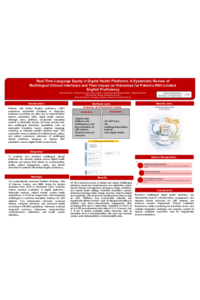
Introduction: Patients with limited English proficiency (LEP) experience substantial inequities in diagnosis, treatment, and follow-up, often due to communication barriers embedded within digital health systems. Although many platforms incorporate translated content or interpreter access, far fewer provide real-time multilingual interaction capabilities, such as automated translation layers, adaptive language switching, or culturally specific interface logic. This systematic review evaluates the effectiveness, safety, and patient experience outcomes of multilingual clinical interfaces designed to support LEP populations across digital health environments.
Methods: We systematically searched PubMed, Embase, Web of Science, Scopus, and IEEE Xplore for studies published from 2010 to December 2025. Inclusion criteria required evaluation of digital platforms—telehealth systems, patient portals, mobile health applications, or AI-driven triage tools—that integrated multilingual or real-time translation features for LEP patients. Two independent reviewers screened studies, extracted outcomes, and assessed quality according to PRISMA guidelines. Outcomes included diagnostic accuracy, adherence, communication comprehension, satisfaction, and health system utilization.
Results: Of 193 screened records, 8 studies met the criteria. Multilingual interfaces enhanced comprehension and satisfaction across chronic disease management, emergency triage, pediatrics, and mental health settings. Real-time translation systems enhanced message clarity, though accuracy varied by dialect and complexity, with some tools reporting error rates as high as 30%. Platforms that incorporated culturally and linguistically tailored content—such as bilingual storytelling or adapted user flows—demonstrated engagement rates exceeding 60% and, in select trials, reductions in HbA1c of up to 0.8% and adherence odds ratios of 2.11. However, only four of the eight studies evaluated safety outcomes such as translation error or misinterpretation risk, and none reported system-wide implementation or interoperability data.
Conclusions: Real-time multilingual digital health interfaces can substantially improve communication, engagement, and selected clinical outcomes for LEP patients, but evidence remains fragmented. Robust evaluation frameworks, safety monitoring for translation errors, and scalable integration strategies are urgently needed to support equitable connected care for linguistically diverse populations.
Keywords
Limited English Proficiency
Multilingual Digital Health
Real-Time Clinical Translation
Telehealth Communication Equity
Poster
Brian_Eposter.pdf
ANALYSIS OF MEDICAL PERSONNEL IN THE PRIMARY HEALTH CARE SERVICE IN PUBLIC AND PRIVATE HEALTH SECTORS
Federated Learning in Healthcare: A Systematic Review of Transparency, Privacy, and Clinical Utility