Event submissions
Published
This submission belongs to the session S2. Patient-Centered Care—Optimizing Care Pathways through Engagement and Outcome Measurement of the event The 1st International Online Conference on Healthcare
Published date
20 Mar, 2026
Academic Editor
'%3e%3cpath%20d='M12.6657%2010.9104C12.4185%2010.325%2012.0599%209.79327%2011.6097%209.34482C11.1609%208.89508%2010.6293%208.5365%2010.0442%208.28888C10.0389%208.28626%2010.0337%208.28495%2010.0285%208.28233C10.8446%207.69279%2011.3752%206.73249%2011.3752%205.64904C11.3752%203.8542%209.92103%202.39999%208.1262%202.39999C6.33136%202.39999%204.87715%203.8542%204.87715%205.64904C4.87715%206.73249%205.40774%207.69279%206.22393%208.28364C6.21869%208.28626%206.21345%208.28757%206.20821%208.29019C5.62129%208.5378%205.09463%208.89284%204.64265%209.34613C4.1929%209.79493%203.83432%2010.3266%203.58671%2010.9117C3.34345%2011.4845%203.21226%2012.0987%203.20023%2012.7209C3.19988%2012.7349%203.20233%2012.7488%203.20744%2012.7619C3.21255%2012.7749%203.22022%2012.7867%203.22998%2012.7968C3.23975%2012.8068%203.25142%2012.8147%203.26431%2012.8202C3.2772%2012.8256%203.29105%2012.8284%203.30504%2012.8284H4.09109C4.14874%2012.8284%204.19459%2012.7825%204.1959%2012.7262C4.2221%2011.7148%204.62823%2010.7676%205.34617%2010.0497C6.08899%209.30683%207.0755%208.89808%208.1262%208.89808C9.17689%208.89808%2010.1634%209.30683%2010.9062%2010.0497C11.6242%2010.7676%2012.0303%2011.7148%2012.0565%2012.7262C12.0578%2012.7838%2012.1037%2012.8284%2012.1613%2012.8284H12.9474C12.9613%2012.8284%2012.9752%2012.8256%2012.9881%2012.8202C13.001%2012.8147%2013.0126%2012.8068%2013.0224%2012.7968C13.0322%2012.7867%2013.0398%2012.7749%2013.0449%2012.7619C13.0501%2012.7488%2013.0525%2012.7349%2013.0522%2012.7209C13.0391%2012.0947%2012.9094%2011.4855%2012.6657%2010.9104ZM8.1262%207.9024C7.52486%207.9024%206.9589%207.6679%206.53312%207.24211C6.10733%206.81633%205.87283%206.25037%205.87283%205.64904C5.87283%205.0477%206.10733%204.48174%206.53312%204.05596C6.9589%203.63018%207.52486%203.39567%208.1262%203.39567C8.72753%203.39567%209.29349%203.63018%209.71927%204.05596C10.1451%204.48174%2010.3796%205.0477%2010.3796%205.64904C10.3796%206.25037%2010.1451%206.81633%209.71927%207.24211C9.29349%207.6679%208.72753%207.9024%208.1262%207.9024Z'%20fill='%235D1EE1'/%3e%3c/g%3e%3c/svg%3e) Lorraine Evangelista
Lorraine EvangelistaCitation
Harleen Kaur Multani, Kiratpreet Kaur Sraa, Shikha Gandhi, Hana Abbas, Optimizing Care Pathways Through Digital Symptom Tracking and Patient‑Reported Outcomes., in Proceedings of The 1st International Online Conference on Healthcare, 25 March–26 March 2026, MDPI: Basel, Switzerland
Share
Email
Facebook
Twitter
LinkedIn
Optimizing Care Pathways Through Digital Symptom Tracking and Patient‑Reported Outcomes.
'%3e%3cpath%20d='M12.6647%2010.9104C12.4176%2010.325%2012.0589%209.7933%2011.6088%209.34485C11.16%208.89511%2010.6283%208.53653%2010.0432%208.28891C10.038%208.28629%2010.0327%208.28498%2010.0275%208.28236C10.8437%207.69282%2011.3743%206.73252%2011.3743%205.64907C11.3743%203.85423%209.92005%202.40002%208.12522%202.40002C6.33038%202.40002%204.87618%203.85423%204.87618%205.64907C4.87618%206.73252%205.40677%207.69282%206.22296%208.28367C6.21772%208.28629%206.21248%208.2876%206.20724%208.29022C5.62031%208.53783%205.09365%208.89287%204.64167%209.34616C4.19192%209.79496%203.83334%2010.3266%203.58573%2010.9117C3.34247%2011.4846%203.21128%2012.0987%203.19925%2012.721C3.1989%2012.735%203.20135%2012.7489%203.20646%2012.7619C3.21157%2012.7749%203.21924%2012.7868%203.22901%2012.7968C3.23877%2012.8068%203.25045%2012.8148%203.26334%2012.8202C3.27623%2012.8256%203.29007%2012.8284%203.30406%2012.8284H4.09012C4.14776%2012.8284%204.19362%2012.7825%204.19493%2012.7262C4.22113%2011.7148%204.62726%2010.7676%205.34519%2010.0497C6.08802%209.30686%207.07452%208.89811%208.12522%208.89811C9.17592%208.89811%2010.1624%209.30686%2010.9052%2010.0497C11.6232%2010.7676%2012.0293%2011.7148%2012.0555%2012.7262C12.0568%2012.7839%2012.1027%2012.8284%2012.1603%2012.8284H12.9464C12.9604%2012.8284%2012.9742%2012.8256%2012.9871%2012.8202C13%2012.8148%2013.0117%2012.8068%2013.0214%2012.7968C13.0312%2012.7868%2013.0389%2012.7749%2013.044%2012.7619C13.0491%2012.7489%2013.0515%2012.735%2013.0512%2012.721C13.0381%2012.0947%2012.9084%2011.4856%2012.6647%2010.9104ZM8.12522%207.90243C7.52388%207.90243%206.95792%207.66793%206.53214%207.24215C6.10636%206.81636%205.87185%206.2504%205.87185%205.64907C5.87185%205.04773%206.10636%204.48177%206.53214%204.05599C6.95792%203.63021%207.52388%203.3957%208.12522%203.3957C8.72655%203.3957%209.29252%203.63021%209.7183%204.05599C10.1441%204.48177%2010.3786%205.04773%2010.3786%205.64907C10.3786%206.2504%2010.1441%206.81636%209.7183%207.24215C9.29252%207.66793%208.72655%207.90243%208.12522%207.90243Z'%20fill='%235D1EE1'/%3e%3c/g%3e%3c/svg%3e)
Harleen Kaur Multani 1
Kiratpreet Kaur Sraa 2
Shikha Gandhi 2
Hana Abbas 1
1. Meharry Medical College School of Medicine, Nashville, TN, USA, USA
2. Arizona College of Osteopathic Medicine, Glendale, AZ, USA, USA
Abstract
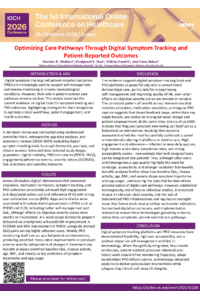
Introduction: Digital symptom tracking and patient-reported outcomes (PRO) are increasingly used to support self-management and remote monitoring in chronic dermatological conditions. However, their role in patient-centred care pathways remains unclear. This review examines the current evidence on digital tools for symptom tracking and PRO collection, highlighting strategies for their integration to optimize clinical workflows, patient engagement, and health outcomes.
Method: A literature review was conducted using randomized controlled trials, retrospective app‑data analyses, and systematic reviews (2010–2025) evaluating digital symptom‑tracking tools for atopic dermatitis, psoriasis, and chronic eczema. Extracted data included study design, population, digital modality, PRO instruments (POEM, DLQI), engagement/adherence metrics, severity indices (SCORAD), QoL outcomes, and usability measures.
Results: Across 30 studies, digital interventions that combined education, medication reminders, symptom tracking, and PRO collection consistently achieved high engagement (≥ 6 days/week active use) and adherence (9 %) with strong user‑satisfaction scores (88%). Apps and e-diaries were associated with substantial improvements in PROs such as POEM and DLQI, indicating better self-management and QoL, although effects on objective severity scores were smaller or inconsistent. A 6‑week atopic dermatitis program delivered via smartphone achieved 44% improvement in SCORAD and 46% improvement in POEM, alongside marked DLQI gains among highly adherent users. Weekly PRO monitoring itself can act as a behavioral co‑intervention, producing small but measurable improvements in perceived eczema severity independent of changes in treatment use. AutoML analyses identified baseline QoL, disease activity, age, BMI, and anxiety as key predictors of symptom trajectories and app usage.
Conclusion: Digital symptom‑tracking platforms and PRO measures have demonstrated feasibility, high user acceptability, and a positive impact on self‑management and QoL in dermatology. When thoughtfully integrated, they enable continuous, patient‑centred, precision‑informed care . Future work should refine monitoring frequency, adopt standardized PRO infrastructures, and leverage advanced analytics to deliver personalized interventions while safeguarding clinical and research integrity.
Keywords
digital health interventions
patient-reported outcomes
self-management
chronic cutaneous conditions
Poster
IOCOH.pdf
Health Behaviors and Psychosocial Profile of Tunisian Medical Students: A Call for Student Well-being Initiatives
Clinical Assessment of Medical Device–Related Pressure Injury Risk: Profiling Risk Levels in Patients Using Medical Devices