Event submissions
Published
This submission belongs to the session S2. Patient-Centered Care—Optimizing Care Pathways through Engagement and Outcome Measurement of the event The 1st International Online Conference on Healthcare
Published date
20 Mar, 2026
Academic Editor
'%3e%3cpath%20d='M12.6657%2010.9104C12.4185%2010.325%2012.0599%209.79327%2011.6097%209.34482C11.1609%208.89508%2010.6293%208.5365%2010.0442%208.28888C10.0389%208.28626%2010.0337%208.28495%2010.0285%208.28233C10.8446%207.69279%2011.3752%206.73249%2011.3752%205.64904C11.3752%203.8542%209.92103%202.39999%208.1262%202.39999C6.33136%202.39999%204.87715%203.8542%204.87715%205.64904C4.87715%206.73249%205.40774%207.69279%206.22393%208.28364C6.21869%208.28626%206.21345%208.28757%206.20821%208.29019C5.62129%208.5378%205.09463%208.89284%204.64265%209.34613C4.1929%209.79493%203.83432%2010.3266%203.58671%2010.9117C3.34345%2011.4845%203.21226%2012.0987%203.20023%2012.7209C3.19988%2012.7349%203.20233%2012.7488%203.20744%2012.7619C3.21255%2012.7749%203.22022%2012.7867%203.22998%2012.7968C3.23975%2012.8068%203.25142%2012.8147%203.26431%2012.8202C3.2772%2012.8256%203.29105%2012.8284%203.30504%2012.8284H4.09109C4.14874%2012.8284%204.19459%2012.7825%204.1959%2012.7262C4.2221%2011.7148%204.62823%2010.7676%205.34617%2010.0497C6.08899%209.30683%207.0755%208.89808%208.1262%208.89808C9.17689%208.89808%2010.1634%209.30683%2010.9062%2010.0497C11.6242%2010.7676%2012.0303%2011.7148%2012.0565%2012.7262C12.0578%2012.7838%2012.1037%2012.8284%2012.1613%2012.8284H12.9474C12.9613%2012.8284%2012.9752%2012.8256%2012.9881%2012.8202C13.001%2012.8147%2013.0126%2012.8068%2013.0224%2012.7968C13.0322%2012.7867%2013.0398%2012.7749%2013.0449%2012.7619C13.0501%2012.7488%2013.0525%2012.7349%2013.0522%2012.7209C13.0391%2012.0947%2012.9094%2011.4855%2012.6657%2010.9104ZM8.1262%207.9024C7.52486%207.9024%206.9589%207.6679%206.53312%207.24211C6.10733%206.81633%205.87283%206.25037%205.87283%205.64904C5.87283%205.0477%206.10733%204.48174%206.53312%204.05596C6.9589%203.63018%207.52486%203.39567%208.1262%203.39567C8.72753%203.39567%209.29349%203.63018%209.71927%204.05596C10.1451%204.48174%2010.3796%205.0477%2010.3796%205.64904C10.3796%206.25037%2010.1451%206.81633%209.71927%207.24211C9.29349%207.6679%208.72753%207.9024%208.1262%207.9024Z'%20fill='%235D1EE1'/%3e%3c/g%3e%3c/svg%3e) Lorraine Evangelista
Lorraine EvangelistaCitation
Francisco Nieto Escámez, Paula Latorre, Inmaculada Fernández-Agis, Cleiton Ferreira, The Impact of Affective Symptoms on Subjective Memory Complaints: Implications for Patient-Centered Cognitive Assessment and Gender-Sensitive Care, in Proceedings of The 1st International Online Conference on Healthcare, 25 March–26 March 2026, MDPI: Basel, Switzerland
Share
Email
Facebook
Twitter
LinkedIn
The Impact of Affective Symptoms on Subjective Memory Complaints: Implications for Patient-Centered Cognitive Assessment and Gender-Sensitive Care
'%3e%3cpath%20d='M12.6647%2010.9104C12.4176%2010.325%2012.0589%209.7933%2011.6088%209.34485C11.16%208.89511%2010.6283%208.53653%2010.0432%208.28891C10.038%208.28629%2010.0327%208.28498%2010.0275%208.28236C10.8437%207.69282%2011.3743%206.73252%2011.3743%205.64907C11.3743%203.85423%209.92005%202.40002%208.12522%202.40002C6.33038%202.40002%204.87618%203.85423%204.87618%205.64907C4.87618%206.73252%205.40677%207.69282%206.22296%208.28367C6.21772%208.28629%206.21248%208.2876%206.20724%208.29022C5.62031%208.53783%205.09365%208.89287%204.64167%209.34616C4.19192%209.79496%203.83334%2010.3266%203.58573%2010.9117C3.34247%2011.4846%203.21128%2012.0987%203.19925%2012.721C3.1989%2012.735%203.20135%2012.7489%203.20646%2012.7619C3.21157%2012.7749%203.21924%2012.7868%203.22901%2012.7968C3.23877%2012.8068%203.25045%2012.8148%203.26334%2012.8202C3.27623%2012.8256%203.29007%2012.8284%203.30406%2012.8284H4.09012C4.14776%2012.8284%204.19362%2012.7825%204.19493%2012.7262C4.22113%2011.7148%204.62726%2010.7676%205.34519%2010.0497C6.08802%209.30686%207.07452%208.89811%208.12522%208.89811C9.17592%208.89811%2010.1624%209.30686%2010.9052%2010.0497C11.6232%2010.7676%2012.0293%2011.7148%2012.0555%2012.7262C12.0568%2012.7839%2012.1027%2012.8284%2012.1603%2012.8284H12.9464C12.9604%2012.8284%2012.9742%2012.8256%2012.9871%2012.8202C13%2012.8148%2013.0117%2012.8068%2013.0214%2012.7968C13.0312%2012.7868%2013.0389%2012.7749%2013.044%2012.7619C13.0491%2012.7489%2013.0515%2012.735%2013.0512%2012.721C13.0381%2012.0947%2012.9084%2011.4856%2012.6647%2010.9104ZM8.12522%207.90243C7.52388%207.90243%206.95792%207.66793%206.53214%207.24215C6.10636%206.81636%205.87185%206.2504%205.87185%205.64907C5.87185%205.04773%206.10636%204.48177%206.53214%204.05599C6.95792%203.63021%207.52388%203.3957%208.12522%203.3957C8.72655%203.3957%209.29252%203.63021%209.7183%204.05599C10.1441%204.48177%2010.3786%205.04773%2010.3786%205.64907C10.3786%206.2504%2010.1441%206.81636%209.7183%207.24215C9.29252%207.66793%208.72655%207.90243%208.12522%207.90243Z'%20fill='%235D1EE1'/%3e%3c/g%3e%3c/svg%3e)
Paula Latorre 1
Inmaculada Fernández-Agis 1,2
Cleiton Ferreira 3

Francisco Nieto Escámez 1,2
1. Department of Psychology, Campus La Cañada, University of Almeria, Ctra. Sacramento S/N, 04120 Almería, Spain, Spain
2. CIBIS Research Center (Centro de Investigación para el Bienestar y la Inclusión Social), University of Almeria, 04120 Almería, Spain
3. Instituto Federal de Educação, Ciência e Tecnologia do Rio Grande do Sul, Rio Grande 96201-460, Brazil, Brazil
Abstract
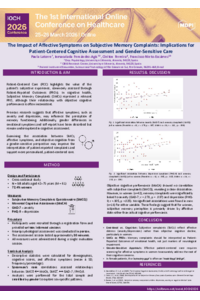
Introduction: The evolution of healthcare towards Patient-Centered Care (PCC) emphasizes the value of the patient's perspective, measured through Patient-Reported Outcomes (PROs). Subjective memory complaints (SMCs) represent a crucial PRO in the field of cognitive health. This study examines gender differences in the relationship between SMCs, affective symptoms, and objective cognitive performance, seeking to optimize care pathways by enhancing the interpretation of patient engagement and reported symptoms.
Methods: The sample included 58 participants aged 42 to 75 years (mean = 61), predominantly women (72.4%). Participants completed the Montreal Cognitive Assessment (MoCA), Subjective Memory Complaints Questionnaire (SMCQ), and measures of anxiety (GAD-7) and depression (PHQ-9). The inclusion of self-report measures supports the patient-centered approach by prioritizing the individual's perspective.
Results: Analysis revealed a clear dissociation between subjective memory complaints and objective cognitive performance, with no significant correlations between SMCQ and MoCA scores in the total sample or by gender. However, significant positive correlations emerged between SMCs and both anxiety (rho = 0.238, p = 0.036) and depression (rho = 0.271, p = 0.02). Gender-stratified analysis showed that these associations were significant only in women (anxiety: rho = 0.278, p = 0.037; depression: rho = 0.305, p = 0.025), with no significant correlations in men.
Conclusion: The findings highlight that, particularly in women, SMCs are more closely tied to affective symptoms than to objective cognitive performance. This proposes that in a PCC model, SMCs should not be solely interpreted as cognitive deficit markers but as valid indicators of affective distress that impair patient engagement and satisfaction. Incorporating gender-sensitive assessment of anxiety and depression is crucial to optimize care pathways in cognitive health, ensuring personalized interventions that address the root cause of the patient's concern, thereby improving overall patient outcomes.
Keywords
Patient-Centered Care (PCC)
Patient-Reported Outcomes (PROs)
gender
subjective memory complaints
aging
cognitive assessment
anxiety
depression.
Poster
Poster IOCH March 2026.pdf
Clinical Assessment of Medical Device–Related Pressure Injury Risk: Profiling Risk Levels in Patients Using Medical Devices
Reclaiming self and family: A phenomenological exploration of the unmet needs and lived experiences of breast cancer survivors in Hong Kong