Event submissions
Published
This submission belongs to the session S2. Patient-Centered Care—Optimizing Care Pathways through Engagement and Outcome Measurement of the event The 1st International Online Conference on Healthcare
Published date
20 Mar, 2026
Academic Editor
'%3e%3cpath%20d='M12.6657%2010.9104C12.4185%2010.325%2012.0599%209.79327%2011.6097%209.34482C11.1609%208.89508%2010.6293%208.5365%2010.0442%208.28888C10.0389%208.28626%2010.0337%208.28495%2010.0285%208.28233C10.8446%207.69279%2011.3752%206.73249%2011.3752%205.64904C11.3752%203.8542%209.92103%202.39999%208.1262%202.39999C6.33136%202.39999%204.87715%203.8542%204.87715%205.64904C4.87715%206.73249%205.40774%207.69279%206.22393%208.28364C6.21869%208.28626%206.21345%208.28757%206.20821%208.29019C5.62129%208.5378%205.09463%208.89284%204.64265%209.34613C4.1929%209.79493%203.83432%2010.3266%203.58671%2010.9117C3.34345%2011.4845%203.21226%2012.0987%203.20023%2012.7209C3.19988%2012.7349%203.20233%2012.7488%203.20744%2012.7619C3.21255%2012.7749%203.22022%2012.7867%203.22998%2012.7968C3.23975%2012.8068%203.25142%2012.8147%203.26431%2012.8202C3.2772%2012.8256%203.29105%2012.8284%203.30504%2012.8284H4.09109C4.14874%2012.8284%204.19459%2012.7825%204.1959%2012.7262C4.2221%2011.7148%204.62823%2010.7676%205.34617%2010.0497C6.08899%209.30683%207.0755%208.89808%208.1262%208.89808C9.17689%208.89808%2010.1634%209.30683%2010.9062%2010.0497C11.6242%2010.7676%2012.0303%2011.7148%2012.0565%2012.7262C12.0578%2012.7838%2012.1037%2012.8284%2012.1613%2012.8284H12.9474C12.9613%2012.8284%2012.9752%2012.8256%2012.9881%2012.8202C13.001%2012.8147%2013.0126%2012.8068%2013.0224%2012.7968C13.0322%2012.7867%2013.0398%2012.7749%2013.0449%2012.7619C13.0501%2012.7488%2013.0525%2012.7349%2013.0522%2012.7209C13.0391%2012.0947%2012.9094%2011.4855%2012.6657%2010.9104ZM8.1262%207.9024C7.52486%207.9024%206.9589%207.6679%206.53312%207.24211C6.10733%206.81633%205.87283%206.25037%205.87283%205.64904C5.87283%205.0477%206.10733%204.48174%206.53312%204.05596C6.9589%203.63018%207.52486%203.39567%208.1262%203.39567C8.72753%203.39567%209.29349%203.63018%209.71927%204.05596C10.1451%204.48174%2010.3796%205.0477%2010.3796%205.64904C10.3796%206.25037%2010.1451%206.81633%209.71927%207.24211C9.29349%207.6679%208.72753%207.9024%208.1262%207.9024Z'%20fill='%235D1EE1'/%3e%3c/g%3e%3c/svg%3e) Lorraine S. Evangelista
Lorraine S. EvangelistaCitation
Sonsoles Valdivia-Salas, Alejandra Chulián, Penelope Quilez-Domene, Carlos Garcia-Prado, Sara Escriche-Martinez, How is purpose in life experienced when the road ahead is shorter than the road behind?, in Proceedings of The 1st International Online Conference on Healthcare, 25 March–26 March 2026, MDPI: Basel, Switzerland
Share
Email
Facebook
Twitter
LinkedIn
How is purpose in life experienced when the road ahead is shorter than the road behind?
'%3e%3cpath%20d='M12.6647%2010.9104C12.4176%2010.325%2012.0589%209.7933%2011.6088%209.34485C11.16%208.89511%2010.6283%208.53653%2010.0432%208.28891C10.038%208.28629%2010.0327%208.28498%2010.0275%208.28236C10.8437%207.69282%2011.3743%206.73252%2011.3743%205.64907C11.3743%203.85423%209.92005%202.40002%208.12522%202.40002C6.33038%202.40002%204.87618%203.85423%204.87618%205.64907C4.87618%206.73252%205.40677%207.69282%206.22296%208.28367C6.21772%208.28629%206.21248%208.2876%206.20724%208.29022C5.62031%208.53783%205.09365%208.89287%204.64167%209.34616C4.19192%209.79496%203.83334%2010.3266%203.58573%2010.9117C3.34247%2011.4846%203.21128%2012.0987%203.19925%2012.721C3.1989%2012.735%203.20135%2012.7489%203.20646%2012.7619C3.21157%2012.7749%203.21924%2012.7868%203.22901%2012.7968C3.23877%2012.8068%203.25045%2012.8148%203.26334%2012.8202C3.27623%2012.8256%203.29007%2012.8284%203.30406%2012.8284H4.09012C4.14776%2012.8284%204.19362%2012.7825%204.19493%2012.7262C4.22113%2011.7148%204.62726%2010.7676%205.34519%2010.0497C6.08802%209.30686%207.07452%208.89811%208.12522%208.89811C9.17592%208.89811%2010.1624%209.30686%2010.9052%2010.0497C11.6232%2010.7676%2012.0293%2011.7148%2012.0555%2012.7262C12.0568%2012.7839%2012.1027%2012.8284%2012.1603%2012.8284H12.9464C12.9604%2012.8284%2012.9742%2012.8256%2012.9871%2012.8202C13%2012.8148%2013.0117%2012.8068%2013.0214%2012.7968C13.0312%2012.7868%2013.0389%2012.7749%2013.044%2012.7619C13.0491%2012.7489%2013.0515%2012.735%2013.0512%2012.721C13.0381%2012.0947%2012.9084%2011.4856%2012.6647%2010.9104ZM8.12522%207.90243C7.52388%207.90243%206.95792%207.66793%206.53214%207.24215C6.10636%206.81636%205.87185%206.2504%205.87185%205.64907C5.87185%205.04773%206.10636%204.48177%206.53214%204.05599C6.95792%203.63021%207.52388%203.3957%208.12522%203.3957C8.72655%203.3957%209.29252%203.63021%209.7183%204.05599C10.1441%204.48177%2010.3786%205.04773%2010.3786%205.64907C10.3786%206.2504%2010.1441%206.81636%209.7183%207.24215C9.29252%207.66793%208.72655%207.90243%208.12522%207.90243Z'%20fill='%235D1EE1'/%3e%3c/g%3e%3c/svg%3e)
Alejandra Chulián 1
Penelope Quilez-Domene 2
Carlos Garcia-Prado 3
Sara Escriche-Martinez 3
Sonsoles Valdivia-Salas 3
1. Department of Psychology, Distance University of Madrid, Madrid, 28400, Spain, Spain
2. Department of Elderly Care, Rey Ardid Foundation, Teruel, 44003, Spain, Spain
3. Department of Psychology and Sociology, University of Zaragoza, Teruel, 44003, Spain, Spain
Abstract
Introduction
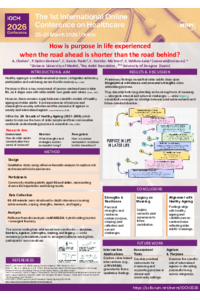
Healthy aging is internationally conceptualized as a multidimensional process encompassing autonomy, participation, functional capacity, and well-being. Purpose in life is increasingly recognized as a key element of person-centered care in later life; however, a significant gap remains between scientific frameworks and the ways in which older adults themselves experience and describe purpose. Within the context of the United Nations Decade of Healthy Ageing (2021–2030), this study explores how adults aged 65 and older understand, maintain, or renegotiate their life purpose with the ultimate goal of supporting the development of person-centered care models that are responsive to older adults’ own understandings and expressions of meaning and direction in later life.
Methods
Adults aged 65+ participated in 60 to 90-minute semi-structured, in-depth interviews that examined major life achievements, transformative experiences, difficulties and coping strategies, personal strengths, current barriers to purposeful living, and views on legacy. Interviews were analyzed using reflexive thematic analysis supported by MAXQDA. Coding was informed by an a priori coding tree (purpose, barriers, ageism, strengths, coping, legacy) while remaining open to emergent themes.
Results
Preliminary thematic patterns indicate that older adults draw upon a combination of biographical milestones and personal strengths when articulating their purpose. Participants referenced both long-standing and evolving forms of purpose, and described internal (e.g., internalized ageism) and external factors (e.g., changes in significant social networks) that challenge purposeful living. Notions of legacy appeared as a bridge between past achievements and future-oriented meaning. Variability in the influence of internalized ageism was noted.
Conclusions
The findings underscore the importance of integrating personal strengths, resilience, and legacy into the study of purpose in later life. These dimensions influence how individuals make sense of their past, respond to current challenges, and orient themselves towards meaningful future contributions, aligning closely with core principles of healthy ageing.
Keywords
purpose in life
older adults
qualitative
personal strenghts
coping strategies
legacy
Poster
poster alejandra.pdf
LivingVerb: A Single-Session Gamified Value-Clarification Intervention to Activate Life Projects across the Adult Lifespan
Optimizing Care for Infants with Colic through Probiotic Intervention