Event submissions
Published
This submission belongs to the session S4. Clinical Data Management—Balancing Transparency with Innovation for Enhanced Care Quality of the event The 1st International Online Conference on Healthcare
Published date
20 Mar, 2026
Academic Editor
'%3e%3cpath%20d='M12.6657%2010.9104C12.4185%2010.325%2012.0599%209.79327%2011.6097%209.34482C11.1609%208.89508%2010.6293%208.5365%2010.0442%208.28888C10.0389%208.28626%2010.0337%208.28495%2010.0285%208.28233C10.8446%207.69279%2011.3752%206.73249%2011.3752%205.64904C11.3752%203.8542%209.92103%202.39999%208.1262%202.39999C6.33136%202.39999%204.87715%203.8542%204.87715%205.64904C4.87715%206.73249%205.40774%207.69279%206.22393%208.28364C6.21869%208.28626%206.21345%208.28757%206.20821%208.29019C5.62129%208.5378%205.09463%208.89284%204.64265%209.34613C4.1929%209.79493%203.83432%2010.3266%203.58671%2010.9117C3.34345%2011.4845%203.21226%2012.0987%203.20023%2012.7209C3.19988%2012.7349%203.20233%2012.7488%203.20744%2012.7619C3.21255%2012.7749%203.22022%2012.7867%203.22998%2012.7968C3.23975%2012.8068%203.25142%2012.8147%203.26431%2012.8202C3.2772%2012.8256%203.29105%2012.8284%203.30504%2012.8284H4.09109C4.14874%2012.8284%204.19459%2012.7825%204.1959%2012.7262C4.2221%2011.7148%204.62823%2010.7676%205.34617%2010.0497C6.08899%209.30683%207.0755%208.89808%208.1262%208.89808C9.17689%208.89808%2010.1634%209.30683%2010.9062%2010.0497C11.6242%2010.7676%2012.0303%2011.7148%2012.0565%2012.7262C12.0578%2012.7838%2012.1037%2012.8284%2012.1613%2012.8284H12.9474C12.9613%2012.8284%2012.9752%2012.8256%2012.9881%2012.8202C13.001%2012.8147%2013.0126%2012.8068%2013.0224%2012.7968C13.0322%2012.7867%2013.0398%2012.7749%2013.0449%2012.7619C13.0501%2012.7488%2013.0525%2012.7349%2013.0522%2012.7209C13.0391%2012.0947%2012.9094%2011.4855%2012.6657%2010.9104ZM8.1262%207.9024C7.52486%207.9024%206.9589%207.6679%206.53312%207.24211C6.10733%206.81633%205.87283%206.25037%205.87283%205.64904C5.87283%205.0477%206.10733%204.48174%206.53312%204.05596C6.9589%203.63018%207.52486%203.39567%208.1262%203.39567C8.72753%203.39567%209.29349%203.63018%209.71927%204.05596C10.1451%204.48174%2010.3796%205.0477%2010.3796%205.64904C10.3796%206.25037%2010.1451%206.81633%209.71927%207.24211C9.29349%207.6679%208.72753%207.9024%208.1262%207.9024Z'%20fill='%235D1EE1'/%3e%3c/g%3e%3c/svg%3e) Rüdiger Pryss
Rüdiger PryssCitation
Monica L. Miller, Brooke Hildebrand, Kalpesh Patel, Ellen Schellhease, Michelle Sullilvan, Turning Incident Reports into Insights: Leveraging Medication Error Reports in a Cardiac Care Unit, in Proceedings of The 1st International Online Conference on Healthcare, 25 March–26 March 2026, MDPI: Basel, Switzerland
Share
Email
Facebook
Twitter
LinkedIn
Turning Incident Reports into Insights: Leveraging Medication Error Reports in a Cardiac Care Unit
'%3e%3cpath%20d='M12.6647%2010.9104C12.4176%2010.325%2012.0589%209.7933%2011.6088%209.34485C11.16%208.89511%2010.6283%208.53653%2010.0432%208.28891C10.038%208.28629%2010.0327%208.28498%2010.0275%208.28236C10.8437%207.69282%2011.3743%206.73252%2011.3743%205.64907C11.3743%203.85423%209.92005%202.40002%208.12522%202.40002C6.33038%202.40002%204.87618%203.85423%204.87618%205.64907C4.87618%206.73252%205.40677%207.69282%206.22296%208.28367C6.21772%208.28629%206.21248%208.2876%206.20724%208.29022C5.62031%208.53783%205.09365%208.89287%204.64167%209.34616C4.19192%209.79496%203.83334%2010.3266%203.58573%2010.9117C3.34247%2011.4846%203.21128%2012.0987%203.19925%2012.721C3.1989%2012.735%203.20135%2012.7489%203.20646%2012.7619C3.21157%2012.7749%203.21924%2012.7868%203.22901%2012.7968C3.23877%2012.8068%203.25045%2012.8148%203.26334%2012.8202C3.27623%2012.8256%203.29007%2012.8284%203.30406%2012.8284H4.09012C4.14776%2012.8284%204.19362%2012.7825%204.19493%2012.7262C4.22113%2011.7148%204.62726%2010.7676%205.34519%2010.0497C6.08802%209.30686%207.07452%208.89811%208.12522%208.89811C9.17592%208.89811%2010.1624%209.30686%2010.9052%2010.0497C11.6232%2010.7676%2012.0293%2011.7148%2012.0555%2012.7262C12.0568%2012.7839%2012.1027%2012.8284%2012.1603%2012.8284H12.9464C12.9604%2012.8284%2012.9742%2012.8256%2012.9871%2012.8202C13%2012.8148%2013.0117%2012.8068%2013.0214%2012.7968C13.0312%2012.7868%2013.0389%2012.7749%2013.044%2012.7619C13.0491%2012.7489%2013.0515%2012.735%2013.0512%2012.721C13.0381%2012.0947%2012.9084%2011.4856%2012.6647%2010.9104ZM8.12522%207.90243C7.52388%207.90243%206.95792%207.66793%206.53214%207.24215C6.10636%206.81636%205.87185%206.2504%205.87185%205.64907C5.87185%205.04773%206.10636%204.48177%206.53214%204.05599C6.95792%203.63021%207.52388%203.3957%208.12522%203.3957C8.72655%203.3957%209.29252%203.63021%209.7183%204.05599C10.1441%204.48177%2010.3786%205.04773%2010.3786%205.64907C10.3786%206.2504%2010.1441%206.81636%209.7183%207.24215C9.29252%207.66793%208.72655%207.90243%208.12522%207.90243Z'%20fill='%235D1EE1'/%3e%3c/g%3e%3c/svg%3e)
Brooke Hildebrand 1
Kalpesh Patel 2
Ellen Schellhease 1
Michelle Sullilvan 2
Monica L. Miller 1
1. College of Pharmacy, Purdue University, West Lafayette, Indiana 47907, United States of America, USA
2. St Bartholomew's Hospital, London, UK, UK
Abstract
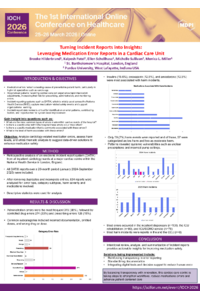
Introduction: Clinical data management is essential for improving patient safety and care quality. In cardiology care, medication errors pose significant risks, making transparent reporting and innovative solutions critical. The study objective was to analyse cardiology-related medication errors, assess harm levels, and utilize thematic analysis to suggest data-driven solutions to enhance medication safety.
Methods: A retrospective review of an electronic incident reporting system (DATIX) from all inpatient cardiology wards at a major cardiac care centre within the National Health Service in London, England, was conducted. All DATIX reports over a 20-month period (January 2024–September 2025) were included. After removing duplicates and incomplete entries, 834 reports were analysed for error type, category subtypes, harm severity, and medications involved.
Results: Administration errors were most frequent 315 (38%), followed by controlled drug discrepancies 274 (33%) and prescribing errors 128 (15%). Common subcategories included incorrect documentation, omitted doses, and wrong drug or dose. Insulin, enoxaparin, and amiodarone were most associated with harm incidents. Only 59 (7%) harm events were reported and of those, 57 were categorized as low harm and two moderate harm. Patterns revealed systemic vulnerabilities such as unclear prescriptions and incorrect pump settings.
Conclusion: Intentional review, analysis, and summarization of incident reports provides actionable insights for improving medication safety. Recommendations include reinforcing transparency in error reporting, standardising documentation, and integrating digital tools and decision support to reduce human error. By balancing transparency with innovation, this cardiac care centre is taking steps to strengthen workflows, reduce medication errors, and advance patient-centred care.
Keywords
Clinical Data Management
Transparency & Trust
Digital Health Innovation
Artificial Intelligence & LLMs
Medical Informatics
Mobile & Ubiquitous Computing
Research Infrastructures
Patient-Centered Care.
Poster
HILDERBRAND IOCH 2026 2.0 POSTER - Read-Only.pdf
Resting Heart Rate Variability Profile in Women with Stage II-III Breast Cancer Enrolled in the MAMA_MOVE Program
Intersection of CKD and Fragility Fractures: A growing Concern among older people