Event submissions
Published
This submission belongs to the session S2. Patient-Centered Care—Optimizing Care Pathways through Engagement and Outcome Measurement of the event The 1st International Online Conference on Healthcare
Published date
20 Mar, 2026
Academic Editor
'%3e%3cpath%20d='M12.6657%2010.9104C12.4185%2010.325%2012.0599%209.79327%2011.6097%209.34482C11.1609%208.89508%2010.6293%208.5365%2010.0442%208.28888C10.0389%208.28626%2010.0337%208.28495%2010.0285%208.28233C10.8446%207.69279%2011.3752%206.73249%2011.3752%205.64904C11.3752%203.8542%209.92103%202.39999%208.1262%202.39999C6.33136%202.39999%204.87715%203.8542%204.87715%205.64904C4.87715%206.73249%205.40774%207.69279%206.22393%208.28364C6.21869%208.28626%206.21345%208.28757%206.20821%208.29019C5.62129%208.5378%205.09463%208.89284%204.64265%209.34613C4.1929%209.79493%203.83432%2010.3266%203.58671%2010.9117C3.34345%2011.4845%203.21226%2012.0987%203.20023%2012.7209C3.19988%2012.7349%203.20233%2012.7488%203.20744%2012.7619C3.21255%2012.7749%203.22022%2012.7867%203.22998%2012.7968C3.23975%2012.8068%203.25142%2012.8147%203.26431%2012.8202C3.2772%2012.8256%203.29105%2012.8284%203.30504%2012.8284H4.09109C4.14874%2012.8284%204.19459%2012.7825%204.1959%2012.7262C4.2221%2011.7148%204.62823%2010.7676%205.34617%2010.0497C6.08899%209.30683%207.0755%208.89808%208.1262%208.89808C9.17689%208.89808%2010.1634%209.30683%2010.9062%2010.0497C11.6242%2010.7676%2012.0303%2011.7148%2012.0565%2012.7262C12.0578%2012.7838%2012.1037%2012.8284%2012.1613%2012.8284H12.9474C12.9613%2012.8284%2012.9752%2012.8256%2012.9881%2012.8202C13.001%2012.8147%2013.0126%2012.8068%2013.0224%2012.7968C13.0322%2012.7867%2013.0398%2012.7749%2013.0449%2012.7619C13.0501%2012.7488%2013.0525%2012.7349%2013.0522%2012.7209C13.0391%2012.0947%2012.9094%2011.4855%2012.6657%2010.9104ZM8.1262%207.9024C7.52486%207.9024%206.9589%207.6679%206.53312%207.24211C6.10733%206.81633%205.87283%206.25037%205.87283%205.64904C5.87283%205.0477%206.10733%204.48174%206.53312%204.05596C6.9589%203.63018%207.52486%203.39567%208.1262%203.39567C8.72753%203.39567%209.29349%203.63018%209.71927%204.05596C10.1451%204.48174%2010.3796%205.0477%2010.3796%205.64904C10.3796%206.25037%2010.1451%206.81633%209.71927%207.24211C9.29349%207.6679%208.72753%207.9024%208.1262%207.9024Z'%20fill='%235D1EE1'/%3e%3c/g%3e%3c/svg%3e) Lorraine S. Evangelista
Lorraine S. EvangelistaCitation
Anna Patrikakou, Nadia El-Fellah, Nikolaos Kasimatis, Sofia Kasidiaraki, Dimitrios Tsiftsis, Christina Lithari, Improving Emergency Department Efficiency Through a Primary-Care-Led Fast Track Model: A High-Volume Hospital Experience, in Proceedings of The 1st International Online Conference on Healthcare, 25 March–26 March 2026, MDPI: Basel, Switzerland
Share
Email
Facebook
Twitter
LinkedIn
Improving Emergency Department Efficiency Through a Primary-Care-Led Fast Track Model: A High-Volume Hospital Experience
'%3e%3cpath%20d='M12.6647%2010.9104C12.4176%2010.325%2012.0589%209.7933%2011.6088%209.34485C11.16%208.89511%2010.6283%208.53653%2010.0432%208.28891C10.038%208.28629%2010.0327%208.28498%2010.0275%208.28236C10.8437%207.69282%2011.3743%206.73252%2011.3743%205.64907C11.3743%203.85423%209.92005%202.40002%208.12522%202.40002C6.33038%202.40002%204.87618%203.85423%204.87618%205.64907C4.87618%206.73252%205.40677%207.69282%206.22296%208.28367C6.21772%208.28629%206.21248%208.2876%206.20724%208.29022C5.62031%208.53783%205.09365%208.89287%204.64167%209.34616C4.19192%209.79496%203.83334%2010.3266%203.58573%2010.9117C3.34247%2011.4846%203.21128%2012.0987%203.19925%2012.721C3.1989%2012.735%203.20135%2012.7489%203.20646%2012.7619C3.21157%2012.7749%203.21924%2012.7868%203.22901%2012.7968C3.23877%2012.8068%203.25045%2012.8148%203.26334%2012.8202C3.27623%2012.8256%203.29007%2012.8284%203.30406%2012.8284H4.09012C4.14776%2012.8284%204.19362%2012.7825%204.19493%2012.7262C4.22113%2011.7148%204.62726%2010.7676%205.34519%2010.0497C6.08802%209.30686%207.07452%208.89811%208.12522%208.89811C9.17592%208.89811%2010.1624%209.30686%2010.9052%2010.0497C11.6232%2010.7676%2012.0293%2011.7148%2012.0555%2012.7262C12.0568%2012.7839%2012.1027%2012.8284%2012.1603%2012.8284H12.9464C12.9604%2012.8284%2012.9742%2012.8256%2012.9871%2012.8202C13%2012.8148%2013.0117%2012.8068%2013.0214%2012.7968C13.0312%2012.7868%2013.0389%2012.7749%2013.044%2012.7619C13.0491%2012.7489%2013.0515%2012.735%2013.0512%2012.721C13.0381%2012.0947%2012.9084%2011.4856%2012.6647%2010.9104ZM8.12522%207.90243C7.52388%207.90243%206.95792%207.66793%206.53214%207.24215C6.10636%206.81636%205.87185%206.2504%205.87185%205.64907C5.87185%205.04773%206.10636%204.48177%206.53214%204.05599C6.95792%203.63021%207.52388%203.3957%208.12522%203.3957C8.72655%203.3957%209.29252%203.63021%209.7183%204.05599C10.1441%204.48177%2010.3786%205.04773%2010.3786%205.64907C10.3786%206.2504%2010.1441%206.81636%209.7183%207.24215C9.29252%207.66793%208.72655%207.90243%208.12522%207.90243Z'%20fill='%235D1EE1'/%3e%3c/g%3e%3c/svg%3e)
Nadia El-Fellah 1
Anna Patrikakou 2
Nikolaos Kasimatis 1
Sofia Kasidiaraki 1
Christina Lithari 1
Dimitrios Tsiftsis 1
1. Emergency Department of General Hospital of Nikaia-Piraeus, Nikaia 18454, Greece, Greece
2. 2nd Regional Health Authority, Health Ministry, Agios Ioannis Rentis, 18233, Greece, Greece
Abstract
Background
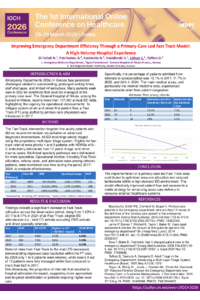
Emergency Departments (EDs) in Greece face persistent challenges related to overcrowding, prolonged waiting times, staff shortages, and limited infrastructure. Many patients seek care in EDs for conditions that could be managed at the primary care level. The General Hospital of Nikaia, among the busiest in Athens, reports more than 107,000 annual ED visits, highlighting the urgency for operational improvements. To mitigate system strain and streamline patient flow, a Fast Track (FT) area staffed by primary care physicians was introduced in 2017.
Methods
The Fast Track intervention targeted low-acuity patients who did not require immediate resuscitation or advanced diagnostic interventions. All ED attendees were screened through a standardized triage process using the Emergency Severity Index (ESI) and National Early Warning Score (NEWS). Eligible Fast Track patients included those classified as ESI 4–5, with NEWSs of 0–3, ambulatory individuals over 16 years of age, and minor trauma cases. Additional specialty pathways were delineated for more specialties. Operational metrics, including Fast Track utilization, referral rates, and admission rates among referred patients, were monitored over time to evaluate effectiveness.
Results
Findings indicate a significant increase in Fast Track utilization across the observation period. Referral rates from Fast Track to the main ED decreased, demonstrating improved case resolution within the FT unit. Simultaneously, the proportion of referrals that resulted in hospital admission increased, suggesting more appropriate and targeted identification of patients requiring higher-level care. The main medical areas, and particularly the internal medicine area, experienced demonstrable relief from patient congestion.
Conclusion
The implementation of a primary-care-led Fast Track area contributed to more efficient triage, optimized resource allocation, and reduced bottlenecks within a high-demand ED environment. The model effectively improved patient flow and represents a viable strategy for enhancing acute care delivery in resource-strained healthcare systems.
Keywords
Fast Track
Patient Flow
Resource Optimization
ED Operations
Primary Care Physicians
Poster
160411_Improving Emergency Department Efficiency_Primary Care Led Fast Track Model_A High Volume Hospital Experience.pdf
A comprehensive framework for quality and patient safety in the field of a Greek Emergency Department
Beyond Protocols: Uncovering Allergy-Related Medication Errors in the Digital Prescribing Era