Event submissions
Published
This submission belongs to the session S2. Patient-Centered Care—Optimizing Care Pathways through Engagement and Outcome Measurement of the event The 1st International Online Conference on Healthcare
Published date
20 Mar, 2026
Academic Editor
'%3e%3cpath%20d='M12.6657%2010.9104C12.4185%2010.325%2012.0599%209.79327%2011.6097%209.34482C11.1609%208.89508%2010.6293%208.5365%2010.0442%208.28888C10.0389%208.28626%2010.0337%208.28495%2010.0285%208.28233C10.8446%207.69279%2011.3752%206.73249%2011.3752%205.64904C11.3752%203.8542%209.92103%202.39999%208.1262%202.39999C6.33136%202.39999%204.87715%203.8542%204.87715%205.64904C4.87715%206.73249%205.40774%207.69279%206.22393%208.28364C6.21869%208.28626%206.21345%208.28757%206.20821%208.29019C5.62129%208.5378%205.09463%208.89284%204.64265%209.34613C4.1929%209.79493%203.83432%2010.3266%203.58671%2010.9117C3.34345%2011.4845%203.21226%2012.0987%203.20023%2012.7209C3.19988%2012.7349%203.20233%2012.7488%203.20744%2012.7619C3.21255%2012.7749%203.22022%2012.7867%203.22998%2012.7968C3.23975%2012.8068%203.25142%2012.8147%203.26431%2012.8202C3.2772%2012.8256%203.29105%2012.8284%203.30504%2012.8284H4.09109C4.14874%2012.8284%204.19459%2012.7825%204.1959%2012.7262C4.2221%2011.7148%204.62823%2010.7676%205.34617%2010.0497C6.08899%209.30683%207.0755%208.89808%208.1262%208.89808C9.17689%208.89808%2010.1634%209.30683%2010.9062%2010.0497C11.6242%2010.7676%2012.0303%2011.7148%2012.0565%2012.7262C12.0578%2012.7838%2012.1037%2012.8284%2012.1613%2012.8284H12.9474C12.9613%2012.8284%2012.9752%2012.8256%2012.9881%2012.8202C13.001%2012.8147%2013.0126%2012.8068%2013.0224%2012.7968C13.0322%2012.7867%2013.0398%2012.7749%2013.0449%2012.7619C13.0501%2012.7488%2013.0525%2012.7349%2013.0522%2012.7209C13.0391%2012.0947%2012.9094%2011.4855%2012.6657%2010.9104ZM8.1262%207.9024C7.52486%207.9024%206.9589%207.6679%206.53312%207.24211C6.10733%206.81633%205.87283%206.25037%205.87283%205.64904C5.87283%205.0477%206.10733%204.48174%206.53312%204.05596C6.9589%203.63018%207.52486%203.39567%208.1262%203.39567C8.72753%203.39567%209.29349%203.63018%209.71927%204.05596C10.1451%204.48174%2010.3796%205.0477%2010.3796%205.64904C10.3796%206.25037%2010.1451%206.81633%209.71927%207.24211C9.29349%207.6679%208.72753%207.9024%208.1262%207.9024Z'%20fill='%235D1EE1'/%3e%3c/g%3e%3c/svg%3e) Lorraine Evangelista
Lorraine EvangelistaCitation
Sara Escriche-Martinez, Esther Sierra- Martínez, Carlos Gala-Serra, Ginesa López-Crespo, Raúl López-Antón, Independent Cognitive and Emotional Domains in Older Adults with Prolonged Hospitalization: Implications for Patient-Centered Care Pathways, in Proceedings of The 1st International Online Conference on Healthcare, 25 March–26 March 2026, MDPI: Basel, Switzerland
Share
Email
Facebook
Twitter
LinkedIn
Independent Cognitive and Emotional Domains in Older Adults with Prolonged Hospitalization: Implications for Patient-Centered Care Pathways
'%3e%3cpath%20d='M12.6647%2010.9104C12.4176%2010.325%2012.0589%209.7933%2011.6088%209.34485C11.16%208.89511%2010.6283%208.53653%2010.0432%208.28891C10.038%208.28629%2010.0327%208.28498%2010.0275%208.28236C10.8437%207.69282%2011.3743%206.73252%2011.3743%205.64907C11.3743%203.85423%209.92005%202.40002%208.12522%202.40002C6.33038%202.40002%204.87618%203.85423%204.87618%205.64907C4.87618%206.73252%205.40677%207.69282%206.22296%208.28367C6.21772%208.28629%206.21248%208.2876%206.20724%208.29022C5.62031%208.53783%205.09365%208.89287%204.64167%209.34616C4.19192%209.79496%203.83334%2010.3266%203.58573%2010.9117C3.34247%2011.4846%203.21128%2012.0987%203.19925%2012.721C3.1989%2012.735%203.20135%2012.7489%203.20646%2012.7619C3.21157%2012.7749%203.21924%2012.7868%203.22901%2012.7968C3.23877%2012.8068%203.25045%2012.8148%203.26334%2012.8202C3.27623%2012.8256%203.29007%2012.8284%203.30406%2012.8284H4.09012C4.14776%2012.8284%204.19362%2012.7825%204.19493%2012.7262C4.22113%2011.7148%204.62726%2010.7676%205.34519%2010.0497C6.08802%209.30686%207.07452%208.89811%208.12522%208.89811C9.17592%208.89811%2010.1624%209.30686%2010.9052%2010.0497C11.6232%2010.7676%2012.0293%2011.7148%2012.0555%2012.7262C12.0568%2012.7839%2012.1027%2012.8284%2012.1603%2012.8284H12.9464C12.9604%2012.8284%2012.9742%2012.8256%2012.9871%2012.8202C13%2012.8148%2013.0117%2012.8068%2013.0214%2012.7968C13.0312%2012.7868%2013.0389%2012.7749%2013.044%2012.7619C13.0491%2012.7489%2013.0515%2012.735%2013.0512%2012.721C13.0381%2012.0947%2012.9084%2011.4856%2012.6647%2010.9104ZM8.12522%207.90243C7.52388%207.90243%206.95792%207.66793%206.53214%207.24215C6.10636%206.81636%205.87185%206.2504%205.87185%205.64907C5.87185%205.04773%206.10636%204.48177%206.53214%204.05599C6.95792%203.63021%207.52388%203.3957%208.12522%203.3957C8.72655%203.3957%209.29252%203.63021%209.7183%204.05599C10.1441%204.48177%2010.3786%205.04773%2010.3786%205.64907C10.3786%206.2504%2010.1441%206.81636%209.7183%207.24215C9.29252%207.66793%208.72655%207.90243%208.12522%207.90243Z'%20fill='%235D1EE1'/%3e%3c/g%3e%3c/svg%3e)
Sara Escriche-Martinez 1
Esther Sierra- Martínez 2
Carlos Gala-Serra 3
Ginesa López-Crespo 1

Raúl López-Antón 1
1. Departamento de Psicología y Sociología, Facultad de Ciencias Sociales y Humanas (Campus de Teruel), Universidad de Zaragoza, 50009 Zaragoza, Spain, Spain
2. Hospital San Juan de DIos, Zaragoza 50006, Spain, Spain
3. Hospital San José, 44001 Teruel, Spain, Spain
Abstract
Cognitive impairment, anxiety, and depression are prevalent among older adults during prolonged hospital admissions, yet their interplay remains insufficiently understood despite its relevance to patient-centred care. Emotional distress is often presumed to influence cognitive performance in inpatient settings, although empirical evidence remains inconsistent. Clarifying whether global cognition and emotional symptomatology function as overlapping or independent clinical domains is therefore essential for designing responsive care pathways.
This study analysed the associations between global cognition and emotional symptoms in 61 Spanish adults aged 65 years and older who experienced prolonged hospital stays on general medical wards. Standardised assessments included the Spanish-adapted Mini-Mental State Examination (MMSE) and the Goldberg Anxiety and Depression Scale (GADS). Spearman correlations indicated no association between MMSE scores and anxiety (ρ = –.010, p = .937) or depression (ρ = .066, p = .614). A multivariable linear regression model incorporating both emotional measures confirmed the absence of a relationship, accounting for only 1.1% of the variance in global cognition (R² = .011; p = .721). In contrast, anxiety and depression showed a robust correlation (ρ = .613, p < .001), suggesting a coherent emotional profile that may be amenable to joint screening.
These findings indicate that cognitive performance and emotional distress operate as differentiated yet complementary domains in older adults admitted for prolonged stays. The absence of association between MMSE scores and GADS anxiety or depression suggests that cognitive status cannot be inferred from emotional symptomatology, nor vice versa. Clinically, these results challenge the assumption that higher emotional distress predicts poorer cognitive functioning. From a patient-centred perspective, the findings highlight the need for dual screening pathways: an integrated circuit for emotional distress and a distinct circuit for cognitive evaluation. Separating these domains may prevent unsupported clinical inferences, improve early identification of vulnerability, and support more precise models of inpatient care for older adults.
Keywords
Older adults
Prolonged hospital admissions
Cognitive screening
Anxiety and depression
Patient-centered care
Poster
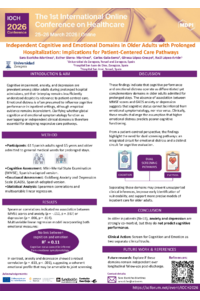
IOCH2026_Escriche et al.pdf
Optimizing Clinical Trial Screening with LLMs: A New Era in Healthcare Technology
Evaluating Generative AI in Dermatology: Evidence-Based Assessment of Diagnostic and Therapeutic Applications