Event submissions
Published
This submission belongs to the session S2. Patient-Centered Care—Optimizing Care Pathways through Engagement and Outcome Measurement of the event The 1st International Online Conference on Healthcare
Published date
20 Mar, 2026
Academic Editor
'%3e%3cpath%20d='M12.6657%2010.9104C12.4185%2010.325%2012.0599%209.79327%2011.6097%209.34482C11.1609%208.89508%2010.6293%208.5365%2010.0442%208.28888C10.0389%208.28626%2010.0337%208.28495%2010.0285%208.28233C10.8446%207.69279%2011.3752%206.73249%2011.3752%205.64904C11.3752%203.8542%209.92103%202.39999%208.1262%202.39999C6.33136%202.39999%204.87715%203.8542%204.87715%205.64904C4.87715%206.73249%205.40774%207.69279%206.22393%208.28364C6.21869%208.28626%206.21345%208.28757%206.20821%208.29019C5.62129%208.5378%205.09463%208.89284%204.64265%209.34613C4.1929%209.79493%203.83432%2010.3266%203.58671%2010.9117C3.34345%2011.4845%203.21226%2012.0987%203.20023%2012.7209C3.19988%2012.7349%203.20233%2012.7488%203.20744%2012.7619C3.21255%2012.7749%203.22022%2012.7867%203.22998%2012.7968C3.23975%2012.8068%203.25142%2012.8147%203.26431%2012.8202C3.2772%2012.8256%203.29105%2012.8284%203.30504%2012.8284H4.09109C4.14874%2012.8284%204.19459%2012.7825%204.1959%2012.7262C4.2221%2011.7148%204.62823%2010.7676%205.34617%2010.0497C6.08899%209.30683%207.0755%208.89808%208.1262%208.89808C9.17689%208.89808%2010.1634%209.30683%2010.9062%2010.0497C11.6242%2010.7676%2012.0303%2011.7148%2012.0565%2012.7262C12.0578%2012.7838%2012.1037%2012.8284%2012.1613%2012.8284H12.9474C12.9613%2012.8284%2012.9752%2012.8256%2012.9881%2012.8202C13.001%2012.8147%2013.0126%2012.8068%2013.0224%2012.7968C13.0322%2012.7867%2013.0398%2012.7749%2013.0449%2012.7619C13.0501%2012.7488%2013.0525%2012.7349%2013.0522%2012.7209C13.0391%2012.0947%2012.9094%2011.4855%2012.6657%2010.9104ZM8.1262%207.9024C7.52486%207.9024%206.9589%207.6679%206.53312%207.24211C6.10733%206.81633%205.87283%206.25037%205.87283%205.64904C5.87283%205.0477%206.10733%204.48174%206.53312%204.05596C6.9589%203.63018%207.52486%203.39567%208.1262%203.39567C8.72753%203.39567%209.29349%203.63018%209.71927%204.05596C10.1451%204.48174%2010.3796%205.0477%2010.3796%205.64904C10.3796%206.25037%2010.1451%206.81633%209.71927%207.24211C9.29349%207.6679%208.72753%207.9024%208.1262%207.9024Z'%20fill='%235D1EE1'/%3e%3c/g%3e%3c/svg%3e) Lorraine S. Evangelista
Lorraine S. EvangelistaCitation
Yuan Li, Yunyun Chen, Qiong Fang, Survival is the priority; side effects can be "Tolerated": Symptom management experience and guided self-help intervention needs of breast cancer women treated with ovarian function suppression., in Proceedings of The 1st International Online Conference on Healthcare, 25 March–26 March 2026, MDPI: Basel, Switzerland
Share
Email
Facebook
Twitter
LinkedIn
Survival is the priority; side effects can be "Tolerated": Symptom management experience and guided self-help intervention needs of breast cancer women treated with ovarian function suppression.
'%3e%3cpath%20d='M12.6647%2010.9104C12.4176%2010.325%2012.0589%209.7933%2011.6088%209.34485C11.16%208.89511%2010.6283%208.53653%2010.0432%208.28891C10.038%208.28629%2010.0327%208.28498%2010.0275%208.28236C10.8437%207.69282%2011.3743%206.73252%2011.3743%205.64907C11.3743%203.85423%209.92005%202.40002%208.12522%202.40002C6.33038%202.40002%204.87618%203.85423%204.87618%205.64907C4.87618%206.73252%205.40677%207.69282%206.22296%208.28367C6.21772%208.28629%206.21248%208.2876%206.20724%208.29022C5.62031%208.53783%205.09365%208.89287%204.64167%209.34616C4.19192%209.79496%203.83334%2010.3266%203.58573%2010.9117C3.34247%2011.4846%203.21128%2012.0987%203.19925%2012.721C3.1989%2012.735%203.20135%2012.7489%203.20646%2012.7619C3.21157%2012.7749%203.21924%2012.7868%203.22901%2012.7968C3.23877%2012.8068%203.25045%2012.8148%203.26334%2012.8202C3.27623%2012.8256%203.29007%2012.8284%203.30406%2012.8284H4.09012C4.14776%2012.8284%204.19362%2012.7825%204.19493%2012.7262C4.22113%2011.7148%204.62726%2010.7676%205.34519%2010.0497C6.08802%209.30686%207.07452%208.89811%208.12522%208.89811C9.17592%208.89811%2010.1624%209.30686%2010.9052%2010.0497C11.6232%2010.7676%2012.0293%2011.7148%2012.0555%2012.7262C12.0568%2012.7839%2012.1027%2012.8284%2012.1603%2012.8284H12.9464C12.9604%2012.8284%2012.9742%2012.8256%2012.9871%2012.8202C13%2012.8148%2013.0117%2012.8068%2013.0214%2012.7968C13.0312%2012.7868%2013.0389%2012.7749%2013.044%2012.7619C13.0491%2012.7489%2013.0515%2012.735%2013.0512%2012.721C13.0381%2012.0947%2012.9084%2011.4856%2012.6647%2010.9104ZM8.12522%207.90243C7.52388%207.90243%206.95792%207.66793%206.53214%207.24215C6.10636%206.81636%205.87185%206.2504%205.87185%205.64907C5.87185%205.04773%206.10636%204.48177%206.53214%204.05599C6.95792%203.63021%207.52388%203.3957%208.12522%203.3957C8.72655%203.3957%209.29252%203.63021%209.7183%204.05599C10.1441%204.48177%2010.3786%205.04773%2010.3786%205.64907C10.3786%206.2504%2010.1441%206.81636%209.7183%207.24215C9.29252%207.66793%208.72655%207.90243%208.12522%207.90243Z'%20fill='%235D1EE1'/%3e%3c/g%3e%3c/svg%3e)
Yuan Li 1
Yunyun Chen 2
Qiong Fang 1
1. School of Nursing, Shanghai Jiao Tong University, Shanghai 200000, China, China
2. Comprehensive Breast Health Cente, Ruijin Hospital, Shanghai Jiao Tong University, Shanghai 200000, China, China
Abstract
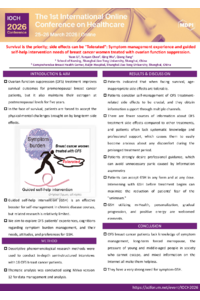
Introduction: Ovarian function suppression (OFS) treatment improves survival outcomes for premenopausal breast cancer patients, but it also maintains their estrogen at postmenopausal levels for five years. In the face of survival, patients are forced to accept the physical/mental challenges brought on by long-term side effects. Guided self-help intervention (GSH) is an effective booster for self-management in chronic disease courses, but related research is relatively limited. We aim to explore OFS patients' experiences, cognitions regarding symptom burden management, and their needs, attitudes, and preferences for GSH.
Methods: Descriptive phenomenological research methods were used to conduct in-depth semi-structured interviews with 18 OFS breast cancer patients. Thematic analysis was conducted using NVivo version 12 for data management and analysis.
Results: Patients indicated that when facing survival, age-inappropriate side effects are tolerable. Patients consider self-management of OFS treatment-related side effects to be crucial, and they obtain information support through multiple channels. There are fewer sources of information about OFS treatment side effects compared to other treatments, and patients often lack systematic knowledge and professional support, which causes them to easily become anxious about any discomfort during the prolonged treatment period. Patients strongly desire professional guidance, which can avoid unnecessary panic caused by information asymmetry. Patients can accept GSH in any form and at any dose. Intervening with GSH before treatment begins can maximize the reduction of patients' fear of the "unknown." GSH utilizing m-Health, personalization, gradual progression, and positive energy is a welcomed element.
Conclusions: OFS breast cancer patients lack knowledge of symptom management, long-term forced menopause, the pressure of young and middle-aged people in society who cannot escape, and mixed information on the Internet, all of which contribute to feelings of helplessness. They have a very strong need for GSH.
Keywords
breast cancer
ovarian function suppression
symptom management
guided self-help intervention
Poster
Patient_CenteredCare_OptimizingCarePathwaysthroughEngagementandOutcomeMeasurement_29978_Survival_is_the_priority_side_slides.pdf
Characteristics of Social Relationships in Premenopausal Breast Cancer Patients Receiving Ovarian Function Suppression: A Latent Class Analysis
- Closing the Outcome Gap: A Patient-Engagement Ecosystem for Smarter Clinical Pathway Design