Event submissions
Published
This submission belongs to the session S2. Patient-Centered Care—Optimizing Care Pathways through Engagement and Outcome Measurement of the event The 1st International Online Conference on Healthcare
Published date
20 Mar, 2026
Academic Editor
'%3e%3cpath%20d='M12.6657%2010.9104C12.4185%2010.325%2012.0599%209.79327%2011.6097%209.34482C11.1609%208.89508%2010.6293%208.5365%2010.0442%208.28888C10.0389%208.28626%2010.0337%208.28495%2010.0285%208.28233C10.8446%207.69279%2011.3752%206.73249%2011.3752%205.64904C11.3752%203.8542%209.92103%202.39999%208.1262%202.39999C6.33136%202.39999%204.87715%203.8542%204.87715%205.64904C4.87715%206.73249%205.40774%207.69279%206.22393%208.28364C6.21869%208.28626%206.21345%208.28757%206.20821%208.29019C5.62129%208.5378%205.09463%208.89284%204.64265%209.34613C4.1929%209.79493%203.83432%2010.3266%203.58671%2010.9117C3.34345%2011.4845%203.21226%2012.0987%203.20023%2012.7209C3.19988%2012.7349%203.20233%2012.7488%203.20744%2012.7619C3.21255%2012.7749%203.22022%2012.7867%203.22998%2012.7968C3.23975%2012.8068%203.25142%2012.8147%203.26431%2012.8202C3.2772%2012.8256%203.29105%2012.8284%203.30504%2012.8284H4.09109C4.14874%2012.8284%204.19459%2012.7825%204.1959%2012.7262C4.2221%2011.7148%204.62823%2010.7676%205.34617%2010.0497C6.08899%209.30683%207.0755%208.89808%208.1262%208.89808C9.17689%208.89808%2010.1634%209.30683%2010.9062%2010.0497C11.6242%2010.7676%2012.0303%2011.7148%2012.0565%2012.7262C12.0578%2012.7838%2012.1037%2012.8284%2012.1613%2012.8284H12.9474C12.9613%2012.8284%2012.9752%2012.8256%2012.9881%2012.8202C13.001%2012.8147%2013.0126%2012.8068%2013.0224%2012.7968C13.0322%2012.7867%2013.0398%2012.7749%2013.0449%2012.7619C13.0501%2012.7488%2013.0525%2012.7349%2013.0522%2012.7209C13.0391%2012.0947%2012.9094%2011.4855%2012.6657%2010.9104ZM8.1262%207.9024C7.52486%207.9024%206.9589%207.6679%206.53312%207.24211C6.10733%206.81633%205.87283%206.25037%205.87283%205.64904C5.87283%205.0477%206.10733%204.48174%206.53312%204.05596C6.9589%203.63018%207.52486%203.39567%208.1262%203.39567C8.72753%203.39567%209.29349%203.63018%209.71927%204.05596C10.1451%204.48174%2010.3796%205.0477%2010.3796%205.64904C10.3796%206.25037%2010.1451%206.81633%209.71927%207.24211C9.29349%207.6679%208.72753%207.9024%208.1262%207.9024Z'%20fill='%235D1EE1'/%3e%3c/g%3e%3c/svg%3e) Lorraine Evangelista
Lorraine EvangelistaCitation
lu zhou, Tingting Zou, Yue Liu, Runli Yang, Medication Safety Management of Cancer Patients' Participation in Intravenous Anticancer Therapy Based on the Theory of Planned Behavior: A qualitative study, in Proceedings of The 1st International Online Conference on Healthcare, 25 March–26 March 2026, MDPI: Basel, Switzerland
Share
Email
Facebook
Twitter
LinkedIn
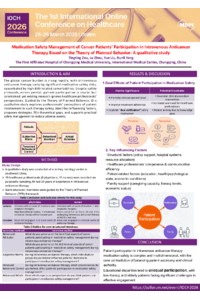
Medication Safety Management of Cancer Patients' Participation in Intravenous Anticancer Therapy Based on the Theory of Planned Behavior: A qualitative study
'%3e%3cpath%20d='M12.6647%2010.9104C12.4176%2010.325%2012.0589%209.7933%2011.6088%209.34485C11.16%208.89511%2010.6283%208.53653%2010.0432%208.28891C10.038%208.28629%2010.0327%208.28498%2010.0275%208.28236C10.8437%207.69282%2011.3743%206.73252%2011.3743%205.64907C11.3743%203.85423%209.92005%202.40002%208.12522%202.40002C6.33038%202.40002%204.87618%203.85423%204.87618%205.64907C4.87618%206.73252%205.40677%207.69282%206.22296%208.28367C6.21772%208.28629%206.21248%208.2876%206.20724%208.29022C5.62031%208.53783%205.09365%208.89287%204.64167%209.34616C4.19192%209.79496%203.83334%2010.3266%203.58573%2010.9117C3.34247%2011.4846%203.21128%2012.0987%203.19925%2012.721C3.1989%2012.735%203.20135%2012.7489%203.20646%2012.7619C3.21157%2012.7749%203.21924%2012.7868%203.22901%2012.7968C3.23877%2012.8068%203.25045%2012.8148%203.26334%2012.8202C3.27623%2012.8256%203.29007%2012.8284%203.30406%2012.8284H4.09012C4.14776%2012.8284%204.19362%2012.7825%204.19493%2012.7262C4.22113%2011.7148%204.62726%2010.7676%205.34519%2010.0497C6.08802%209.30686%207.07452%208.89811%208.12522%208.89811C9.17592%208.89811%2010.1624%209.30686%2010.9052%2010.0497C11.6232%2010.7676%2012.0293%2011.7148%2012.0555%2012.7262C12.0568%2012.7839%2012.1027%2012.8284%2012.1603%2012.8284H12.9464C12.9604%2012.8284%2012.9742%2012.8256%2012.9871%2012.8202C13%2012.8148%2013.0117%2012.8068%2013.0214%2012.7968C13.0312%2012.7868%2013.0389%2012.7749%2013.044%2012.7619C13.0491%2012.7489%2013.0515%2012.735%2013.0512%2012.721C13.0381%2012.0947%2012.9084%2011.4856%2012.6647%2010.9104ZM8.12522%207.90243C7.52388%207.90243%206.95792%207.66793%206.53214%207.24215C6.10636%206.81636%205.87185%206.2504%205.87185%205.64907C5.87185%205.04773%206.10636%204.48177%206.53214%204.05599C6.95792%203.63021%207.52388%203.3957%208.12522%203.3957C8.72655%203.3957%209.29252%203.63021%209.7183%204.05599C10.1441%204.48177%2010.3786%205.04773%2010.3786%205.64907C10.3786%206.2504%2010.1441%206.81636%209.7183%207.24215C9.29252%207.66793%208.72655%207.90243%208.12522%207.90243Z'%20fill='%235D1EE1'/%3e%3c/g%3e%3c/svg%3e)
Tingting Zou 1
lu zhou 2
Yue Liu 1
Runli Yang 3,4
1. Department of Oncology, The First Affiliated Hospital of Chongqing Medical University, Chongqing 400016, China, China
2. International Medical Center, The First Affiliated Hospital of Chongqing Medical University, Chongqing 400016, China, China
3. Department of Nursing, Chongqing Nursing Vocational College, Chongqing 402760, China, China
4. Department of Nursing, The First Affiliated Hospital of Chongqing Medical University, Chongqing 400016, China
Abstract
Objective
This qualitative study investigated the current status and influencing factors of cancer patients' participation in intravenous anticancer therapy medication safety from the perspective of healthcare professionals.
Methods
Using purposeful sampling, 19 physicians and nurses from a tertiary hospital were selected for semi-structured interviews. Data were analyzed based on the Theory of Planned Behavior framework across four dimensions: behavioral attitudes, subjective norms, perceived behavioral control, and behavioral intentions.
Results
The study found that patient participation in medication safety management has dual effects: its positive significance lies in promoting clinician–patient trust, improving adherence, and establishing a "dual verification" mechanism; however, excessive intervention may lead to increased burden on healthcare professionals, communication barriers, and patient anxiety. Key factors influencing patient participation include the following: (1) structural factors (policy support, hospital systems, resource allocation); (2) professional competence and communication efficiency of healthcare professionals; (3) family support, economic conditions, and patient education level; (4) patient health status and psychological state. Furthermore, educational disparities lead to unequal participation, with patients having lower literacy levels and elderly patients facing greater challenges.
Conclusions
Recommendations include optimizing standardized communication processes, developing simplified educational tools, strengthening the supportive role of family members, introducing psychological interventions, and improving medical insurance policies and hospital management systems to establish a collaborative "patient–family–healthcare professional" management model. Future research should expand to multi-center studies and integrate quantitative data to validate the findings. This study provides theoretical and practical foundations for enhancing patient-centered medication safety in intravenous anticancer therapy.
Keywords
Cancer patients
Intravenous medication safety
Qualitative research
Theory of Planned Behavior
Patient participation
Poster
Lu Zhou-Medication Safety Management of Cancer Patients' Participation in Intravenous Anticancer Therapy Based on the Theory of Planned Behavior A qualitative study.pdf
- Closing the Outcome Gap: A Patient-Engagement Ecosystem for Smarter Clinical Pathway Design
The Personal Values-based Care Model (ACIP): A Proposal for Supporting and Restoring Life Projects in Vulnerable Populations