Event submissions
Published
This submission belongs to the session S2. Patient-Centered Care—Optimizing Care Pathways through Engagement and Outcome Measurement of the event The 1st International Online Conference on Healthcare
Published date
20 Mar, 2026
Academic Editor
'%3e%3cpath%20d='M12.6657%2010.9104C12.4185%2010.325%2012.0599%209.79327%2011.6097%209.34482C11.1609%208.89508%2010.6293%208.5365%2010.0442%208.28888C10.0389%208.28626%2010.0337%208.28495%2010.0285%208.28233C10.8446%207.69279%2011.3752%206.73249%2011.3752%205.64904C11.3752%203.8542%209.92103%202.39999%208.1262%202.39999C6.33136%202.39999%204.87715%203.8542%204.87715%205.64904C4.87715%206.73249%205.40774%207.69279%206.22393%208.28364C6.21869%208.28626%206.21345%208.28757%206.20821%208.29019C5.62129%208.5378%205.09463%208.89284%204.64265%209.34613C4.1929%209.79493%203.83432%2010.3266%203.58671%2010.9117C3.34345%2011.4845%203.21226%2012.0987%203.20023%2012.7209C3.19988%2012.7349%203.20233%2012.7488%203.20744%2012.7619C3.21255%2012.7749%203.22022%2012.7867%203.22998%2012.7968C3.23975%2012.8068%203.25142%2012.8147%203.26431%2012.8202C3.2772%2012.8256%203.29105%2012.8284%203.30504%2012.8284H4.09109C4.14874%2012.8284%204.19459%2012.7825%204.1959%2012.7262C4.2221%2011.7148%204.62823%2010.7676%205.34617%2010.0497C6.08899%209.30683%207.0755%208.89808%208.1262%208.89808C9.17689%208.89808%2010.1634%209.30683%2010.9062%2010.0497C11.6242%2010.7676%2012.0303%2011.7148%2012.0565%2012.7262C12.0578%2012.7838%2012.1037%2012.8284%2012.1613%2012.8284H12.9474C12.9613%2012.8284%2012.9752%2012.8256%2012.9881%2012.8202C13.001%2012.8147%2013.0126%2012.8068%2013.0224%2012.7968C13.0322%2012.7867%2013.0398%2012.7749%2013.0449%2012.7619C13.0501%2012.7488%2013.0525%2012.7349%2013.0522%2012.7209C13.0391%2012.0947%2012.9094%2011.4855%2012.6657%2010.9104ZM8.1262%207.9024C7.52486%207.9024%206.9589%207.6679%206.53312%207.24211C6.10733%206.81633%205.87283%206.25037%205.87283%205.64904C5.87283%205.0477%206.10733%204.48174%206.53312%204.05596C6.9589%203.63018%207.52486%203.39567%208.1262%203.39567C8.72753%203.39567%209.29349%203.63018%209.71927%204.05596C10.1451%204.48174%2010.3796%205.0477%2010.3796%205.64904C10.3796%206.25037%2010.1451%206.81633%209.71927%207.24211C9.29349%207.6679%208.72753%207.9024%208.1262%207.9024Z'%20fill='%235D1EE1'/%3e%3c/g%3e%3c/svg%3e) Lorraine Evangelista
Lorraine EvangelistaCitation
sungmin song, Lorazepam-Associated Orthostatic Intolerance and Secondary Headache in a Low-Blood-Pressure Phenotype: A Patient-Centered Case Report, in Proceedings of The 1st International Online Conference on Healthcare, 25 March–26 March 2026, MDPI: Basel, Switzerland
Share
Email
Facebook
Twitter
LinkedIn
Lorazepam-Associated Orthostatic Intolerance and Secondary Headache in a Low-Blood-Pressure Phenotype: A Patient-Centered Case Report
'%3e%3cpath%20d='M12.6647%2010.9104C12.4176%2010.325%2012.0589%209.7933%2011.6088%209.34485C11.16%208.89511%2010.6283%208.53653%2010.0432%208.28891C10.038%208.28629%2010.0327%208.28498%2010.0275%208.28236C10.8437%207.69282%2011.3743%206.73252%2011.3743%205.64907C11.3743%203.85423%209.92005%202.40002%208.12522%202.40002C6.33038%202.40002%204.87618%203.85423%204.87618%205.64907C4.87618%206.73252%205.40677%207.69282%206.22296%208.28367C6.21772%208.28629%206.21248%208.2876%206.20724%208.29022C5.62031%208.53783%205.09365%208.89287%204.64167%209.34616C4.19192%209.79496%203.83334%2010.3266%203.58573%2010.9117C3.34247%2011.4846%203.21128%2012.0987%203.19925%2012.721C3.1989%2012.735%203.20135%2012.7489%203.20646%2012.7619C3.21157%2012.7749%203.21924%2012.7868%203.22901%2012.7968C3.23877%2012.8068%203.25045%2012.8148%203.26334%2012.8202C3.27623%2012.8256%203.29007%2012.8284%203.30406%2012.8284H4.09012C4.14776%2012.8284%204.19362%2012.7825%204.19493%2012.7262C4.22113%2011.7148%204.62726%2010.7676%205.34519%2010.0497C6.08802%209.30686%207.07452%208.89811%208.12522%208.89811C9.17592%208.89811%2010.1624%209.30686%2010.9052%2010.0497C11.6232%2010.7676%2012.0293%2011.7148%2012.0555%2012.7262C12.0568%2012.7839%2012.1027%2012.8284%2012.1603%2012.8284H12.9464C12.9604%2012.8284%2012.9742%2012.8256%2012.9871%2012.8202C13%2012.8148%2013.0117%2012.8068%2013.0214%2012.7968C13.0312%2012.7868%2013.0389%2012.7749%2013.044%2012.7619C13.0491%2012.7489%2013.0515%2012.735%2013.0512%2012.721C13.0381%2012.0947%2012.9084%2011.4856%2012.6647%2010.9104ZM8.12522%207.90243C7.52388%207.90243%206.95792%207.66793%206.53214%207.24215C6.10636%206.81636%205.87185%206.2504%205.87185%205.64907C5.87185%205.04773%206.10636%204.48177%206.53214%204.05599C6.95792%203.63021%207.52388%203.3957%208.12522%203.3957C8.72655%203.3957%209.29252%203.63021%209.7183%204.05599C10.1441%204.48177%2010.3786%205.04773%2010.3786%205.64907C10.3786%206.2504%2010.1441%206.81636%209.7183%207.24215C9.29252%207.66793%208.72655%207.90243%208.12522%207.90243Z'%20fill='%235D1EE1'/%3e%3c/g%3e%3c/svg%3e)
sungmin song 1
1. Trinity School of Medicine, Macon, 31201, USA, South Korea
Abstract
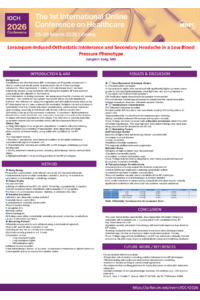
Background: Patients with lifelong low blood pressure may be especially vulnerable to sedative-induced orthostatic symptoms, yet this interaction is rarely described. We report a case where routine insomnia prescribing unmasked clinically meaningful orthostatic intolerance and mucosal dryness in a low-BP phenotype.
Methods: A 30-year-old man with constitutional hypotension (home BP ~90–95/50–55 mmHg) developed lightheadedness, chest tightness, and transient blurred vision on standing after starting nightly lorazepam for chronic insomnia. Symptom and home BP/heart-rate logs were recorded over several weeks, alongside orthostatic vitals at different lorazepam doses and anticholinergic burden scores for co-medications.
Results: Orthostatic testing demonstrated modest BP drops but larger heart-rate rises on 2 mg lorazepam nights, with reproducible symptom provocation; symptoms were milder on 1 mg or off-nights. Urinalysis on high-symptom days showed high specific gravity, intermittent ketonuria, and hyaline casts, consistent with relative dehydration as a symptom amplifier. After corneal refractive surgery, concurrent lorazepam, imipramine, and diphenhydramine were associated with recurrent corneal epithelial erosions and nocturnal nasal obstruction, which improved with hydration and anticholinergic load reduction. No metabolic, endocrine, structural cardiac, or neurologic causes were identified.
Conclusions: This case illustrates how benzodiazepines can precipitate orthostatic intolerance and secondary headache in patients with baseline hypotension and how cumulative anticholinergic exposure can worsen ocular and mucosal symptoms. Simple patient-centered tools—home BP/HR logs, hydration review, medication reconciliation, and orthostatic vitals at the actually used dose—helped uncover a dose–response relationship and guided safer insomnia management. Clinicians should screen for low resting BP, polypharmacy, and anticholinergic burden when prescribing sedatives and consider non-pharmacologic sleep strategies in vulnerable patients.
Keywords
orthostatic intolerance
benzodiazepines
low blood pressure
anticholinergic burden
insomnia
case report
Poster
Sungmin Song_Poster.pdf
Using Probiotics as a Preventive Strategy for Recurrent Urinary Tract Infections: Focusing on Patient Engagement and Quality of Care
Patient-Reported Outcomes (PROMs) and Public Health: Using PROMs for Population-Level Quality Monitoring