Event submissions
Published
This submission belongs to the session S2. Patient-Centered Care—Optimizing Care Pathways through Engagement and Outcome Measurement of the event The 1st International Online Conference on Healthcare
Published date
20 Mar, 2026
Academic Editor
'%3e%3cpath%20d='M12.6657%2010.9104C12.4185%2010.325%2012.0599%209.79327%2011.6097%209.34482C11.1609%208.89508%2010.6293%208.5365%2010.0442%208.28888C10.0389%208.28626%2010.0337%208.28495%2010.0285%208.28233C10.8446%207.69279%2011.3752%206.73249%2011.3752%205.64904C11.3752%203.8542%209.92103%202.39999%208.1262%202.39999C6.33136%202.39999%204.87715%203.8542%204.87715%205.64904C4.87715%206.73249%205.40774%207.69279%206.22393%208.28364C6.21869%208.28626%206.21345%208.28757%206.20821%208.29019C5.62129%208.5378%205.09463%208.89284%204.64265%209.34613C4.1929%209.79493%203.83432%2010.3266%203.58671%2010.9117C3.34345%2011.4845%203.21226%2012.0987%203.20023%2012.7209C3.19988%2012.7349%203.20233%2012.7488%203.20744%2012.7619C3.21255%2012.7749%203.22022%2012.7867%203.22998%2012.7968C3.23975%2012.8068%203.25142%2012.8147%203.26431%2012.8202C3.2772%2012.8256%203.29105%2012.8284%203.30504%2012.8284H4.09109C4.14874%2012.8284%204.19459%2012.7825%204.1959%2012.7262C4.2221%2011.7148%204.62823%2010.7676%205.34617%2010.0497C6.08899%209.30683%207.0755%208.89808%208.1262%208.89808C9.17689%208.89808%2010.1634%209.30683%2010.9062%2010.0497C11.6242%2010.7676%2012.0303%2011.7148%2012.0565%2012.7262C12.0578%2012.7838%2012.1037%2012.8284%2012.1613%2012.8284H12.9474C12.9613%2012.8284%2012.9752%2012.8256%2012.9881%2012.8202C13.001%2012.8147%2013.0126%2012.8068%2013.0224%2012.7968C13.0322%2012.7867%2013.0398%2012.7749%2013.0449%2012.7619C13.0501%2012.7488%2013.0525%2012.7349%2013.0522%2012.7209C13.0391%2012.0947%2012.9094%2011.4855%2012.6657%2010.9104ZM8.1262%207.9024C7.52486%207.9024%206.9589%207.6679%206.53312%207.24211C6.10733%206.81633%205.87283%206.25037%205.87283%205.64904C5.87283%205.0477%206.10733%204.48174%206.53312%204.05596C6.9589%203.63018%207.52486%203.39567%208.1262%203.39567C8.72753%203.39567%209.29349%203.63018%209.71927%204.05596C10.1451%204.48174%2010.3796%205.0477%2010.3796%205.64904C10.3796%206.25037%2010.1451%206.81633%209.71927%207.24211C9.29349%207.6679%208.72753%207.9024%208.1262%207.9024Z'%20fill='%235D1EE1'/%3e%3c/g%3e%3c/svg%3e) Lorraine Evangelista
Lorraine EvangelistaCitation
DIMITRIOS MIMARAKIS, Maria Moudatsou, Philippa Kolokotroni, Athanasios Alegakis, Sofia Koukouli, Euthanasia as a pathway for patients: Healthcare professional characteristics that may impact their attitudes toward euthanasia in Greece., in Proceedings of The 1st International Online Conference on Healthcare, 25 March–26 March 2026, MDPI: Basel, Switzerland
Share
Email
Facebook
Twitter
LinkedIn
Euthanasia as a pathway for patients: Healthcare professional characteristics that may impact their attitudes toward euthanasia in Greece.

DIMITRIOS MIMARAKIS 1,2
'%3e%3cpath%20d='M12.6647%2010.9104C12.4176%2010.325%2012.0589%209.7933%2011.6088%209.34485C11.16%208.89511%2010.6283%208.53653%2010.0432%208.28891C10.038%208.28629%2010.0327%208.28498%2010.0275%208.28236C10.8437%207.69282%2011.3743%206.73252%2011.3743%205.64907C11.3743%203.85423%209.92005%202.40002%208.12522%202.40002C6.33038%202.40002%204.87618%203.85423%204.87618%205.64907C4.87618%206.73252%205.40677%207.69282%206.22296%208.28367C6.21772%208.28629%206.21248%208.2876%206.20724%208.29022C5.62031%208.53783%205.09365%208.89287%204.64167%209.34616C4.19192%209.79496%203.83334%2010.3266%203.58573%2010.9117C3.34247%2011.4846%203.21128%2012.0987%203.19925%2012.721C3.1989%2012.735%203.20135%2012.7489%203.20646%2012.7619C3.21157%2012.7749%203.21924%2012.7868%203.22901%2012.7968C3.23877%2012.8068%203.25045%2012.8148%203.26334%2012.8202C3.27623%2012.8256%203.29007%2012.8284%203.30406%2012.8284H4.09012C4.14776%2012.8284%204.19362%2012.7825%204.19493%2012.7262C4.22113%2011.7148%204.62726%2010.7676%205.34519%2010.0497C6.08802%209.30686%207.07452%208.89811%208.12522%208.89811C9.17592%208.89811%2010.1624%209.30686%2010.9052%2010.0497C11.6232%2010.7676%2012.0293%2011.7148%2012.0555%2012.7262C12.0568%2012.7839%2012.1027%2012.8284%2012.1603%2012.8284H12.9464C12.9604%2012.8284%2012.9742%2012.8256%2012.9871%2012.8202C13%2012.8148%2013.0117%2012.8068%2013.0214%2012.7968C13.0312%2012.7868%2013.0389%2012.7749%2013.044%2012.7619C13.0491%2012.7489%2013.0515%2012.735%2013.0512%2012.721C13.0381%2012.0947%2012.9084%2011.4856%2012.6647%2010.9104ZM8.12522%207.90243C7.52388%207.90243%206.95792%207.66793%206.53214%207.24215C6.10636%206.81636%205.87185%206.2504%205.87185%205.64907C5.87185%205.04773%206.10636%204.48177%206.53214%204.05599C6.95792%203.63021%207.52388%203.3957%208.12522%203.3957C8.72655%203.3957%209.29252%203.63021%209.7183%204.05599C10.1441%204.48177%2010.3786%205.04773%2010.3786%205.64907C10.3786%206.2504%2010.1441%206.81636%209.7183%207.24215C9.29252%207.66793%208.72655%207.90243%208.12522%207.90243Z'%20fill='%235D1EE1'/%3e%3c/g%3e%3c/svg%3e)
Maria Moudatsou 1,2
Philippa Kolokotroni 3
Athanasios Alegakis 4

Sofia Koukouli 1,2
1. Department of Social Work, Faculty of Health Sciences, Hellenic Mediterranean University, 71410 Heraklion, Greece, Greece
2. Laboratory of Interdisciplinary Approaches for the Enhancement of Quality of Life (QoLab), 71410 Heraklion, Greece
3. Department of Psychology, Panteion University of Social & Political Sciences, 17671 Athens, Greece, Greece
4. Department of Toxicology, Faculty of Medicine, University of Crete, 71003 Heraklion, Greece, Greece
Abstract
Context: Euthanasia and assisted suicide have long been subjects of ethical and historical debate, largely due to their connection to the fundamental principle of the right to life. Euthanasia is defined as the intentional act of one individual to end the life of another, using the most humane and painless means available, with the aim of serving the best interests of the person who dies. Research shows that around 10% of terminally ill patients express a moderate-to-strong desire for an early death. While arguments persist both in support of and in opposition to assisted dying, public approval for its legalization has reached unprecedented levels. The international literature indicates that attitudes toward euthanasia are influenced by a combination of sociocultural factors, religious beliefs, professional roles, age, and evolving personal views on death.
Objectives: This study aimed to explore the attitudes of healthcare professionals in Greece toward euthanasia and to assess how individual characteristics, religious orientation, and perceptions of death shape these attitudes.
Methods: A total of 465 healthcare professionals working in Greek healthcare services participated. Data were collected on socio-demographic and professional variables, attitudes toward euthanasia, and views on end-of-life issues. Multiple linear regression analysis was used to identify significant predictors.
Results: Results showed that healthcare professionals’ attitudes toward euthanasia were significantly influenced by age, the type of patient they cared for, religious beliefs, and their views on death and dying.
Conclusions: These findings highlight the multifaceted nature of ethical decision-making in clinical practice, particularly when addressing requests for assisted death from terminally ill patients. In contexts like Greece, where legal frameworks around euthanasia remain restrictive, it is crucial to examine the deeper reasons for the limited public and professional discourse on the issue—especially given the growing global momentum toward its legalization.
Keywords
Euthanasia· end of life· health· professionals· attitudes· Greece
Poster
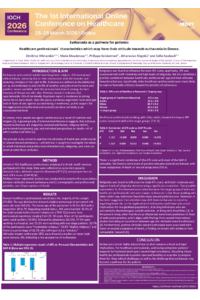
Mimarakis Dimitrios et al. Poster_Healthcare MDPI_2026.pdf
Prescribing Practices, Polypharmacy, and Drug Interaction Risks in Anticoagulant Therapy: Insights from a Secondary Care Hospital
Community Engagement and Caries Prevention in Rural Populations: Lessons Learned from Integrating Oral Health into Public Health in District Mandi, Himachal Pradesh, India